
RETAIL DISPLAY CASE SUPPLIER · CUSTOM STORE DISPLAY PROCUREMENT
Retail Display Case Supplier for Custom Store Display Projects
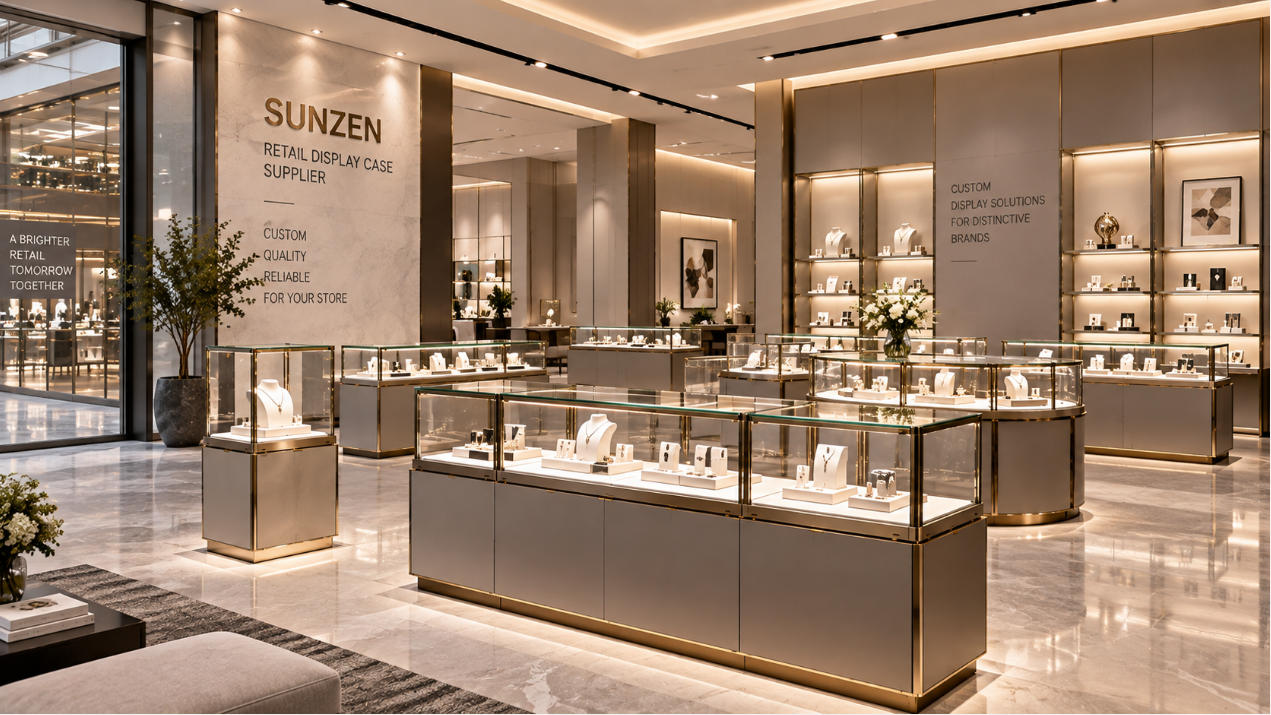
Retail display cases have to do more than hold products. They influence what customers notice, how merchandise is compared, where staff interact with shoppers and how valuable products are secured during daily store operation.
SUNZEN works as a retail display case supplier for branded stores, boutiques and commercial retail projects requiring coordinated counters, islands, wall cases, upright cabinets and other custom display formats.
Instead of selecting unrelated cabinets one by one, buyers can organize the display case package around merchandise categories, store zones, customer sightlines, staff access, lighting, storage, security and project quantities.
START WITH WHAT HAPPENS IN THE STORE
A Retail Display Case Supplier Should Understand Merchandise and Store Operation
A retail display case is part of an active selling environment. Customers approach it, compare products through the glass, move around it and interact with staff across it. Employees open doors and drawers, replenish merchandise, retrieve stock and operate locks throughout the day.
That makes retail procurement different from simply buying display cabinets by size. Case type, viewing direction, access, lighting, storage and placement should respond to the merchandise and the way each store zone operates.
The supplier’s job is to turn those requirements into a coordinated case package that can be manufactured and supplied as one commercial project.
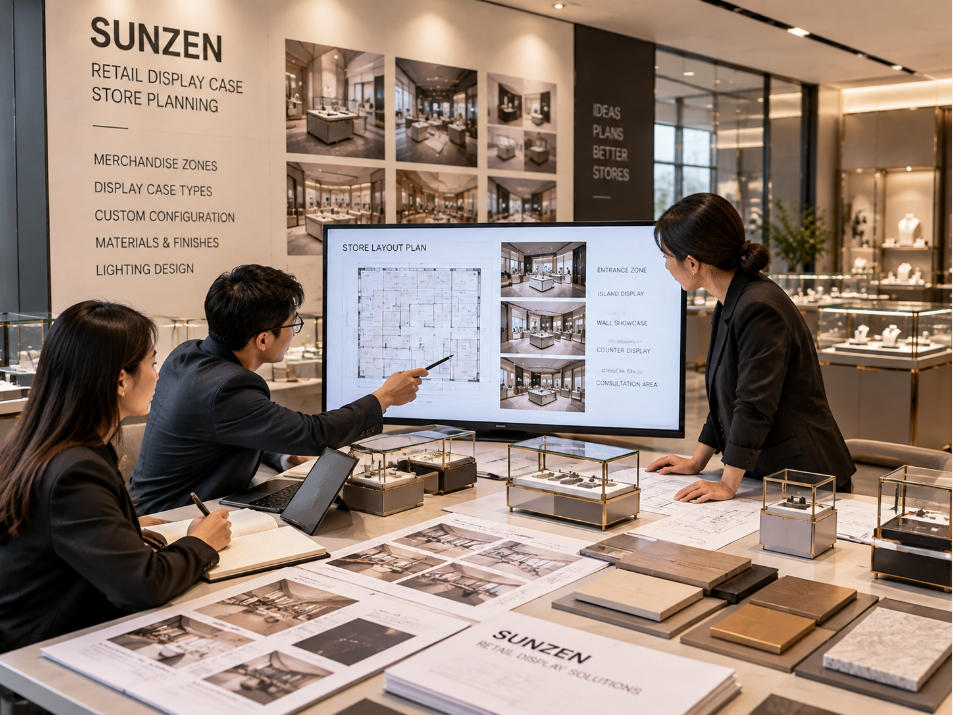
MATCH THE CASE TO THE MERCHANDISE
Different Products Need Different Display Relationships
The first specification question should not be “Which cabinet do you want?” It should be “What does the customer need to see, and how will staff present or replenish the product?”
High-Value Products
Glass enclosures, controlled access, locks and focused lighting can support merchandise requiring stronger security and assisted selling.
Small Products
Shallow display depths, organized presentation surfaces and clear sightlines can make compact merchandise easier to compare.
Feature Products
Pedestal, tower or focal display cases can isolate selected products and create stronger visual emphasis.
Changing Collections
Adjustable interiors and flexible presentation components can support seasonal or frequently updated merchandise.
BUILD THE RIGHT CASE MIX
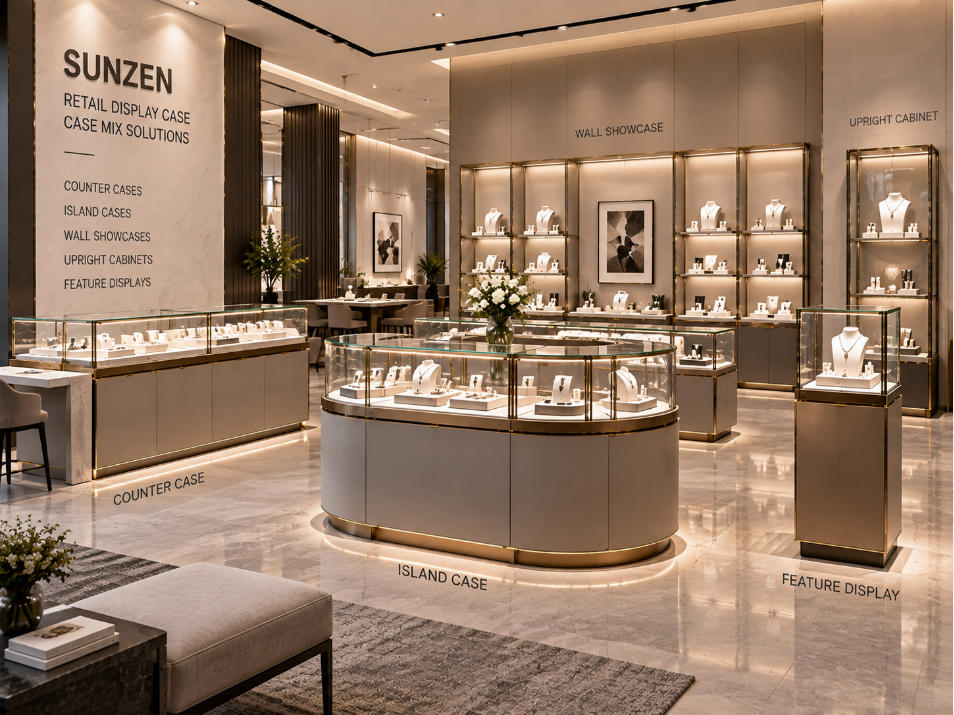
One Store Usually Needs More Than One Retail Display Case Type
A retail project may combine low counters for assisted selling, island cases for central merchandising, wall cases for perimeter presentation, upright cabinets for vertical display and smaller feature units for launches or high-value products.
The value of a supplier is not simply having several case types available. Those types should work together through coordinated proportions, materials, glass details, lighting, finishes and operating logic.
This creates a store-wide display language without forcing every merchandise category into the same cabinet.
SOURCE BY STORE ZONE
Plan Retail Display Cases Around the Customer Journey
Case placement changes how customers discover and interact with merchandise. Organizing procurement by store zone helps connect each display case with a clear commercial role.
Entrance & Feature Zone
Use focal cases to introduce hero products, new collections or campaign merchandise.
Central Selling Zone
Island and counter cases can create product groupings while supporting customer circulation.
Perimeter Zone
Wall and upright cases can increase display capacity while keeping the center of the store open.
Consultation Zone
Cases near consultation areas can support assisted presentation and closer product evaluation.
CUSTOMIZE AROUND THE RETAIL REQUIREMENT
Custom Retail Display Cases Should Start With the Product, Brand and Store
Custom retail display cases are most useful when standard cabinet dimensions or configurations cannot adequately support the store concept, merchandise, brand language or operating requirements.
Dimensions, glass configuration, metal finishes, cabinetry, interior surfaces, lighting, storage, access and security can be developed as connected decisions rather than independent decorative options.
When the project extends beyond enclosed cases into shelving, service furniture, open merchandising units and other store elements, SUNZEN’s custom retail fixtures provide a broader route for coordinating the complete store fixture package.
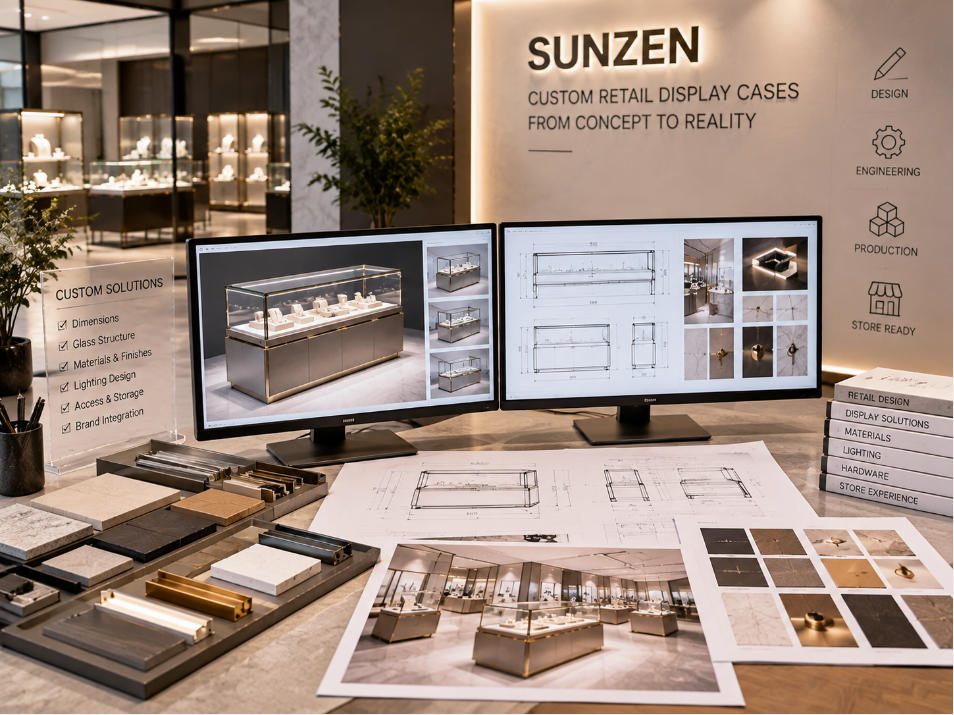
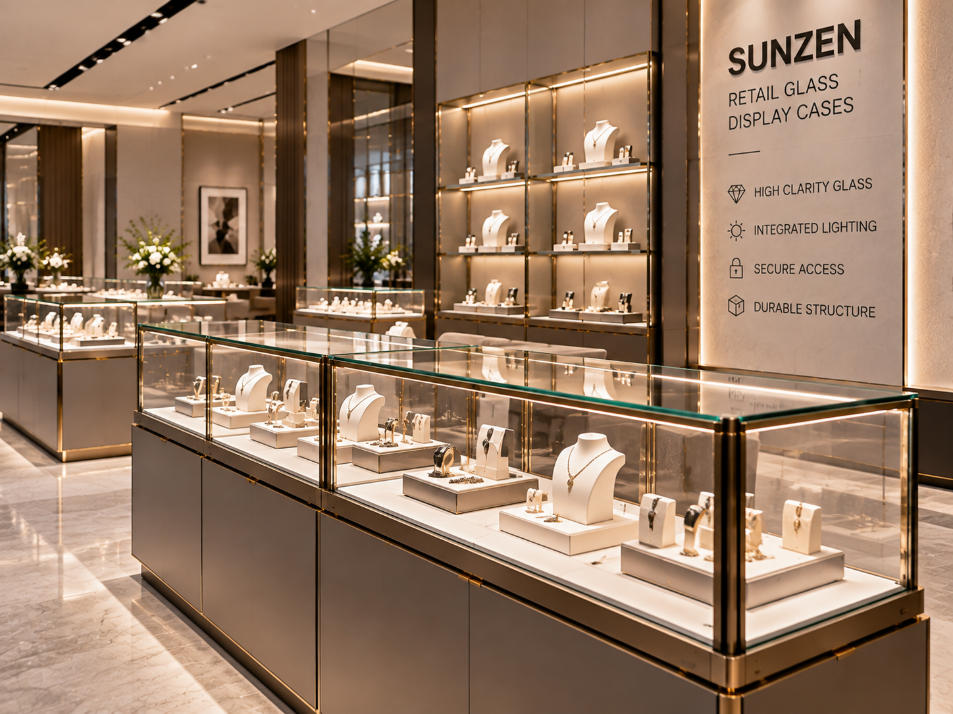
SECONDARY INTENT · RETAIL GLASS DISPLAY CASES
Retail Glass Display Cases Need to Balance Visibility With Daily Operation
For many retail categories, glass is the interface between the shopper and the product. The enclosure should provide clear viewing while supporting the structure, access method, lighting and security requirements of the case.
Retail glass display cases may use different glazing arrangements depending on viewing direction, product value, case height and staff access. The objective is not simply to maximize the amount of glass but to use transparency where it improves merchandise presentation.
Glass edges, joints, doors, shelves and lighting positions should therefore be coordinated with the complete cabinet structure before production.
DESIGN FOR CUSTOMER SIGHTLINES
The Best Case Height Depends on How Customers Discover the Product
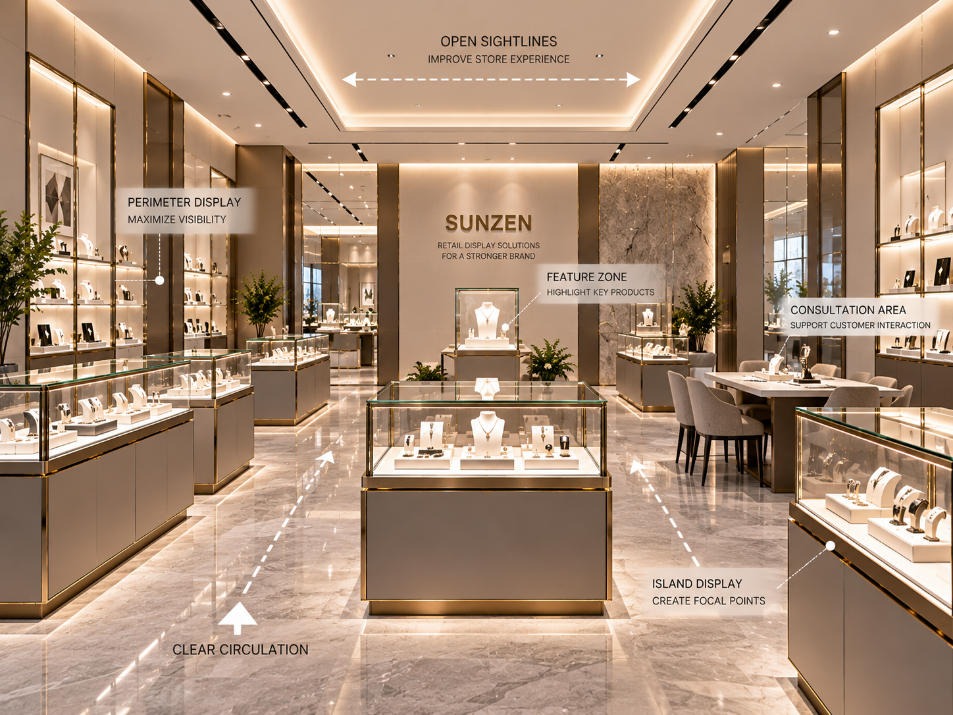
A display case affects more than the products inside it. Height and mass influence what customers can see beyond the case, whether staff remain visible and how open or enclosed the store feels.
Low island cases can preserve long sightlines across the shop, while taller cabinets can create stronger vertical presentation at selected locations. Wall displays can increase merchandising density without occupying central circulation space.
Retail display case planning should therefore be reviewed together with store layout rather than treated as a separate furniture purchase.
LIGHT THE MERCHANDISE, NOT JUST THE CABINET
Integrated Lighting Should Support Product Presentation
Retail case lighting should respond to the merchandise, viewing angle and surrounding store lighting. Poorly positioned light can create reflections, shadows or excessive brightness even when the fixture itself looks attractive.
Lighting positions, channels, wiring routes and service access should be coordinated before manufacturing so electrical components become part of the case rather than an afterthought.
Direct light toward the merchandise presentation area rather than simply illuminating the enclosure.
Consider viewing direction and glass surfaces when positioning light sources.
Plan wiring, drivers and access around the cabinet construction.
Coordinate case lighting with the wider retail lighting environment.
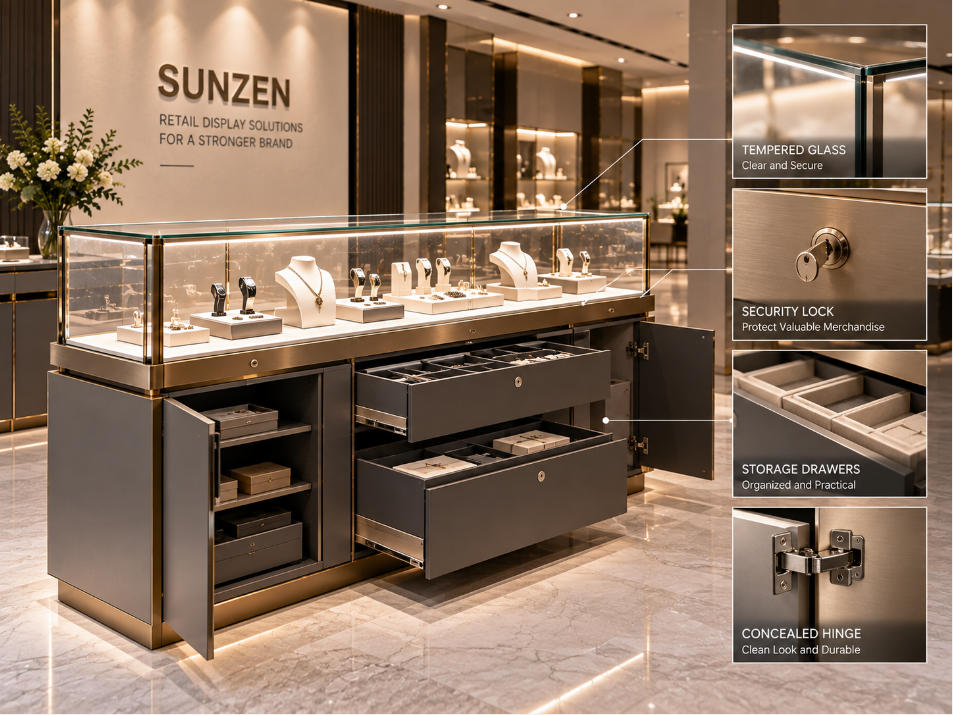
DESIGN THE STAFF SIDE TOO
Access, Storage and Security Shape Everyday Retail Performance
Customers mainly experience the presentation side of a display case, but staff interact repeatedly with doors, drawers, locks, shelves and storage. These operational details can have a major effect on how practical the case feels after installation.
Rear access, sliding or hinged doors, lock positions, drawer clearances and concealed storage should be planned according to staff workflow and available space.
For high-value merchandise, security should be integrated with the access system rather than added after the cabinet structure has already been finalized.
KEEP THE PROCUREMENT BOUNDARY CLEAR
Retail Display Cases and Retail Fixtures Solve Different Parts of the Store
This page focuses specifically on cases and cabinets used to present merchandise. A complete retail fixture package can extend much further into shelving, wall systems, service counters, cashier units, decorative structures, storage furniture and other shopfitting elements.
Keeping this distinction clear protects the search intent of the page. Buyers sourcing primarily counters, vitrines, islands, upright cases and wall display cabinets belong here, while wider store programs may require a broader fixture procurement strategy.
Retail Display Case Scope
Glass counters, island cases, wall cases, upright cabinets, pedestal cases, towers and other merchandise-focused enclosed displays.
Retail Fixture Scope
Display cases plus open fixtures, shelving, service furniture, cashwraps, storage and wider store furniture requirements.
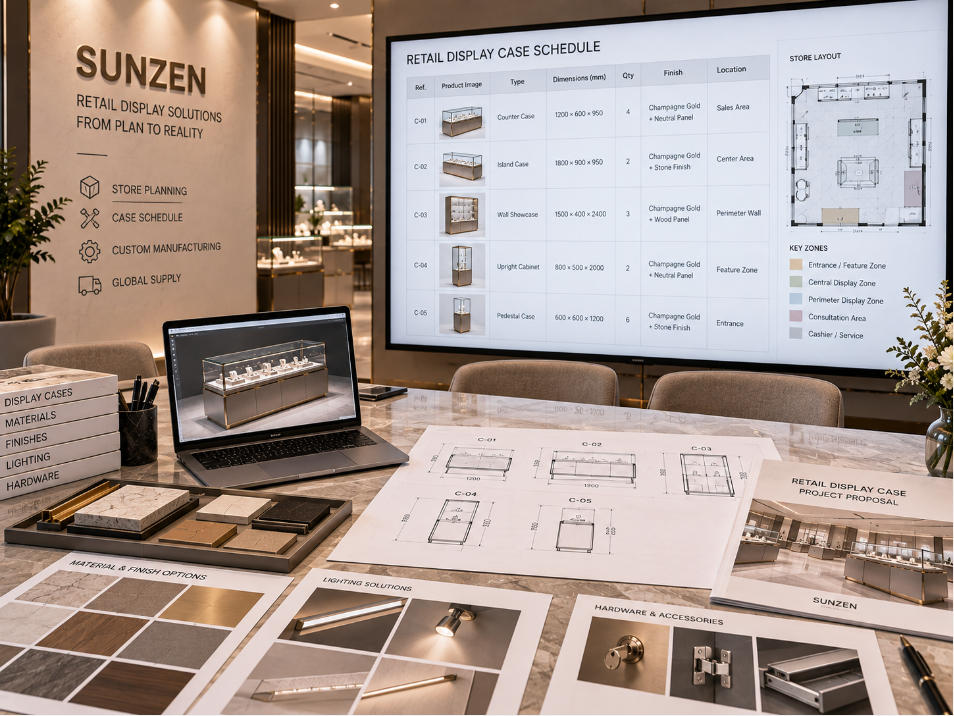
TURN THE STORE PLAN INTO A CASE SCHEDULE
Organize Retail Display Case Procurement Before Production
Once the case mix has been established, each case type can be assigned a reference, quantity, dimensions, merchandise function, materials, glass configuration, lighting, access and finish requirements.
This case schedule creates a bridge between the store layout and the physical order. It helps the buyer, designer, supplier and manufacturing team discuss the same case references instead of relying on visual descriptions alone.
For projects with repeated stores, the same case references can also support quantity planning by location.
SECONDARY INTENT · COMMERCIAL RETAIL DISPLAY CASES
Commercial Retail Display Cases Need to Perform Beyond Opening Day
Commercial retail display cases operate in active customer-facing environments, so appearance at installation is only one part of the requirement. Doors, drawers, lighting, hardware, surfaces and storage may be used repeatedly throughout the working day.
Materials and mechanisms should therefore be selected with routine operation, cleaning, merchandising changes and maintenance in mind.
Doors and drawers should support repeated staff use.
Interior presentation should allow practical product replacement and adjustment.
Visible surfaces and glass should remain accessible for routine maintenance.
Lighting and selected hardware should be considered with future servicing in mind.
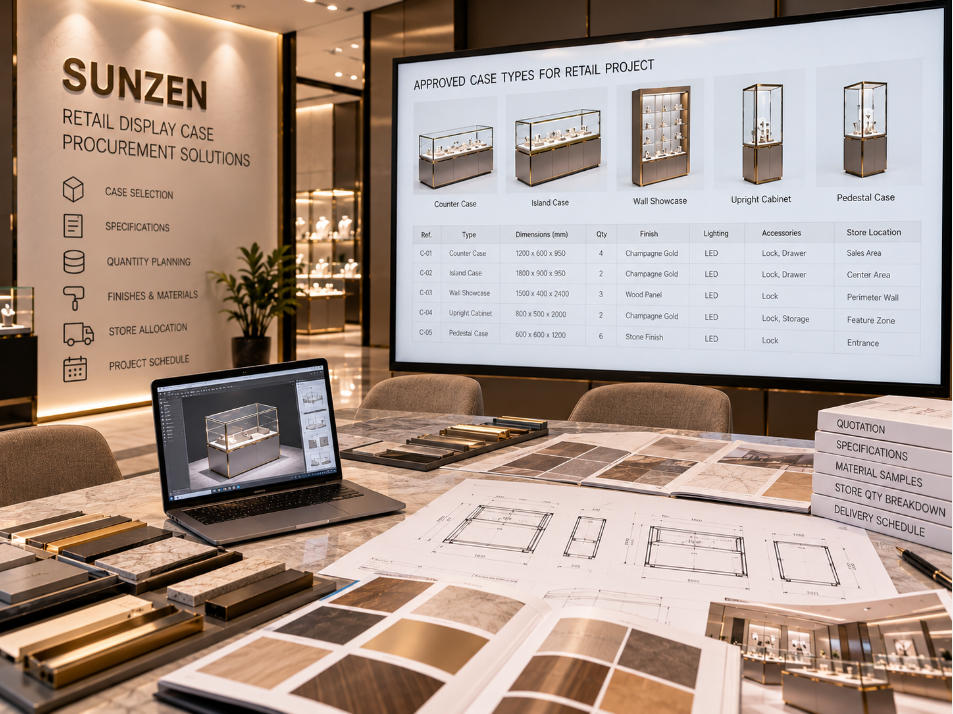
SUPPLIER = PROCUREMENT COORDINATION
The Supplier Role Begins When a Store Needs a Coordinated Case Package
Retail projects often contain several display case types with different dimensions and functions but shared materials and brand standards. The supplier needs to keep those differences organized without allowing the overall package to become inconsistent.
This includes coordinating case references, quantities, approved finishes, glass, lighting, hardware, access requirements and destination information before the order moves through manufacturing and packing.
For buyers, the goal is a controlled retail display case package rather than a collection of independently ordered cabinets.
FROM CUSTOM REQUIREMENTS TO MANUFACTURABLE CASES
Custom Retail Cases Need Manufacturing Decisions Behind the Design
A supplier can coordinate the retail package, but customized dimensions, structures, glass, access, lighting and finishes still need to be converted into buildable specifications before production begins.
Projects requiring deeper custom engineering can review SUNZEN’s custom display case manufacturer capability, which focuses on translating project-specific display requirements into engineered and manufacturable cases.
This separation keeps the current page focused on retail procurement while giving buyers a clear route into the Custom and Manufacturer stage when the case itself requires substantial development.
Develop case proportions around merchandise, store layout and customer interaction.
Coordinate glass, metal and cabinetry into a practical physical assembly.
Integrate lighting, access, locks, storage and service requirements.
Translate approved visual references into controlled production materials and details.
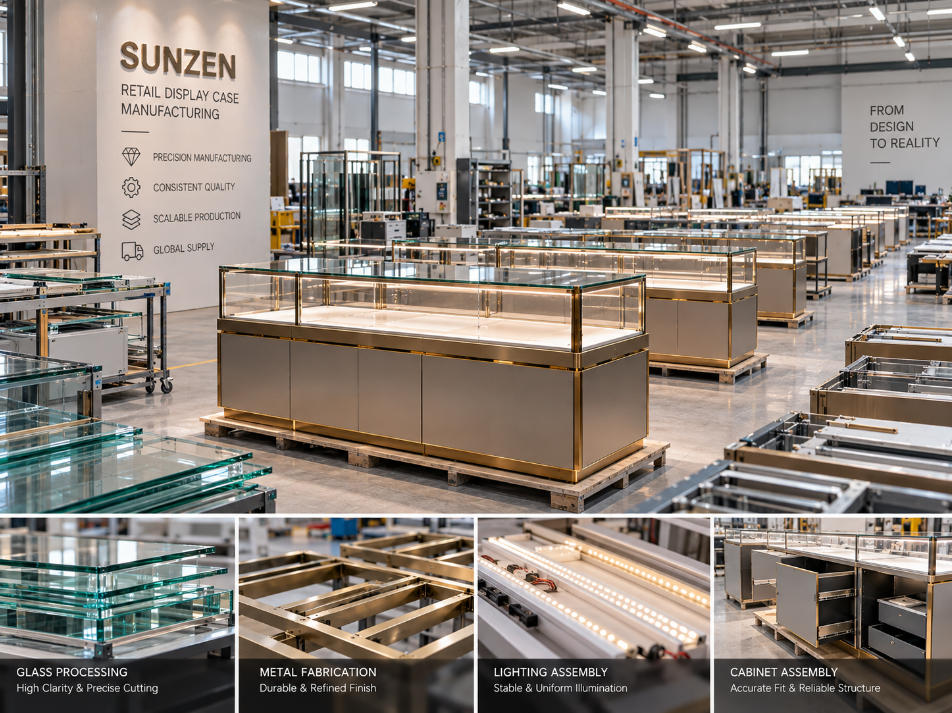
COMMERCIAL USE CHANGES THE MANUFACTURING REQUIREMENT
Retail Display Cases Need to Be Built for Repeated Commercial Operation
A display case intended for an active store has different operating expectations from a decorative cabinet. Doors, drawers, locks, lighting and surfaces can be used continuously, while repeated case types may also need to remain visually consistent across one or several locations.
SUNZEN’s commercial display case manufacturer capability focuses more specifically on producing custom display cases for commercial environments where function, durability and project execution matter alongside appearance.
For this Supplier page, that manufacturing capability supports the broader objective of sourcing cases that remain practical after the store begins daily operation.
VERIFY THE FACTORY BEHIND THE SUPPLY
Factory Capability Matters When a Retail Project Combines Multiple Materials and Case Types
Retail display cases can combine glass, metal structures, cabinetry, decorative finishes, lighting, hardware, locks and storage. Coordinating these components becomes increasingly important when one project contains several case types or repeated store quantities.
Buyers who want to examine production capability separately can review SUNZEN’s showcase factory page for the factory and production environment supporting custom showcase projects.
On this page, factory capability serves as production evidence behind the Supplier role rather than replacing the retail procurement intent.
Coordinate panels, shelves, doors and glass interfaces with the approved case structure.
Produce structural frames, trims and supporting components according to approved details.
Build bases, drawers, storage and finished surfaces around retail operating requirements.
Bring glass, structure, lighting, hardware and finishes together as a completed case.
CONNECT THE APPROVED CASE WITH PRODUCTION
Manufacturing Should Preserve the Retail Case Specification
Once drawings, materials, finishes and functional requirements are approved, production should preserve those decisions through component fabrication, assembly and final inspection.
SUNZEN’s showcase manufacturing page provides a deeper view of how custom showcase components and approved specifications move through production.
For supplier-led retail projects, the important point is traceability: the finished case should remain connected with the case reference, specification and store requirement that created the order.
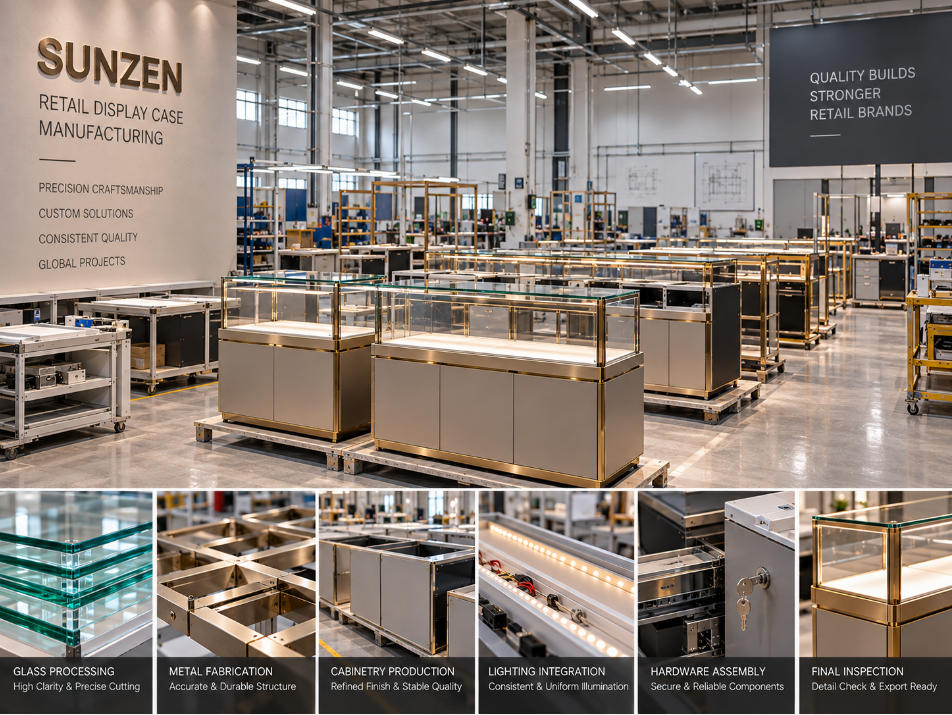
INSPECT WHAT MATTERS IN THE STORE
Retail Display Case Quality Control Should Include Appearance and Operation
A finished retail case should be evaluated as a complete customer-facing and staff-operated product. Inspection can combine visible quality with functional checks before packing.
Visual Alignment
Review glass, joints, doors, trims, gaps and visible surfaces as one completed case.
Functional Operation
Check doors, drawers, locks, slides, hinges and other moving components.
Lighting & Finish
Test integrated lighting and review the completed case against approved material and finish references.
FROM ONE STORE TO REPEATED LOCATIONS
Retail Chains Need Display Case Standards That Can Be Reordered
When a retailer expects multiple locations, the display case package can become a reusable procurement system. Approved case references, dimensions, finishes and functional specifications can form a controlled library for later stores.
Each new location may use different quantities or combinations while retaining the same core case standards. This reduces the need to redefine every cabinet from the beginning and helps maintain a more consistent physical brand language.
For larger programs, SUNZEN’s retail fixture rollout capability addresses the wider challenge of controlling repeatable fixture standards, store-specific quantities and phased deployment across multiple retail locations.
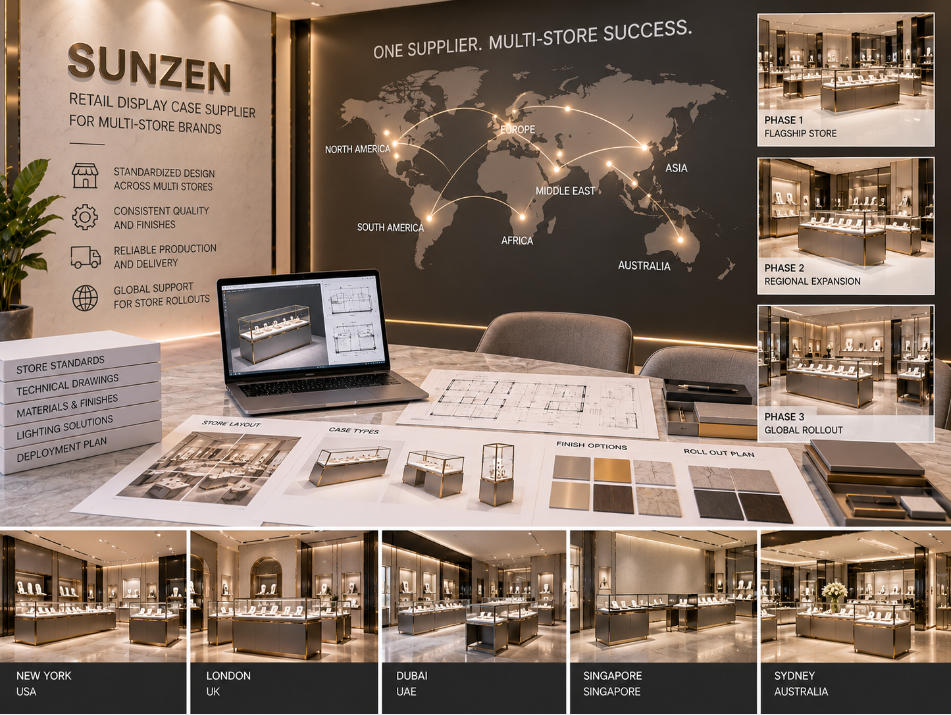
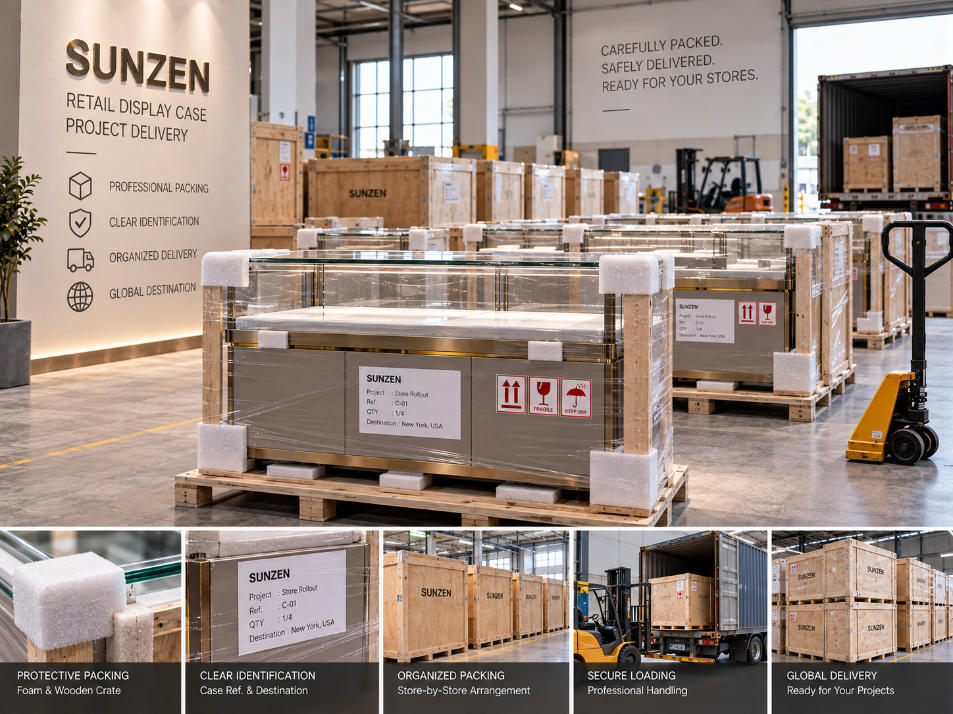
PACK FOR THE ACTUAL PROJECT
Case Identification Helps Keep Retail Deliveries Organized
A commercial order may contain several similar-looking cases intended for different zones or locations. Packing identification can connect each protected unit with its case reference, quantity and project destination.
This becomes especially important for multi-store or phased projects where manufacturing may be consolidated but store schedules differ.
Case-level identification helps receiving and installation teams understand which units belong to each area without relying only on visual recognition after the shipment arrives.
RETAIL DISPLAY CASE SOURCING WORKFLOW
From Merchandise Requirements to Store-Ready Case Supply
The process begins with what needs to be displayed and ends with identified cases prepared for the intended store or project phase.
Map
Identify merchandise categories, store zones, customer interaction and required display case types.
Specify
Confirm dimensions, glass, materials, lighting, access, storage, security and finish requirements.
Coordinate
Organize approved case references, quantities and store-specific requirements before production.
Supply
Manufacture, inspect, identify, protect and prepare the cases for the required project destination.
PREPARE A BETTER RFQ
What to Send a Retail Display Case Supplier
A useful retail display case RFQ does not need to be fully engineered. It should provide enough information to understand the merchandise, store environment, expected case mix and commercial scope.
Show where cases are expected and how customers and staff move around them.
Share available elevations, concepts, sketches or reference images.
Explain what each case will display and whether products require special presentation or security.
Provide estimated quantities by case type or store where available.
Include preferred finishes, glass, lighting, locks, storage and access requirements.
Provide destination, expected schedule and number of locations where known.
FAQ
Retail Display Case Supplier FAQs
What does a retail display case supplier provide?
A retail display case supplier can coordinate the case types, specifications, quantities and project requirements needed for a store. The scope may include counters, islands, wall cases, upright cabinets and other display cases with custom glass, materials, lighting, access, storage and security features.
Can SUNZEN produce custom retail display cases?
Yes. Retail display cases can be developed around project-specific dimensions, merchandise, store layouts, materials, glass configurations, finishes, lighting, storage, locks and staff access requirements.
What types of retail display cases can be included in one project?
A project can combine counter cases, island cases, wall displays, upright cabinets, tower cases, pedestal displays and other custom formats according to the merchandise and store layout.
What is the difference between retail display cases and retail store fixtures?
Retail display cases are merchandise-focused cabinets or vitrines, often incorporating glass, lighting, security and storage. Retail store fixtures are a broader category that can also include open shelving, wall systems, service counters, cashwraps, storage furniture and other shopfitting elements.
Can retail glass display cases include lighting and locks?
Yes. Integrated LED lighting, locks, staff-side access, drawers, shelving and concealed storage can be incorporated according to the merchandise, security level and operating requirements of the store.
Can one retail display case design be repeated across multiple stores?
Yes. Approved case references can establish repeatable dimensions, materials, finishes and functions for later locations. Each store can then use different quantities or combinations according to its layout.
How should retail display cases be organized for a multi-store project?
A case schedule can assign references, quantities, specifications and store destinations to each display case type. Packing identification can then connect finished units with the correct location or rollout phase.
What should I send for a custom retail display case quotation?
Send your store plan, available drawings or renderings, merchandise information, preferred case types, dimensions, materials, lighting and security requirements, estimated quantities, destination and project schedule. SUNZEN can review the information before developing the supply scope and quotation.
SOURCE THE DISPLAY CASE PACKAGE AROUND YOUR STORE
Looking for a Custom Retail Display Case Supplier?
Send SUNZEN your store plan, case schedule, drawings, renderings or merchandise requirements. We can help organize the right case mix, develop custom specifications and coordinate your retail display cases from project requirements through manufacturing and supply.

