
Retail Fixture Rollout for Consistent Multi-Store Expansion
A retail fixture rollout is not simply the same custom project repeated many times. Once a fixture concept moves from one store to multiple locations, the challenge changes: approved standards must remain consistent while quantities, layouts, delivery phases and store-specific requirements continue to change.
SUNZEN supports retail brands developing multi-store fixture programs around approved fixture standards, repeat manufacturing, controlled store variations, project identification and phased delivery — helping one retail concept become a scalable program rather than a collection of disconnected store projects.
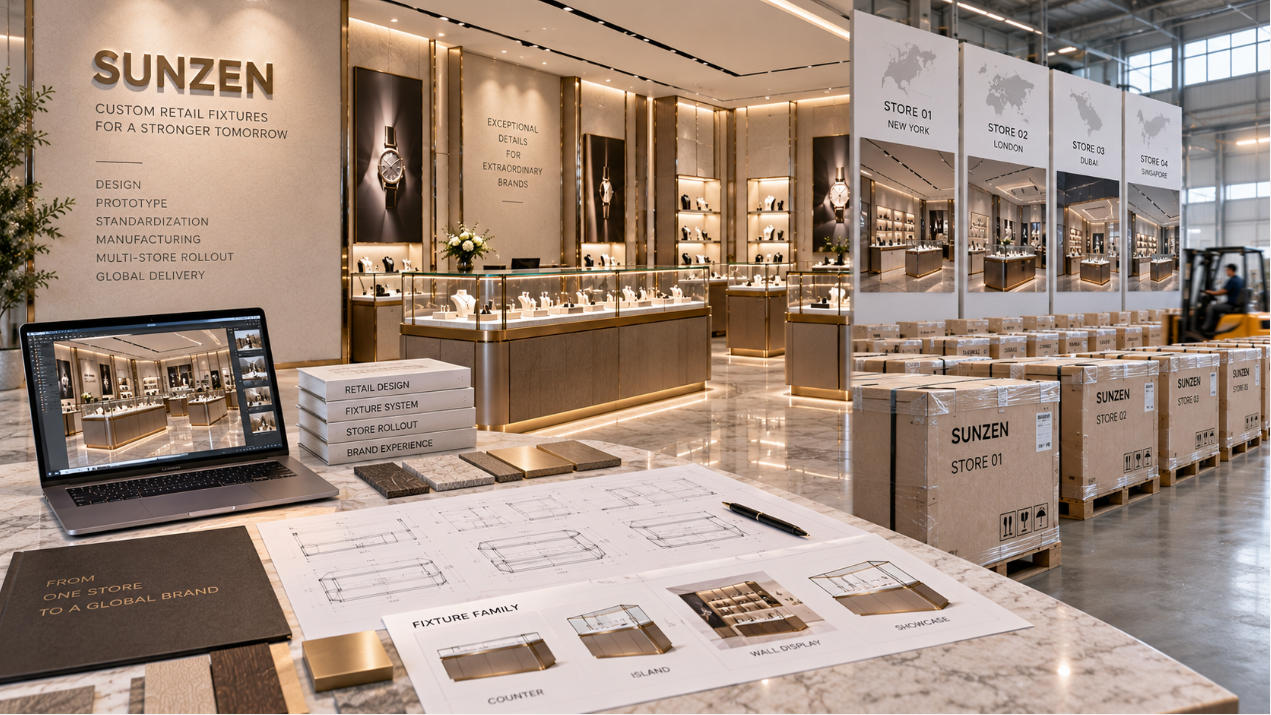
A Retail Fixture Rollout Changes the Manufacturing Question
For one store, the primary challenge is often developing the right fixtures. For twenty, fifty or more locations, the challenge becomes maintaining the approved result while repeating it under different store conditions and schedules.
This is why a multi store fixture rollout needs a program structure. The team needs to know what is fixed, what may vary, which version belongs to each location and when each fixture package must be ready.
What Must Stay the Same?
Approved materials, finishes, construction details, lighting and brand-defining elements should remain controlled across the rollout.
What Can Change by Store?
Fixture quantities, dimensions, wall lengths and selected configurations may need to respond to individual locations.
What Must Be Repeatable?
Construction logic and approved specifications need to support repeated production rather than continuous redesign.
Which Fixture Goes Where?
Store IDs, fixture references, quantities and shipment phases must remain connected throughout the program.
Do Not Scale an Unresolved Fixture
Rollout efficiency begins before volume production. Dimensions, materials, finishes, lighting, hardware, access and important construction details should be sufficiently resolved before the fixture becomes the reference for multiple locations.
A prototype, sample or pilot-store fixture can help expose issues that are inexpensive to correct once but costly to repeat across an entire retail network.
If the fixture family is still being defined, begin with SUNZEN custom retail fixtures before moving into rollout planning.
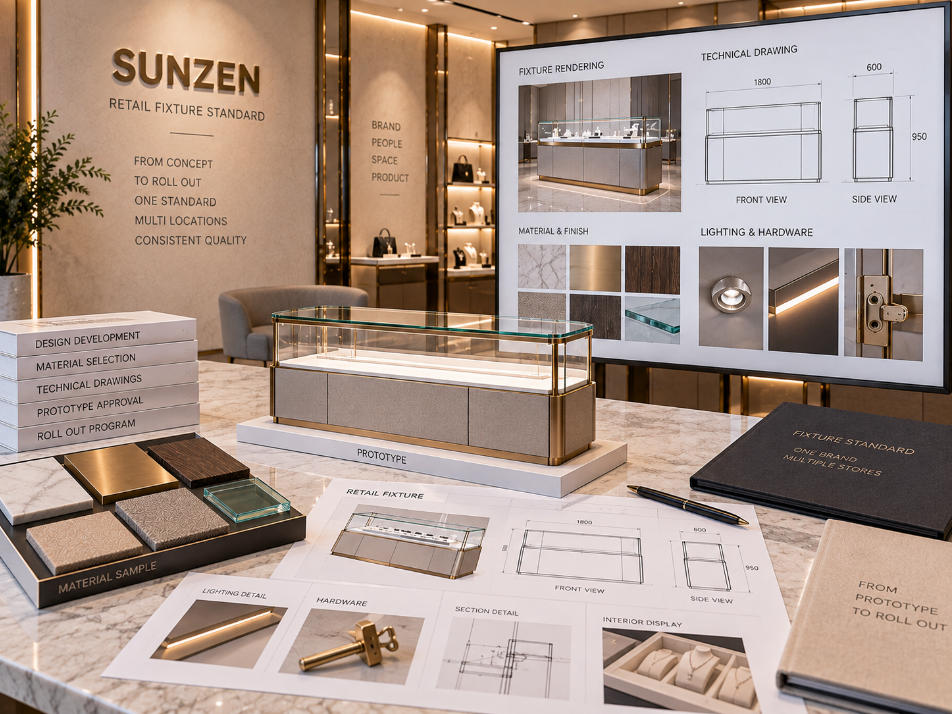
Separate the Fixture Standard From Store-Specific Changes
One of the most important decisions in a retail fixture rollout program is identifying which information belongs to the approved standard and which information is allowed to change by location.
Keep These Consistent
- Core materials and finish references
- Glass specifications
- Lighting specification
- Hardware families
- Construction details
- Brand-defining proportions and details
Allow These to Change When Required
- Fixture quantity
- Selected fixture widths
- Wall-run dimensions
- Fixture combinations
- Store-specific accessories
- Destination and rollout phase
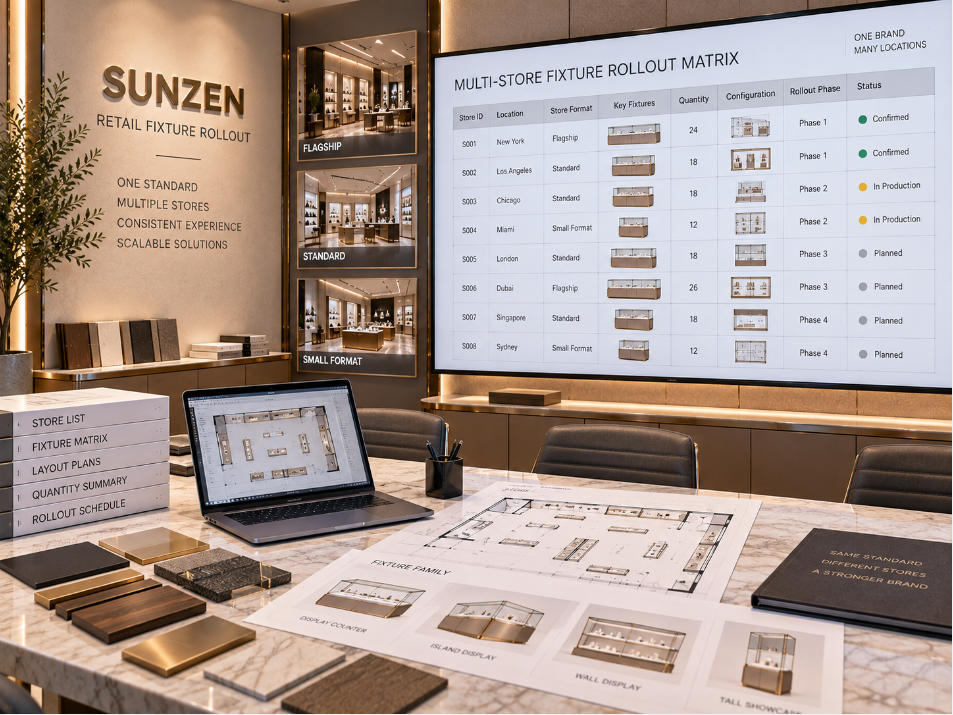
Build a Store Matrix Before the Rollout Becomes a Logistics Problem
Multi location retail fixtures rarely follow exactly the same quantity and configuration at every store. A flagship, standard store and smaller location may share the same fixture language while requiring different combinations.
A store matrix connects each location with its fixture types, versions, quantities and delivery phase. This gives the rollout a structured reference before manufacturing and packing begin.
Repeat the Standard Without Pretending Every Store Is Identical
Successful retail rollout fixtures need repeatability, but rigid duplication can create problems when stores differ in size, layout or merchandising capacity.
Expanded Fixture Package
Larger locations may use the complete fixture family together with feature displays, consultation areas and additional merchandising capacity.
Core Fixture Package
Standard locations can use the primary approved fixture family in a repeatable configuration.
Reduced Fixture Package
Smaller stores may use selected modules or adjusted dimensions while preserving the same materials, detailing and brand language.
Use Modular Logic When Store Variation Is Predictable
Not every retail fixture rollout needs to be modular. However, when the same display functions must fit several store sizes, a controlled module library can reduce the number of completely unique fixtures.
Standard widths, interchangeable display sections or repeatable structural modules can allow the rollout team to assemble different store packages from an approved system.
Brands considering this approach can explore SUNZEN modular glass display cases as a more specialized display-system strategy.
Move From Prototype Approval to Repeat Manufacturing
Once the fixture standard and store matrix are sufficiently controlled, the project can move from development into repeat manufacturing.
Production planning should connect approved fixture references with total quantities, store requirements and rollout phases. This reduces the risk of manufacturing the right fixture in the wrong quantity or for the wrong location.
Retail brands evaluating the production partner behind this stage can review SUNZEN as a retail fixture manufacturer for custom and multi-store programs.
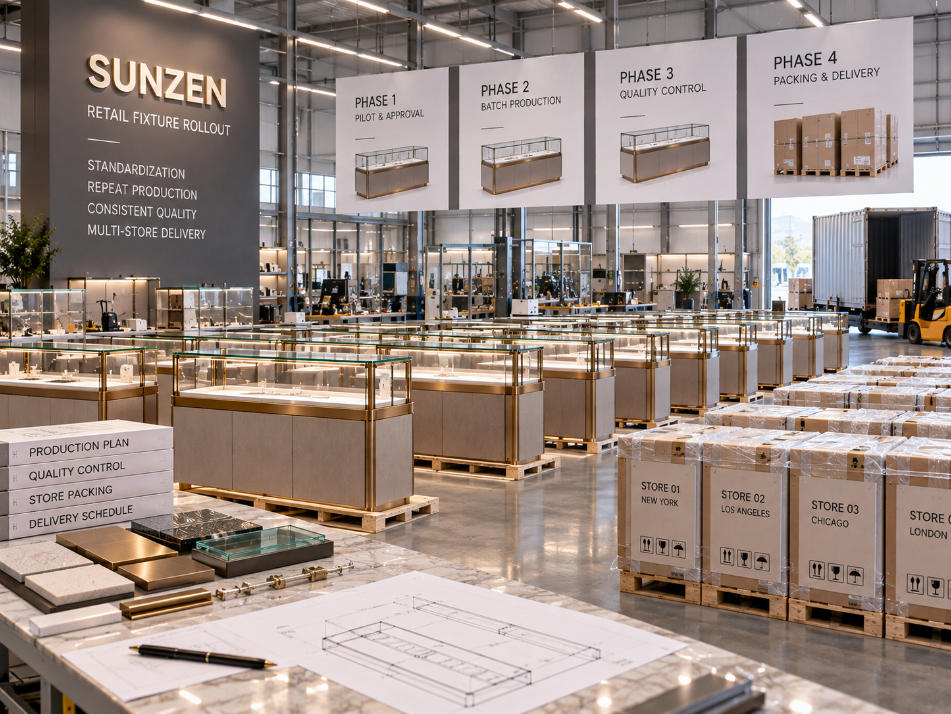
A Rollout Needs More Than the Ability to Build One Good Fixture
A prototype proves that a fixture can be made. A rollout tests whether the approved result can be repeated across a larger quantity while keeping the important specifications controlled.
Repeatability
Production references should make repeated units traceable back to the same approved fixture standard.
Batch Control
Fixture quantities can be organized according to program phases instead of treating the entire rollout as one undifferentiated production order.
Capacity Planning
Production requirements should be aligned with rollout dates before individual store deadlines begin competing for the same manufacturing window.
SUNZEN’s broader showcase factory capability supports the transition from approved display concepts into controlled production.
Consistency Matters More as the Fixture Count Grows
In a single-store project, a small variation may affect one fixture. In a multi store fixture rollout, the same uncontrolled variation can repeat across many units.
Inspection should therefore compare production with approved references for dimensions, materials, finishes, glass, lighting, hardware and visible workmanship rather than relying only on a general visual check.
First Units
Verify early production against the approved fixture standard before the same detail is repeated through the batch.
Batch Inspection
Maintain defined inspection references as repeated fixtures move through production.
Final Identification
Confirm fixture identity and quantity before products enter store-specific packing.
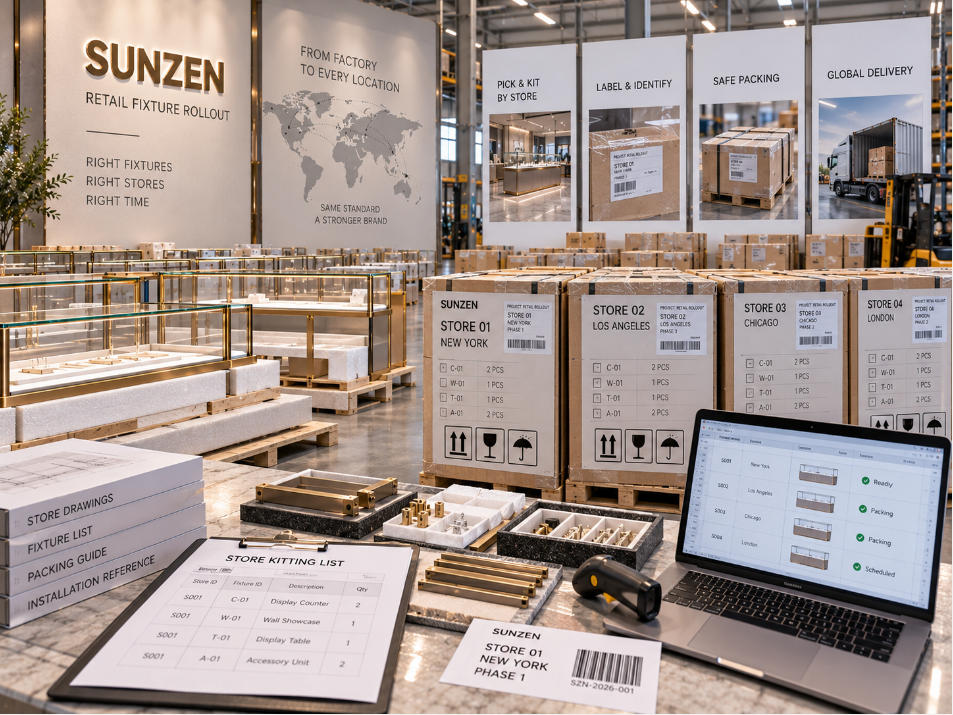
Store-Specific Kitting Connects Manufacturing With Rollout Execution
A finished fixture is not yet rollout-ready if the project team cannot easily identify where it belongs.
Packing references can connect fixtures with the store number, fixture ID, quantity, rollout phase or destination. This becomes increasingly important when several store packages leave production within the same period.
Match Fixture Release With the Store Opening or Remodel Sequence
A retail store rollout does not always need every location completed at the same time. Dividing the program into controlled phases can connect manufacturing and delivery more closely with the actual store schedule.
Pilot
Validate the approved fixture family and important installation or operational details.
First Release
Begin controlled production for the first defined group of stores.
Scale
Repeat the approved standard through additional production batches and store packages.
Replenish
Maintain approved references for later stores, replacement fixtures or future expansion.
The Rollout Continues After Manufacturing Is Complete
Production solves the repeatability question. The next challenge is keeping fixture identity, quantity, store allocation, packing and delivery requirements connected as the program moves toward each location.
Procurement and project teams that need a closer view of this supply stage can continue to SUNZEN’s retail fixture supplier page.
Retail Fixture Rollouts Can Support More Than New Store Openings
New Store Expansion
Repeat an approved fixture family as the brand opens additional locations.
Store Remodels
Replace or update selected fixture families across an existing retail network.
Department Updates
Introduce a new fixture standard into a specific department or product zone across multiple stores.
Shop-in-Shop Programs
Repeat one branded fixture environment across different host stores while managing location-specific conditions.
Useful Information for Planning a Retail Fixture Rollout
Approved Fixture Information
Drawings, dimensions, materials, finishes and approved technical references.
Store List
Locations, store IDs, formats and relevant destination information.
Fixture Matrix
Fixture types, versions and quantities required for each location.
Store Variations
Known dimension changes, special configurations or location-specific requirements.
Rollout Schedule
Pilot timing, production phases, opening dates or remodel windows.
Delivery Requirements
Store allocation, shipment sequence, packing references and other known logistical requirements.
Retail Fixture Rollout FAQ
What is a retail fixture rollout?
A retail fixture rollout is a coordinated program for repeating approved retail fixtures across multiple store locations. It can include fixture standardization, store-specific quantities or variations, repeat manufacturing, quality control, packing identification and phased delivery.
How is a multi store fixture rollout different from a single store project?
A single store project focuses mainly on developing and completing one location. A multi store fixture rollout must also control repeatability, store variations, quantities, location references, production phases and delivery requirements across multiple locations.
Do all stores need exactly the same fixtures in a retail rollout?
No. Stores can share the same approved fixture standards while using different quantities, dimensions or fixture combinations. The important step is separating controlled brand and construction standards from approved store-specific variables.
Why is prototyping important before a fixture rollout?
A prototype or pilot fixture can help validate dimensions, materials, finishes, lighting, hardware, construction and operational details before those decisions are repeated across a larger production quantity.
Can a retail fixture rollout be delivered in phases?
Yes. Rollout programs can be divided into production and delivery phases that follow store opening, remodel or regional schedules. The appropriate sequence depends on store count, production requirements and project timing.
What information does SUNZEN need for a multi location retail fixture program?
Useful information includes approved fixture drawings and specifications, store lists, fixture quantities, store-specific variations, rollout phases, destination information and required dates. If the fixture system is not yet finalized, custom fixture development may need to happen before rollout planning.
Turn an Approved Fixture Standard Into a Repeatable Retail Rollout
Send SUNZEN your approved fixture information, store list, quantities, store variations and rollout schedule. We can review how the fixture program can be organized for repeat manufacturing, location-specific identification and phased project delivery.

