
MULTI-STORE JEWELRY RETAIL · BRAND ROLLOUT SOLUTIONS
Multi Store Jewelry Display Cases for Consistent Brand Rollouts
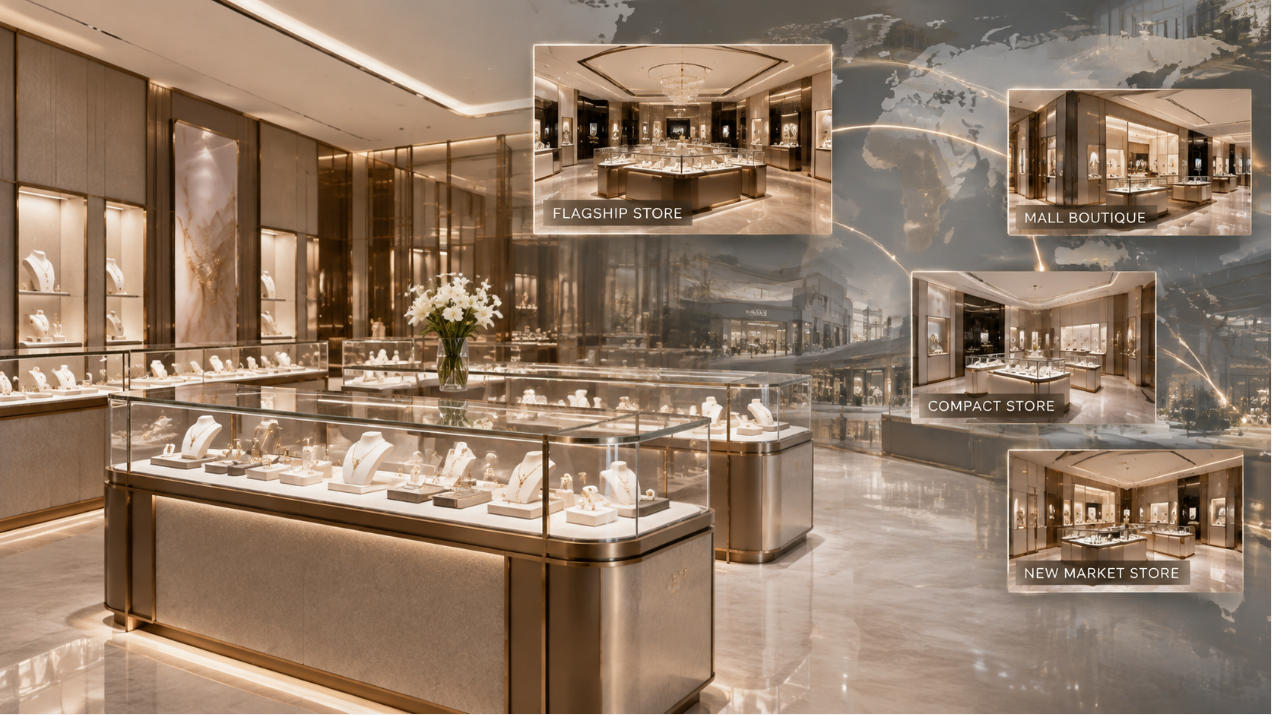
Expanding a jewelry brand across multiple stores requires more than ordering the same cabinets again. The display system has to preserve a recognizable brand standard while adapting to different store sizes, layouts, product mixes and opening phases.
SUNZEN develops multi store jewelry display cases for jewelry brands, retail chains and multi-location expansion programs that need repeatable showcase standards with controlled store-by-store flexibility.
The objective is to turn an approved jewelry retail concept into a practical display case system that can be specified, adapted, manufactured, reordered and supplied across multiple locations without redesigning the entire package for every new store.
DESIGN FOR REPEATABILITY FROM THE BEGINNING
A Multi-Store Jewelry Project Is Different From a Single Boutique
A single jewelry store can be developed around one floor plan, one quantity schedule and one installation date. A multi-store program introduces another requirement: the display decisions made today should remain usable when the next location begins.
That changes how jewelry display cases should be planned. Dimensions, materials, finishes, lighting, access, storage and hardware need enough definition to become repeatable standards, while selected parts of the system remain flexible for local conditions.
The result should not be identical stores. It should be different stores that clearly belong to the same jewelry brand.
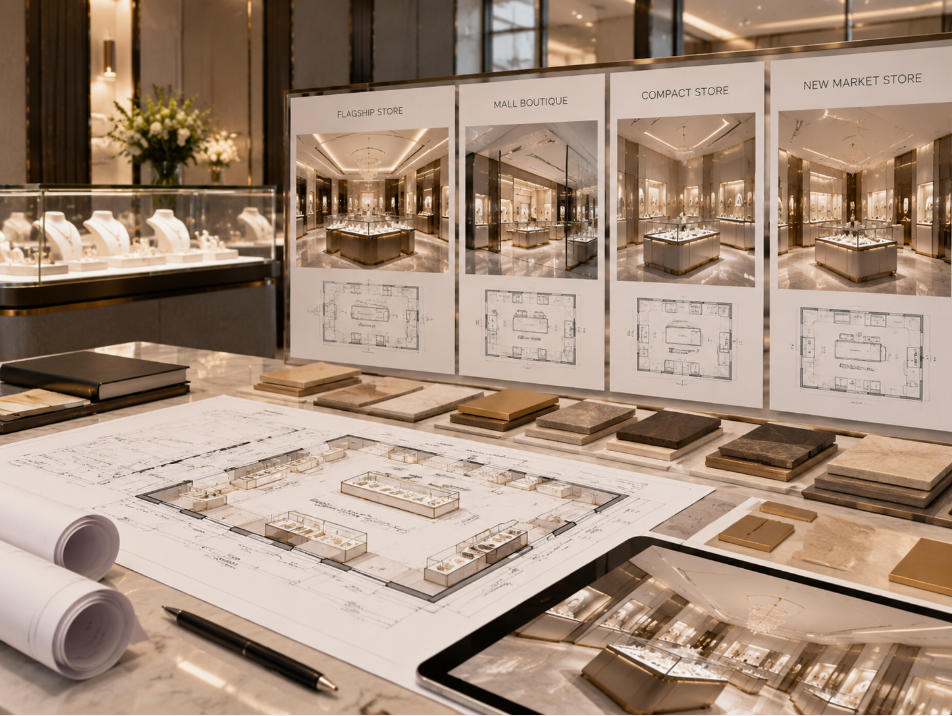
STANDARDIZE WHAT DEFINES THE BRAND
Keep the Jewelry Display Language Consistent Without Making Every Store Identical
The most useful multi-store display standard separates the elements that should remain controlled from the elements that can respond to each location.
Materials & Finishes
Define the glass, metal finishes, cabinetry surfaces, interior materials and decorative details that make the showcase family recognizable.
Lighting Language
Maintain a consistent approach to product illumination, light positions, color quality and visual presentation across different stores.
Access & Security
Standardize practical details such as staff access, locks, doors, drawers and secure storage where the same operating logic is required.
Brand Details
Carry approved proportions, trims, display surfaces and other visible details into later stores as part of the physical brand language.
ADAPT WHAT THE LOCATION REQUIRES
Jewelry Chain Store Display Cases Need Controlled Flexibility
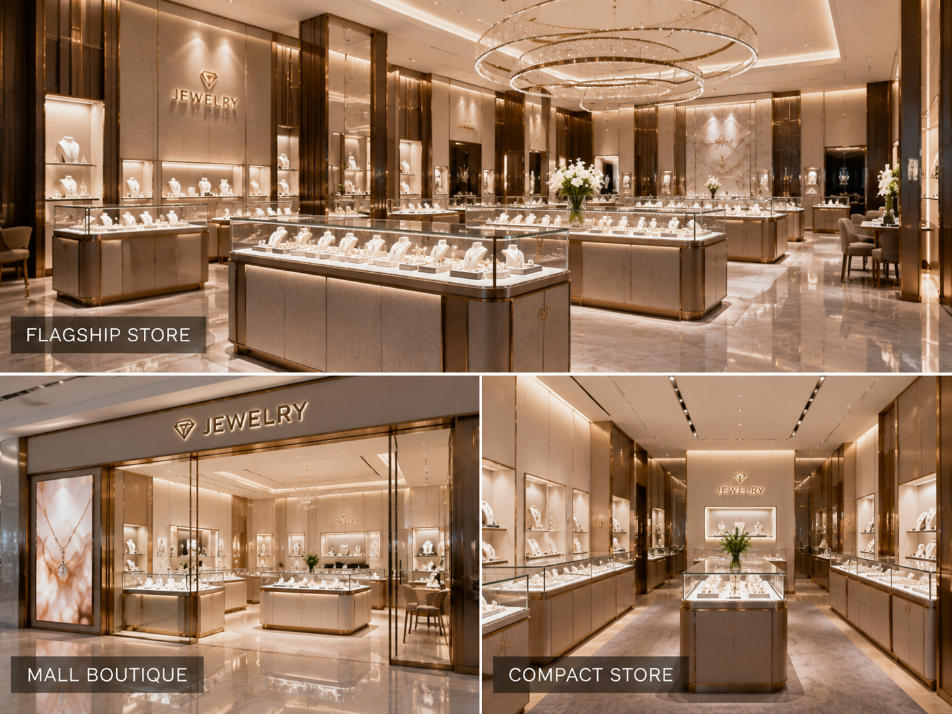
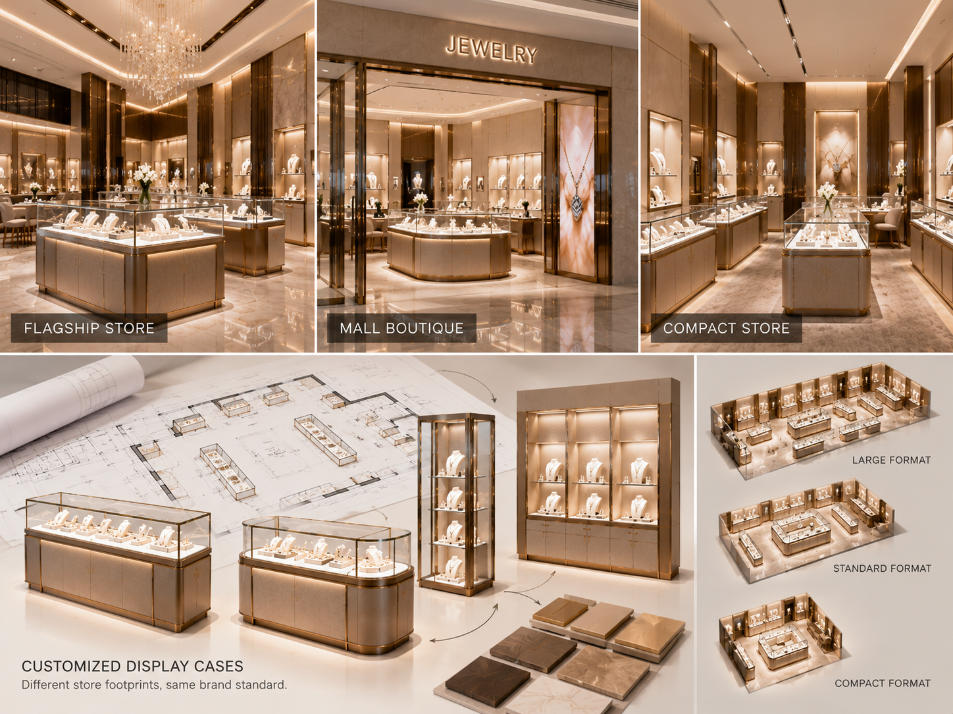
Jewelry chain store display cases cannot always use exactly the same dimensions or quantities. Storefront width, floor area, columns, wall lengths, circulation and merchandise categories can change from one location to another.
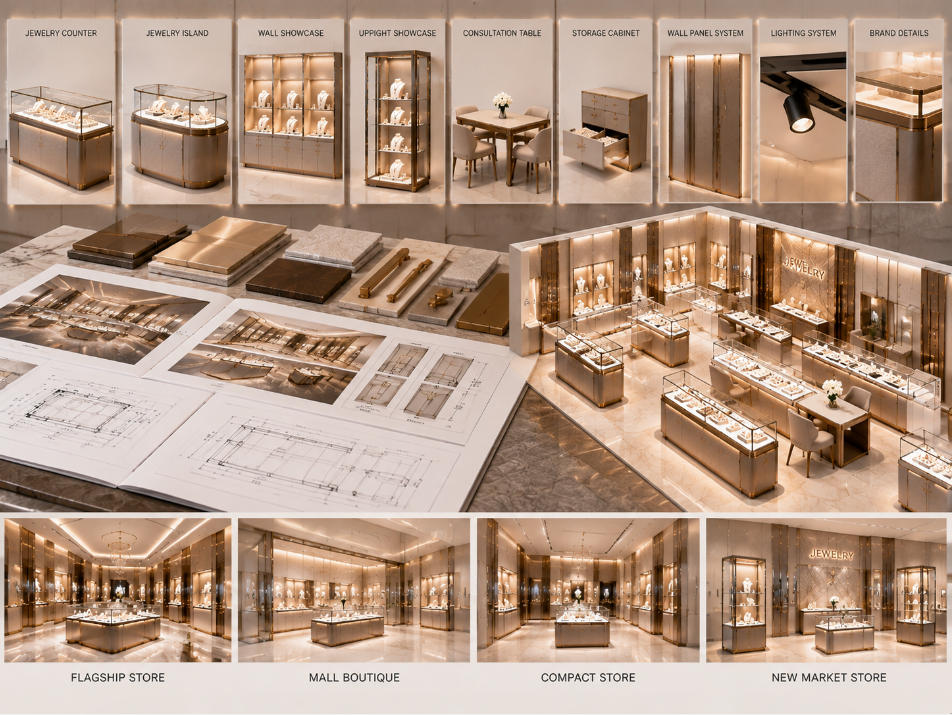
A flagship may require larger feature islands and consultation displays, while a compact mall boutique may use fewer counters and more efficient wall presentation. The configuration changes, but the core showcase language can remain consistent.
This controlled flexibility allows the brand to respond to real store conditions without turning every new location into a completely separate display development project.
ONE STANDARD · DIFFERENT STORE FORMATS
Build Multi Location Jewelry Display Solutions Around the Retail Network
Multi location jewelry display solutions should be flexible enough to support the store formats a jewelry brand actually operates rather than assuming every location has the same commercial role.
Flagship Stores
Use a wider showcase family, larger feature displays and more customized presentation while retaining the approved brand standard.
Mall Boutiques
Configure counters, islands and wall displays around typical shopping-mall footprints, circulation and customer interaction.
Compact Stores
Reduce quantities or adjust dimensions while maintaining recognizable materials, finishes, lighting and jewelry presentation.
New Market Stores
Use the established display standard as a controlled starting point when the retail network expands into additional cities or countries.
CREATE A REUSABLE DISPLAY CASE FAMILY
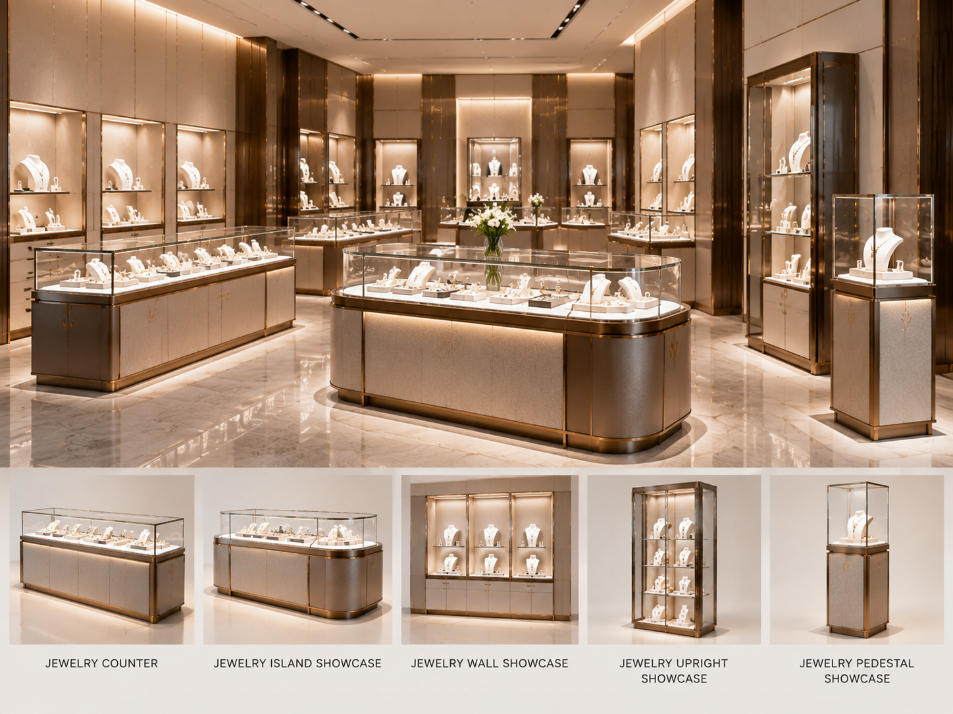
Standardized Jewelry Display Cases Can Be Combined Differently by Store
The most scalable approach is often to develop a family of approved display case types rather than one universal cabinet. The family can include counters, islands, wall cases, upright showcases, window displays and consultation units with shared design standards.
Each case type can receive a reference, approved dimensions or dimensional ranges, material specifications, lighting requirements, access method and functional purpose.
Future stores can then select different quantities and combinations from the approved family instead of redefining every showcase from the beginning.
CUSTOMIZE WITHIN THE APPROVED SYSTEM
Custom Jewelry Display Cases Still Have a Role in a Standardized Rollout
Standardization does not mean removing customization. It means deciding where customization adds value and controlling it within an established display language.
Some locations may require longer counters, special corner conditions, different wall configurations or unique feature cases. SUNZEN’s custom jewelry display case capability provides a route for developing those store-specific requirements while keeping materials, finishes, lighting and construction details connected with the wider brand standard.
This makes custom development part of the rollout system rather than a reason to restart the design process for every store.
CONTROL TWO LEVELS AT THE SAME TIME
A Jewelry Rollout Needs Both Brand-Level and Store-Level Decisions
Multi-store procurement becomes easier when the team separates decisions that apply to the entire retail network from decisions that belong to one specific location.
TURN THE BRAND STANDARD INTO A STORE SCHEDULE
Organize Display Case References and Quantities by Location
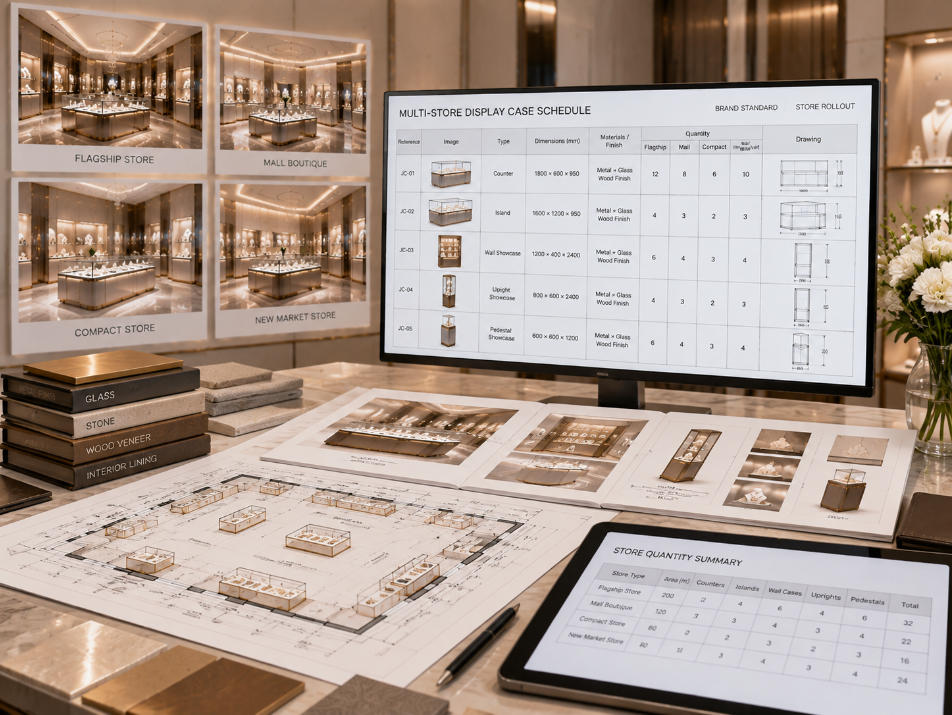
Once the showcase family has been approved, each case type can receive a reference that connects it with dimensions, materials, finishes, glass, lighting, access and other specifications.
Each new store can then use those references to create a location-specific case schedule. One branch may require six counters and two wall cases, while another uses four counters, an island and a different wall configuration.
The store schedule separates quantity and configuration from the core product standard, making repeated procurement easier to control.
REPEAT THE SPECIFICATION, NOT JUST THE APPEARANCE
Jewelry Display Case Manufacturers Need to Control Later Production Batches
A multi-store program may continue for months or move through several expansion phases. That means the manufacturing reference established for the first stores needs to remain useful when later locations are released.
SUNZEN’s jewelry display case manufacturers capability supports the engineering, material coordination, sample confirmation and production decisions behind custom jewelry showcase projects.
Within a rollout program, that manufacturing capability helps connect later batches with approved specifications instead of relying only on photographs of previously completed stores.
PRODUCTION CAPACITY NEEDS PROCESS CONTROL
Factory Production Supports Phased Jewelry Store Expansion
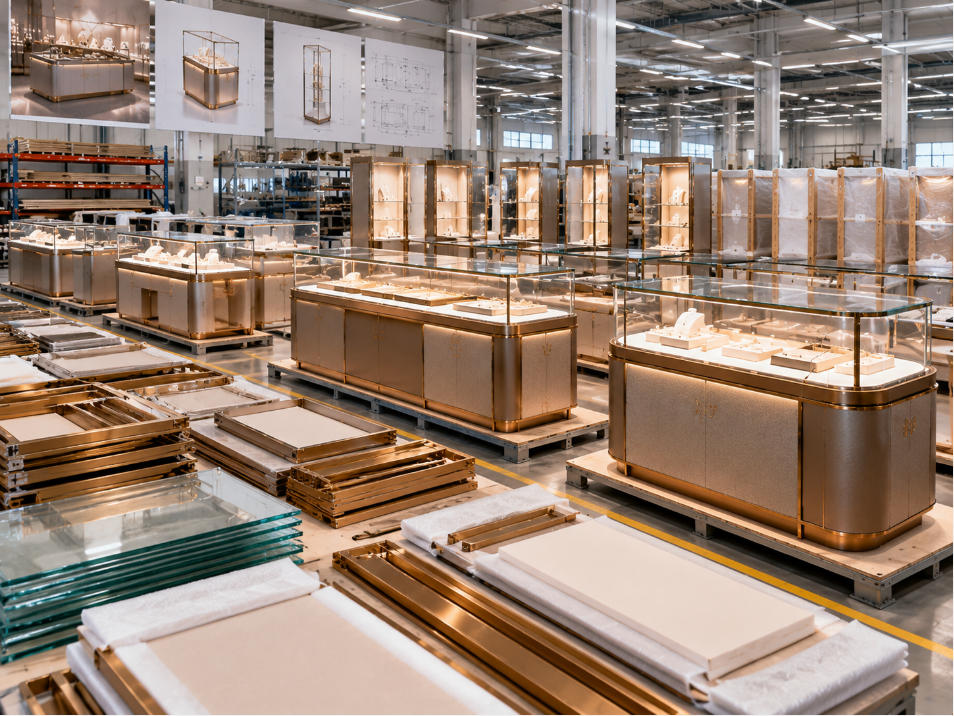
Jewelry brands rarely open every location on the same day. A rollout may begin with one flagship, continue with several mall stores and later expand into additional markets.
SUNZEN’s jewelry display case factory capability supports the production of glass, metal structures, cabinetry, lighting, hardware and completed showcase assemblies for custom jewelry projects.
For multi-store programs, the important factory requirement is not simply producing a larger quantity. It is maintaining the approved display case specification while quantities, store combinations and production dates change.
PLAN PRODUCTION AROUND THE ROLLOUT
Not Every Store Needs to Be Manufactured in the Same Batch
A multi-store program can be organized around actual opening schedules. The display standard remains consistent while quantities are released according to project phases.
This allows the brand to confirm the system in an early location, move into broader production and continue using the established specification framework when additional stores are added later.
QUALITY CONTROL AGAINST THE APPROVED STANDARD
Inspect Multi-Store Display Cases for Both Consistency and Operation
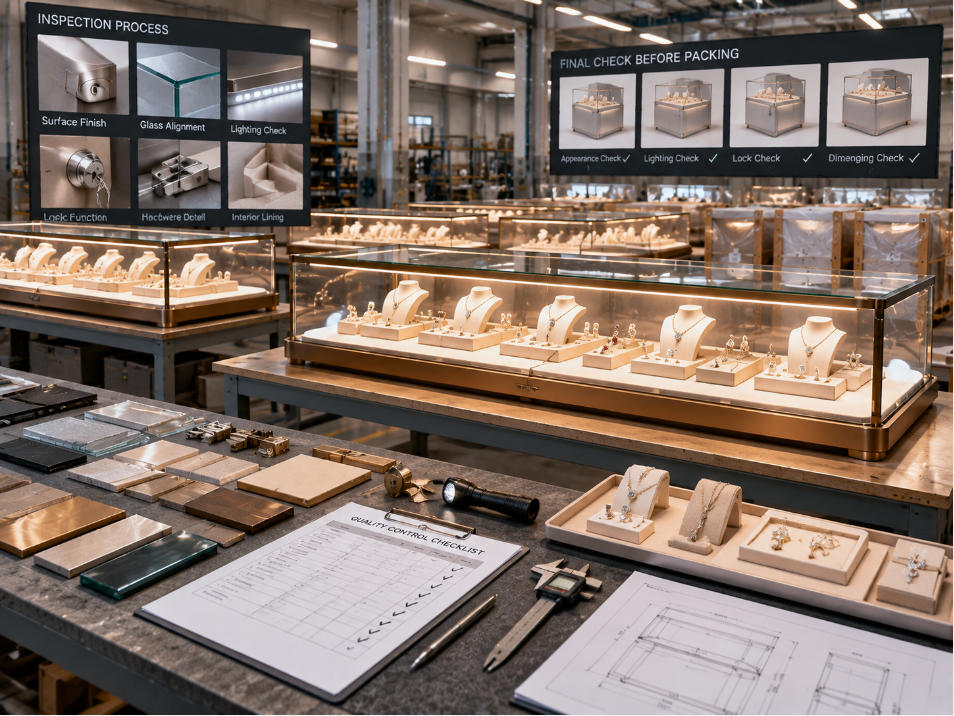
Quality control for repeated jewelry display cases should evaluate more than whether each individual cabinet looks acceptable. Repeated units should also be reviewed against the agreed design and functional references.
Glass alignment, visible gaps, metal finishes, cabinetry surfaces, lighting, doors, drawers, locks and other operating components can be checked as part of the completed case.
For repeated stores, consistency between units becomes another important quality consideration alongside the performance of each individual showcase.
WHEN THE ROLLOUT EXTENDS BEYOND DISPLAY CASES
Coordinate Jewelry Display Cases With the Wider Store Fixture Package
Some jewelry rollouts include more than enclosed display cases. Consultation furniture, wall systems, storage, service elements and other branded fixtures may also need to follow the same multi-store standard.
When the scope expands beyond individual showcases, SUNZEN’s jewelry store fixtures capability provides a broader route for coordinating the surrounding fixture package.
Keeping the distinction clear allows this page to remain focused on multi-store jewelry display cases while still supporting projects where the rollout eventually extends into a more complete store environment.
SECONDARY INTENT · JEWELRY RETAIL ROLLOUT SOLUTIONS
Jewelry Retail Rollout Solutions Connect the Display Standard With Multiple Locations
Jewelry retail rollout solutions become relevant when the project is no longer about one store but about controlling how an approved retail concept is repeated across a growing network.
The display case family, store schedules, approved finishes, production references, quality checks and location identification can all become part of the rollout framework.
For programs that extend into a wider fixture package, SUNZEN’s retail fixture rollout capability addresses the broader process of repeatable fixture standards, store-specific quantities and phased multi-location deployment.
IDENTIFY THE CASE BY STORE AND REFERENCE
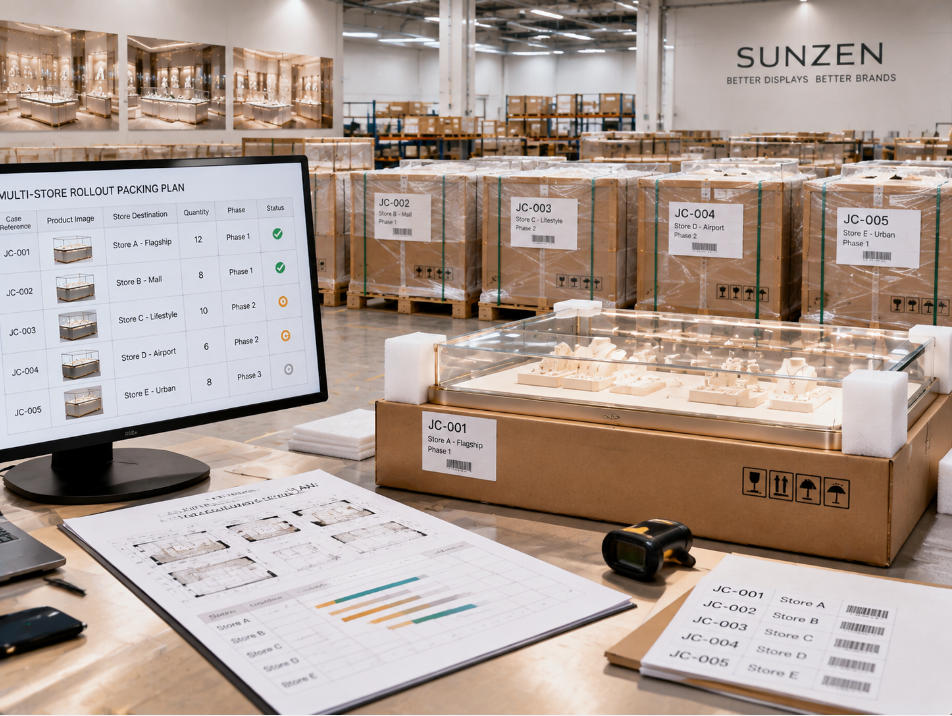
Store-Specific Identification Helps Keep Multi-Location Deliveries Organized
Repeated jewelry display cases can look similar while belonging to different stores, zones or rollout phases. Clear identification helps connect each packed unit with the correct case reference and destination.
This is especially useful when several locations are manufactured within the same production period but have different delivery or installation schedules.
The objective is simple: the repeatable display standard should remain traceable from specification through production, packing and the intended store.
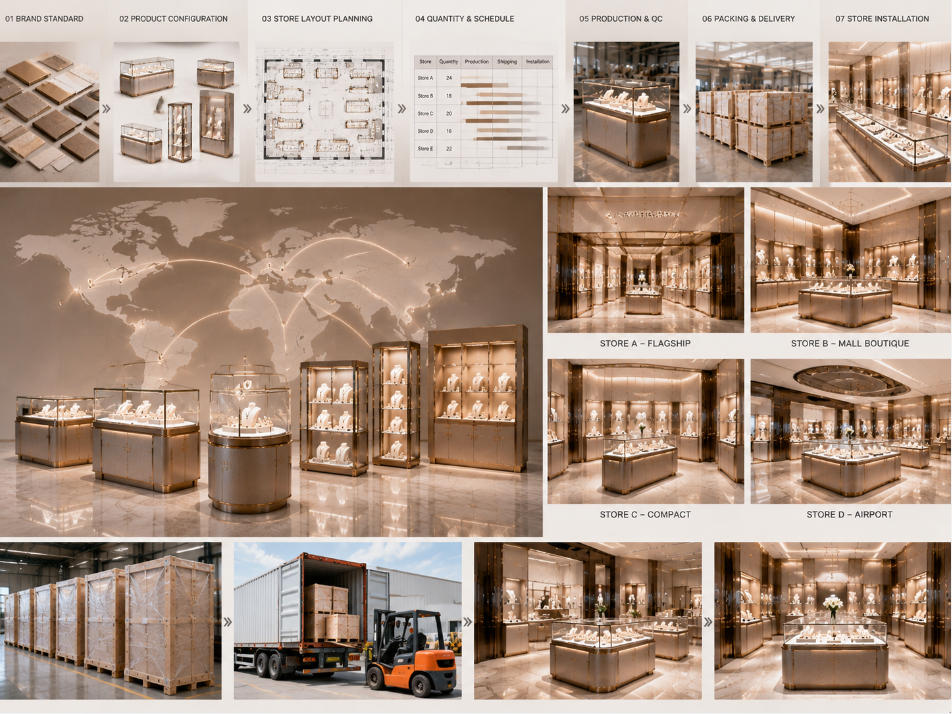
MULTI-STORE JEWELRY DISPLAY WORKFLOW
From Brand Standard to Repeatable Store Rollout
The process converts the jewelry brand’s approved display concept into controlled case references that can be adapted and supplied across multiple locations.
Standardize
Define the display language, materials, finishes, lighting, functions and showcase types that should remain consistent.
Configure
Apply the approved display family to each store layout and identify required standard and custom case variants.
Produce
Manufacture approved store quantities while controlling specifications, materials, finishes and functional requirements.
Roll Out
Identify, pack and supply display cases according to the required store destination and project phase.
PREPARE A MULTI-STORE RFQ
What to Send for a Multi Store Jewelry Display Case Project
You do not need every future store fully designed before discussing a rollout. The most useful starting information helps establish the brand standard, typical store conditions and expected expansion scope.
FAQ
Multi Store Jewelry Display Cases FAQs
What are multi store jewelry display cases?
Multi store jewelry display cases are a coordinated family of showcases developed for jewelry brands operating or expanding across multiple retail locations. The cases use shared design and production standards while allowing controlled adaptation for different store layouts, quantities and merchandise requirements.
Do all jewelry stores need to use exactly the same display cases?
No. A practical multi-store program normally standardizes the elements that define the brand, such as materials, finishes, lighting, hardware and display language, while allowing dimensions, quantities and configurations to change according to each store.
What should be standardized for jewelry chain store display cases?
Useful standards can include showcase types, materials, metal finishes, glass specifications, interior surfaces, lighting approach, locks, staff access, hardware and presentation details. Exact quantities and selected dimensions can then be adapted to individual locations.
Can SUNZEN produce custom jewelry display cases for different store layouts?
Yes. Custom display cases can be developed for store-specific dimensions, corners, wall conditions or feature requirements while retaining the approved materials, finishes, lighting and design language of the wider rollout program.
How can display case quality remain consistent across different production batches?
Approved drawings, material references, finishes, construction details and functional specifications can establish the production standard. Later batches can then be reviewed against those references as additional stores are released.
Can one jewelry display case system work for flagship and smaller stores?
Yes. A display family can contain repeatable counters, islands, wall cases and other case types that are combined differently according to each store. Flagships can use a wider range of cases while smaller locations use fewer or adapted modules.
How should display cases be organized for multiple jewelry stores?
Each approved case type can receive a reference connected with its specification. Individual store schedules can then list the required case references, quantities and selected variants for each location or rollout phase.
What should I send SUNZEN for a multi-store jewelry display case quotation?
Send available brand guidelines, store plans, renderings, existing showcase references, preferred materials, lighting and security requirements, expected case types, number of stores, target destinations and rollout schedule. SUNZEN can review the information and help define the display case scope.
BUILD THE DISPLAY STANDARD FOR YOUR NEXT STORES
Planning a Multi-Store Jewelry Brand Rollout?
Send SUNZEN your brand concept, store plans, showcase drawings or rollout requirements. We can help organize repeatable jewelry display case standards, adapt them to individual locations and coordinate custom manufacturing for phased store expansion.

