
MODULAR DISPLAY CASE SUPPLIER · SCALABLE RETAIL DISPLAY SYSTEMS
Modular Display Case Supplier for Custom Retail Display Systems
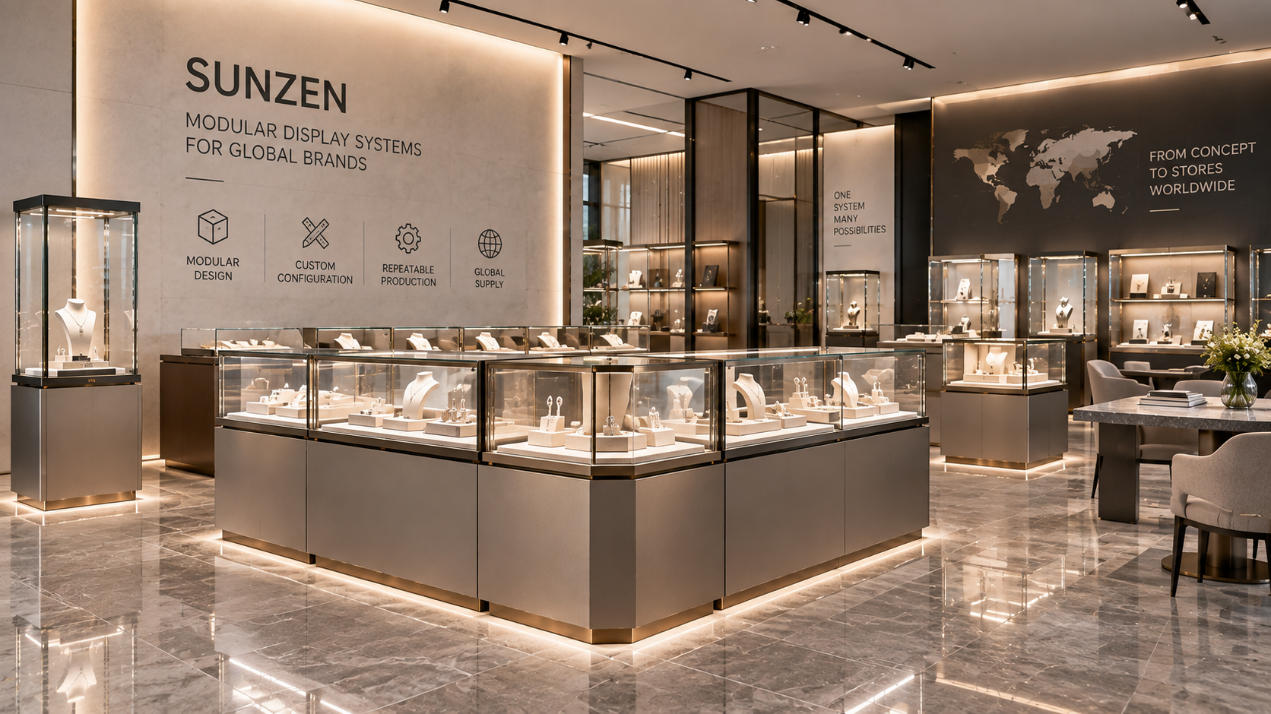
Build a display system that can repeat, adapt and expand instead of redesigning every case from the beginning. SUNZEN supplies modular display cases for retail brands, jewelry stores and commercial projects that need consistent presentation across different products, store layouts and future locations.
As a modular display case supplier, SUNZEN helps buyers define a practical module family, determine what should remain standardized, identify what can be customized and coordinate approved configurations with manufacturing, quality control, packing and phased project supply.
Send us your store plans, fixture schedule, preferred module sizes, reference designs or rollout requirements. We can review how a modular display case system can be structured around your project.
THINK IN SYSTEMS, NOT INDIVIDUAL CABINETS
A Modular Display Case Supplier Should Help You Build a Repeatable System
A conventional custom display project can treat every showcase as an individual design. A modular project starts from a different question: which dimensions, structures, materials and interfaces can become repeatable building blocks?
The objective is not to make every case identical. It is to create a controlled family of modules that can be combined differently while maintaining a recognizable design language and predictable technical relationships.
This approach becomes particularly valuable when a brand expects different store sizes, changing merchandise categories, phased expansion or repeated installations across multiple locations.
CREATE THE MODULE FAMILY FIRST
Build a Small Set of Modules That Can Produce More Store Configurations
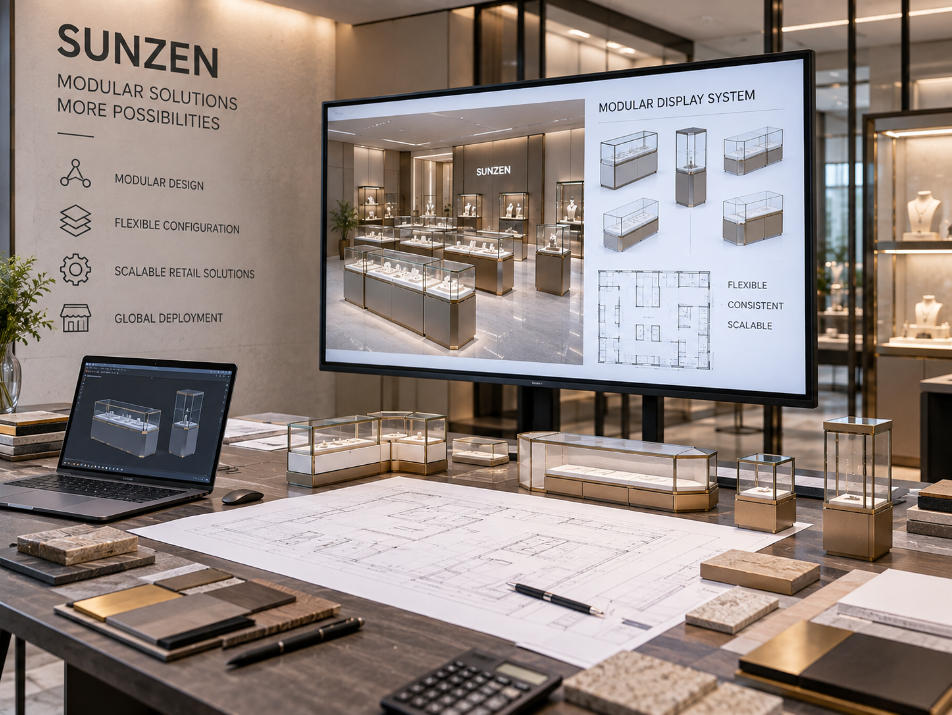
The value of modularity comes from controlled combinations. Instead of creating dozens of unrelated fixtures, a project can establish a smaller family of compatible display modules and use them in different arrangements according to store size, product category and merchandising requirements.
Base Modules
Establish repeatable widths, depths and structural relationships that form the foundation of the system.
Display Modules
Develop glass cases, open displays, counters or presentation zones around different merchandise requirements.
Storage Modules
Integrate drawers, cabinets and concealed storage without changing the overall visual language.
Connector Modules
Use corners, end units, transition pieces or shared interfaces to create larger fixture arrangements.
MODULAR DOES NOT MEAN GENERIC
Modular Display Cases Solve a Different Problem From One-Off Fixtures
A fixed custom fixture can be optimized for one exact location. A modular system needs to perform across several possible configurations while preserving the intended visual and operational standard.
The design challenge therefore shifts from optimizing one cabinet to defining relationships between multiple compatible components.
Create a dimensional logic that can be reused across several configurations.
Coordinate adjoining modules so cases can work together rather than simply stand beside each other.
Allow selected changes without losing the core module standard.
Plan the system so additional modules can extend the display concept later.
CUSTOMIZE THE SYSTEM, NOT EVERY UNIT
Custom Modular Display Cases Balance Standardization With Project Flexibility
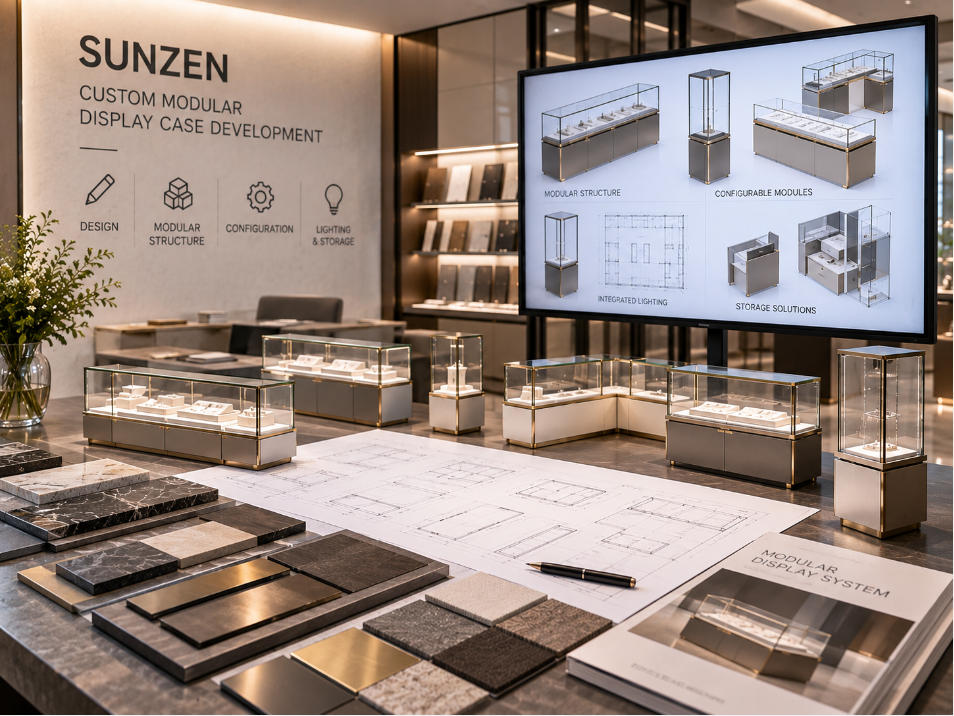
The strongest modular systems define what should remain fixed and what can change. Structural dimensions, connection logic and key visual details may remain standardized, while finishes, display interiors, lighting or selected module functions can adapt to different project requirements.
This is where custom modular display cases differ from generic ready-made modular cabinets. The module family can be developed around the buyer’s brand, merchandise, operating requirements and expected deployment strategy while maintaining repeatable system logic.
For a supplier-led project, this custom development stage establishes the module standards that can later be converted into store-specific quantities and configurations without redesigning every display case from the beginning.
DEFINE FIXED AND VARIABLE ELEMENTS
A Useful Modular Display Case System Needs Clear Rules
Modularity becomes difficult to control when every component is allowed to change. Before manufacturing, the project should define which features form the permanent system standard and which features remain configurable.
Structure
Standardize important structural dimensions, frame relationships and connection principles.
Finishes
Define a controlled finish palette that can support different locations without fragmenting the brand language.
Display Interiors
Allow selected interior trays, shelves, decks or presentation accessories to respond to merchandise categories.
Functions
Identify which modules require glass display, storage, consultation, merchandising or other operational functions.
DESIGN FOR DIFFERENT FOOTPRINTS
One Modular Display System Can Support Several Store Configurations
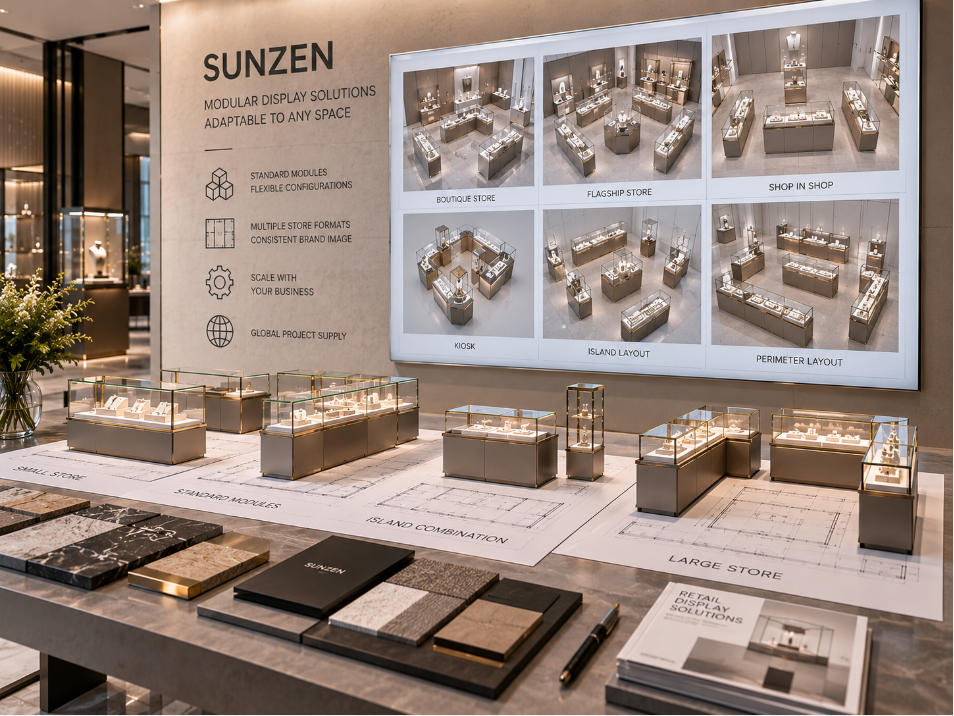
A modular display case system becomes commercially useful when the same module family can respond to different floor plans. A small store may use only core units, while a flagship or larger location can combine those units into longer islands, perimeter runs or additional merchandise zones.
The supplier should therefore review not only the first installation but also the types of layouts the system may need to support later.
This changes modular procurement from buying individual cabinets into planning a reusable display platform.
DESIGN FOR REPEAT DEPLOYMENT
Modular Display Cases Can Simplify Multi-Store Rollout
For retail brands and chains, the first store is only one part of the requirement. Future stores may have different dimensions, merchandise mixes and opening schedules while still needing to look recognizably consistent.
A controlled modular system gives the project team a reusable base that can be configured according to each location instead of restarting fixture development for every store.
Reuse approved module types across different locations.
Adjust the quantity and combination of modules to suit each footprint.
Keep key proportions, materials and visual details aligned across locations.
Organize production and packing according to different store or project batches.
MODULAR SYSTEMS FOR RETAIL
Modular Retail Display Cases Need to Adapt Without Losing Brand Identity
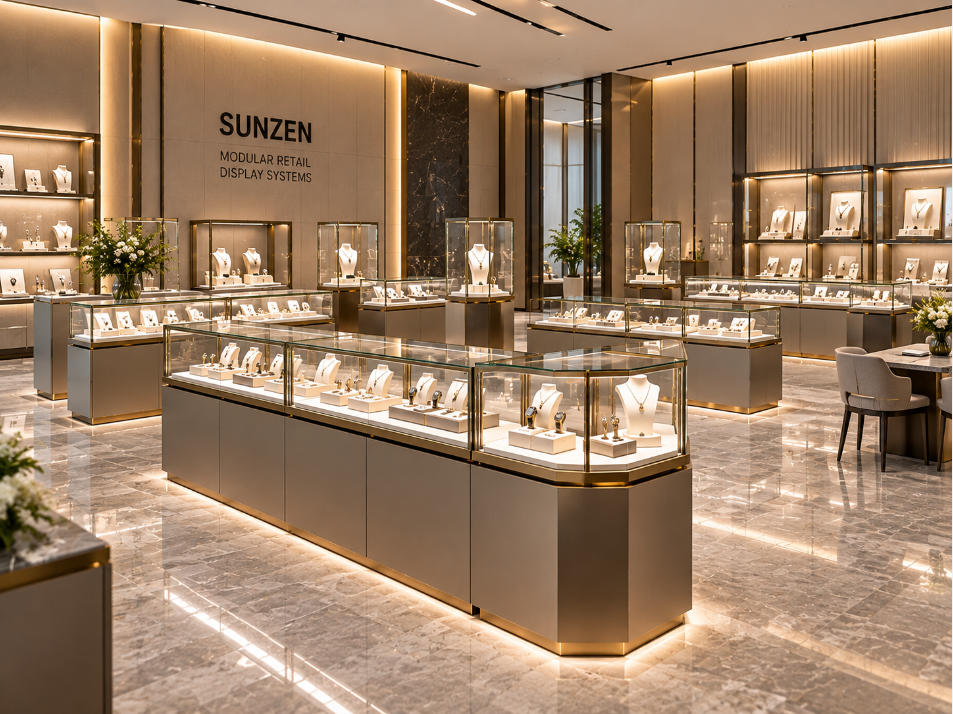
Modular retail display cases can support stores where merchandise categories, seasonal presentations or floor plans change while the overall fixture language remains consistent.
A module family can include different heights, glass configurations, storage arrangements or presentation functions while sharing the same design DNA.
The supplier’s role is to keep these variations controlled so the system remains recognizable and practical rather than becoming a collection of unrelated custom cabinets.
MODULARITY FOR HIGH-VALUE MERCHANDISE
Jewelry Retail Adds Lighting, Security and Staff Access to the Modular Equation
Jewelry and watch stores can benefit from modularity when brands need repeatable counter families across different locations, but these cases also need to coordinate product visibility, integrated lighting, locks, staff-side access and concealed storage.
The module should therefore repeat the brand and structural logic without forcing every jewelry category into exactly the same interior presentation.
Controlled interior variations can support rings, necklaces, watches and other merchandise while preserving the external module family.
Coordinate repeatable lighting positions with different merchandise presentations.
Integrate locks and controlled staff access into the module standard.
Allow concealed operational storage without disrupting the display language.
Use interchangeable or configurable interiors where different product categories require them.
BUILD A CONTROLLED MATERIAL PALETTE
Material Consistency Helps Modular Cases Read as One System
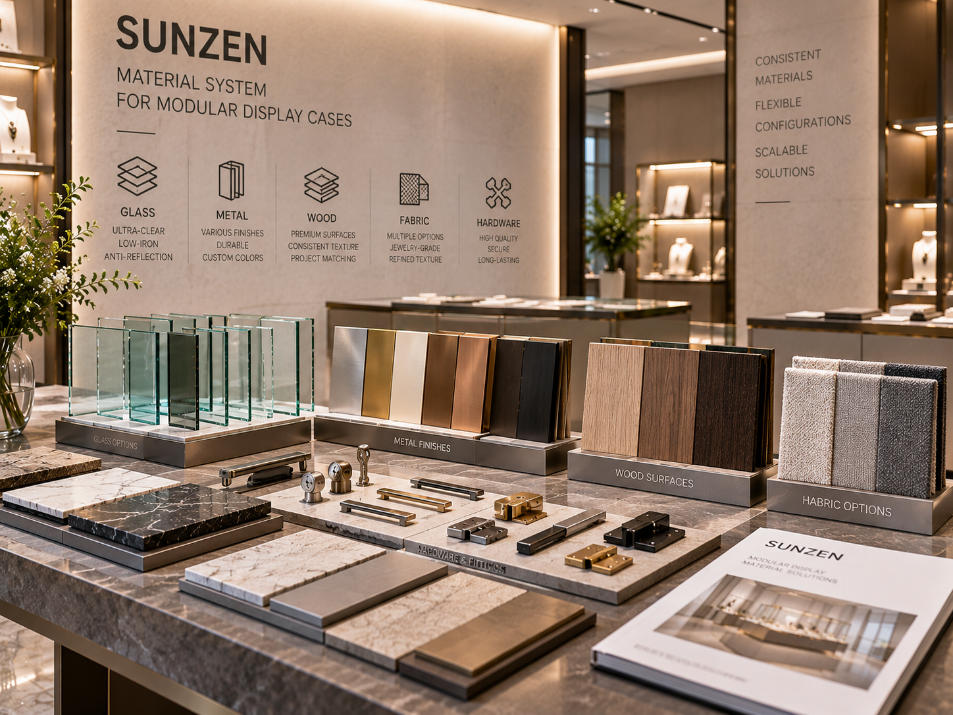
A modular display system can contain several case types without looking fragmented when the material palette is carefully controlled. Glass, metal finishes, wood surfaces, stone-look materials, interior fabrics and hardware can establish visual relationships between different modules.
The objective is not necessarily to use identical materials everywhere. Instead, the system should define approved combinations and finish families that can repeat reliably across modules and future project phases.
This gives the buyer room to adapt the system while maintaining recognizable brand continuity.
STANDARDIZE LIGHTING INTERFACES
Integrated Lighting Should Work Across the Module Family
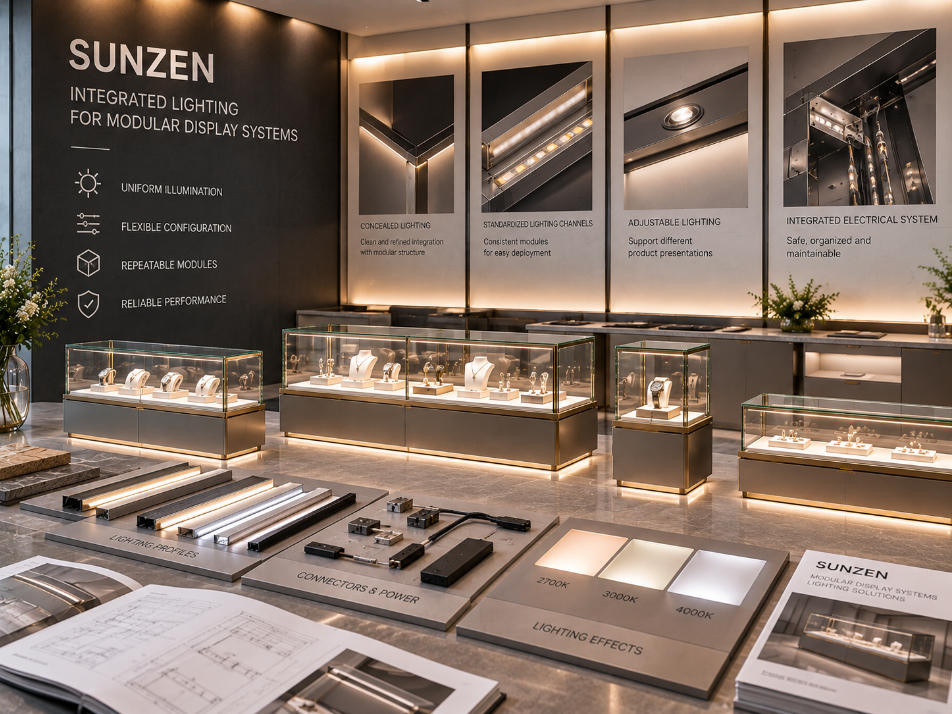
Lighting becomes more complicated when each module uses unrelated positions, components or wiring routes. A modular system can establish repeatable lighting zones and electrical interfaces while allowing the illumination itself to respond to different display functions.
For example, a glass showcase module may need concentrated merchandise lighting while an open merchandising unit requires a different distribution. The system can still share compatible construction and electrical principles.
Planning these interfaces before production makes later configurations easier to manage.
MAKE OPERATION PART OF THE MODULE
Storage and Staff Access Should Be Designed Into the Modular System
Commercial display cases are used every day, so modularity must work operationally as well as visually. Drawers, cabinets, staff doors, locks and service access should be coordinated with the module dimensions from the beginning.
This allows different configurations to retain predictable staff operation even when the arrangement of the store changes.
Display Above
Keep the customer-facing presentation clear and visually consistent.
Storage Below
Use the lower module volume for practical stock, packaging or operational storage where required.
Access Behind
Coordinate staff-side doors, drawers and locks with the intended store workflow.
TURN THE SYSTEM INTO A PROCUREMENT SCHEDULE
Give Every Module Type a Clear Reference Before Ordering
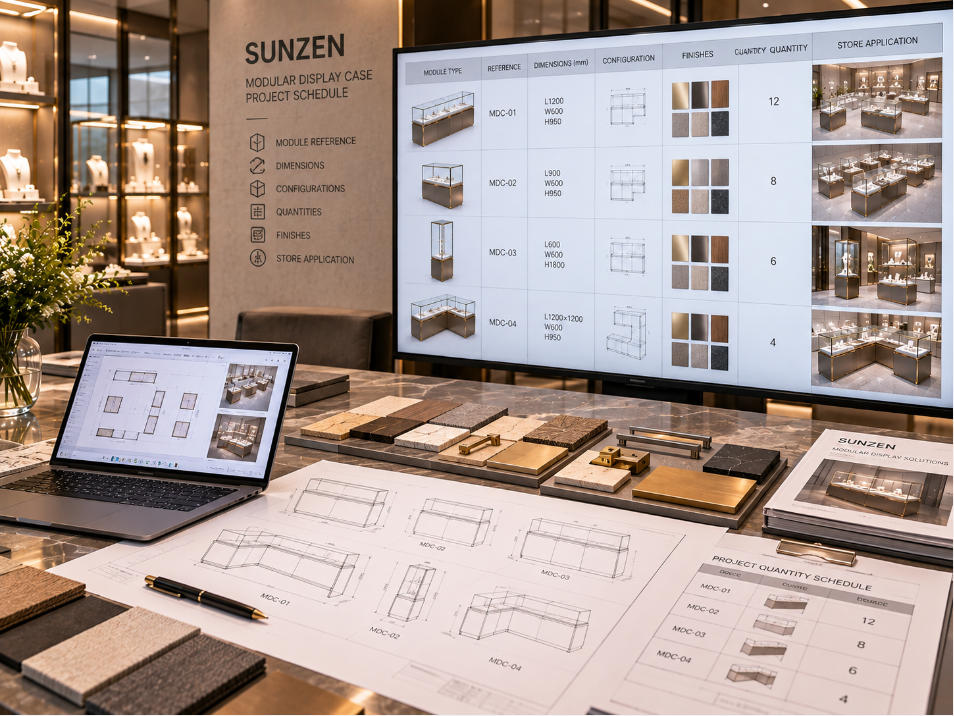
A modular system becomes easier to procure when each approved module has its own reference, dimensions, function, finish and configuration rules. Individual stores can then be defined by the quantity and combination of those references.
This creates a different procurement model from ordering unrelated fixtures. The buyer is sourcing from an approved module library and assembling the required store package from that controlled system.
For multi-location projects, the schedule can also distinguish shared module standards from store-specific quantities and approved variations.
SUPPLIER MEANS SYSTEM COORDINATION
A Modular Display Case Supplier Connects the Module Library With Each Project Order
Once the modular family is approved, individual project requirements still need to be translated into quantities, configurations, finishes and delivery batches. This is where the Supplier role becomes important.
The supplier should help maintain the relationship between the approved module standard and the actual units required for each store, phase or commercial project.
Keep every ordered unit connected with an approved module type.
Record approved options and variations without losing the system standard.
Organize module quantities by location, phase or rollout batch.
Keep packed units identifiable for the intended store or project area.
CONNECT SUPPLY WITH MODULAR MANUFACTURING
Repeatability Depends on a Manufacturer That Can Reproduce the Module Standard
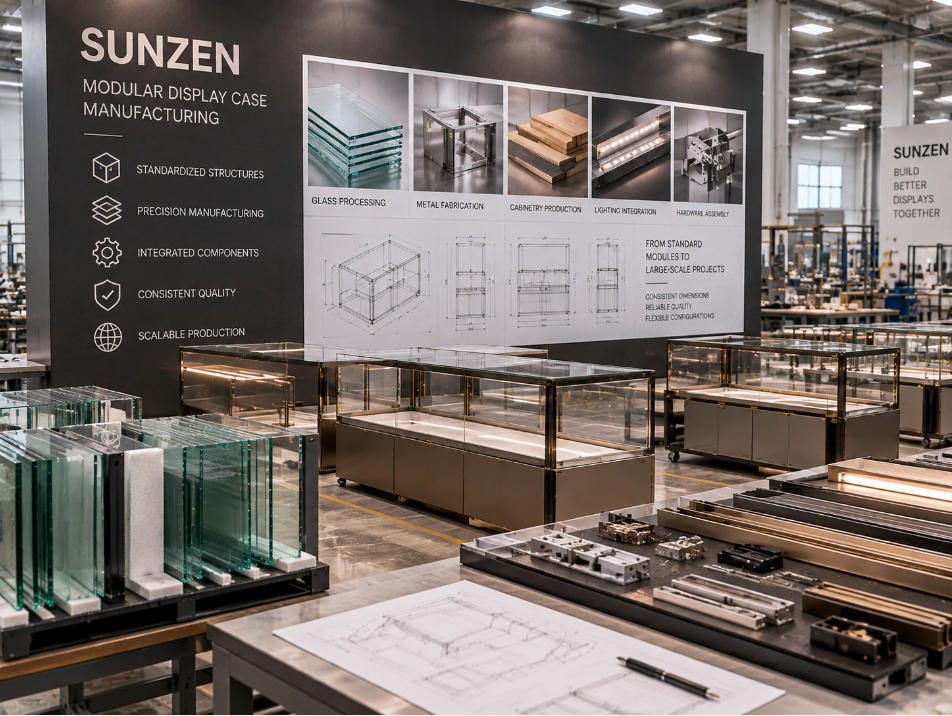
A modular concept only becomes useful when approved dimensions, interfaces and finishes can be reproduced consistently. Manufacturing therefore needs to work from controlled module information rather than interpreting every unit as a new custom product.
For buyers evaluating the production capability behind the system, SUNZEN’s modular display case manufacturers page focuses specifically on the manufacturing side of modular cases, including repeatable structures, coordinated materials, production consistency and scalable project execution.
The search intents remain different. This Supplier page focuses on how buyers source, configure and deploy an approved modular system, while the Manufacturer page addresses the capability required to engineer and reproduce those modules reliably.
VERIFY THE PRODUCTION ROUTE
Factory Capability Supports Consistent Modular Supply
Modular display cases can combine glass, metalwork, cabinetry, lighting, hardware and finished surfaces within the same system. Production therefore needs to coordinate these components while maintaining the dimensional relationships that allow modules to repeat and connect correctly.
Buyers who want to evaluate factory capability separately from supplier coordination can review SUNZEN’s showcase factory content for the production environment behind custom showcase projects.
For the current page, factory capability is evidence supporting the Supplier promise rather than the main search intent. The priority remains controlling the modular system from approved configuration through project supply.
Coordinate glazing and structural components according to the approved module standard.
Maintain repeatable dimensions, storage layouts and visible surface relationships.
Integrate functional components consistently across related module types.
Confirm that completed modules preserve the interfaces required by the wider system.
PRODUCE FROM CONTROLLED MODULE INFORMATION
Manufacturing Should Preserve the Modular Standard Across Every Batch
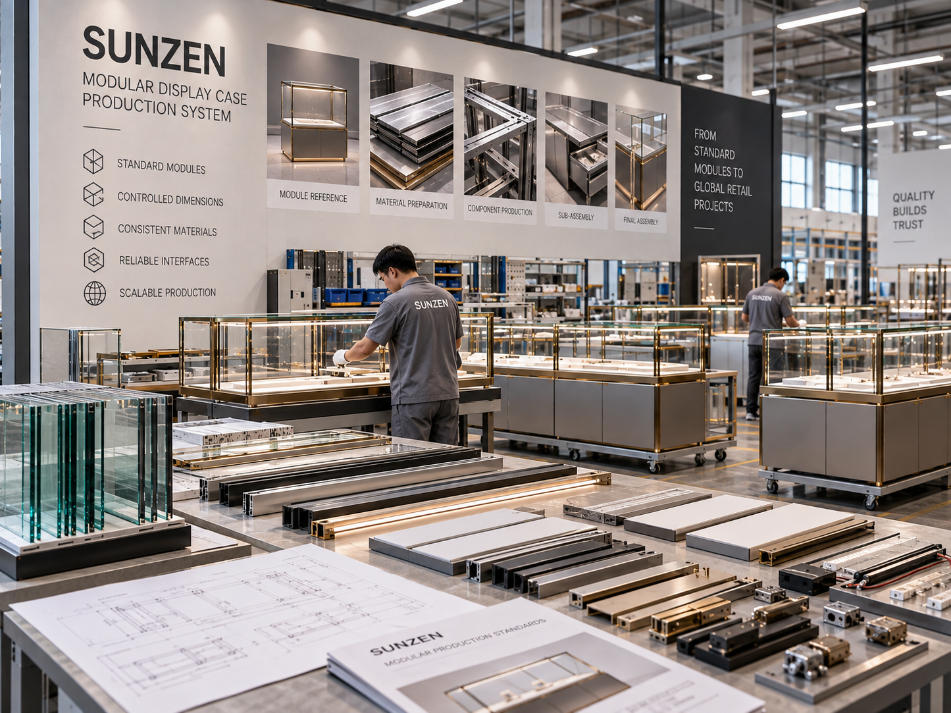
Repeated modules need consistency in dimensions, interfaces, materials and visible details. Small deviations that may be less obvious in a one-off fixture can become noticeable when several identical or related units are installed together.
SUNZEN’s showcase manufacturing capability supports the production route behind custom display systems, including coordination between glass, metalwork, cabinetry, lighting, hardware and assembly processes.
For modular projects, the approved module reference should remain connected with production so each batch can be checked against the same design baseline.
INSPECT THE SYSTEM, NOT ONLY THE INDIVIDUAL CASE
Quality Control Should Check Compatibility Between Modules
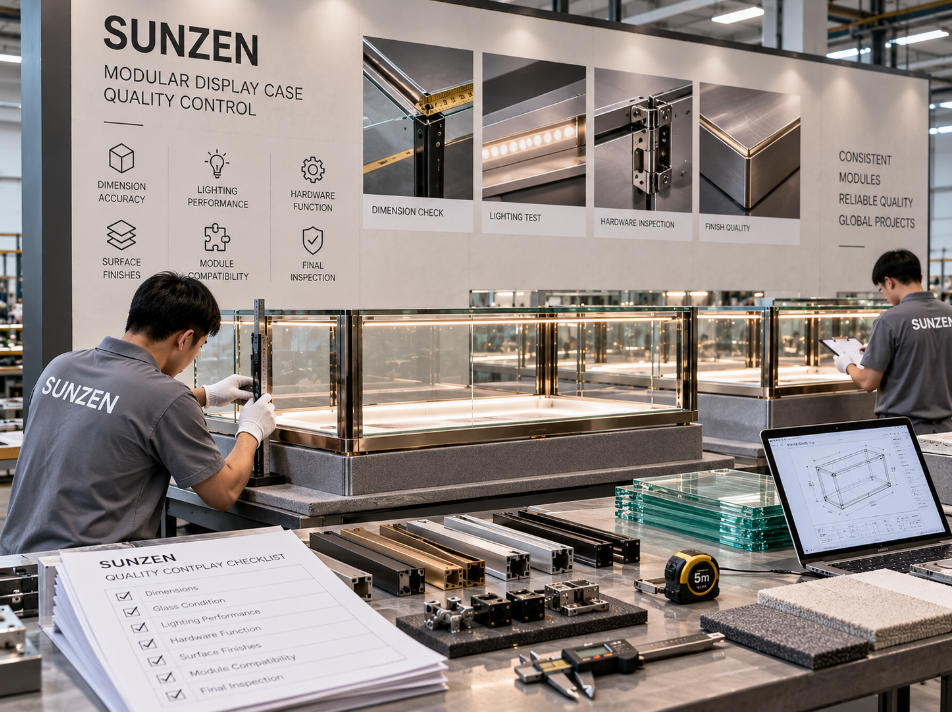
A modular case can look correct by itself but still create problems if dimensions, adjoining surfaces or interfaces do not align with related modules. Inspection should therefore consider both individual workmanship and the relationships that allow the system to function as intended.
Repeated module types should be checked against the same approved reference so dimensions, finishes, lighting, hardware and visible details remain consistent across the production batch.
Where modules are designed to sit together, trial positioning or interface checks can provide additional confirmation before packing.
PACK BY MODULE, STORE AND PHASE
Modular Supply Needs a Delivery System as Organized as the Fixture System
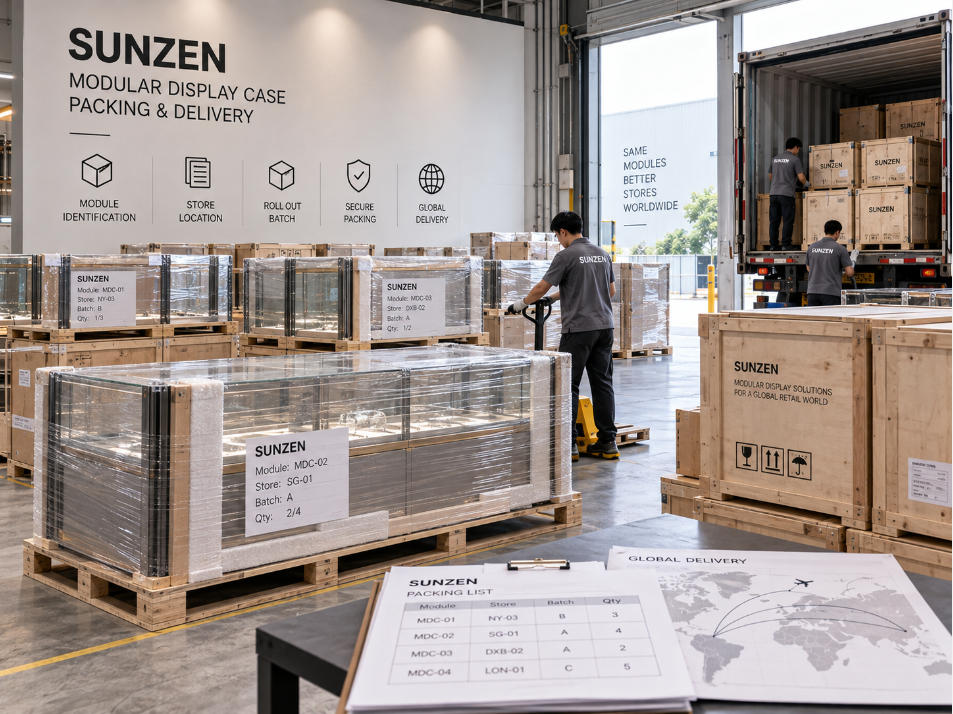
A rollout can contain repeated modules intended for several stores or installation phases. Without clear identification, visually similar units can become difficult to separate after they leave production.
Packing information can connect the physical unit with its module reference, quantity, destination or project phase so receiving teams can understand what belongs to each location.
This makes packing and delivery part of modular procurement rather than an unrelated logistics task.
MODULAR DISPLAY CASE SOURCING WORKFLOW
From Module Strategy to Repeatable Project Supply
A modular project works best when system decisions are made before individual store quantities are released for production.
Define
Identify display functions, store types, merchandise requirements and expected future configurations.
Build
Create the module family, dimensional logic, materials, interfaces and controlled customization options.
Approve
Confirm module references, drawings, finishes, functions and production standards before rollout.
Deploy
Convert the approved system into store-specific quantities, manufacturing batches, packing and delivery.
START WITH THE SYSTEM REQUIREMENTS
What to Send Your Modular Display Case Supplier
You do not need a finished module library before contacting SUNZEN. The most useful starting information explains how the display system needs to work across products, store layouts and future deployment.
Provide one or several representative layouts showing how fixture requirements change by location.
Share renderings, elevations, brand guidelines or existing fixture concepts.
Explain what each module needs to display and how merchandise requirements vary.
Indicate initial quantities, number of stores or expected rollout stages where known.
Identify which dimensions, finishes or functions may need to change between locations.
FAQ
Modular Display Case Supplier FAQs
What is a modular display case system?
A modular display case system uses a controlled family of compatible display units that can be combined into different configurations. Modules can share dimensions, structures, finishes or connection principles while allowing selected variations for merchandise, store layout and operational requirements.
What should I look for in a modular display case supplier?
Look for a supplier that can help define the module family, separate standardized elements from customizable variables, coordinate store-specific quantities and configurations, and connect the approved system with manufacturing, quality control, packing and phased delivery.
Can modular display cases still be customized?
Yes. A modular system can be developed around custom dimensions, materials, finishes, glass configurations, lighting, storage and presentation requirements. The key is to define which features remain standardized and which can vary without breaking the system logic.
Are modular display cases suitable for retail chains?
They can be particularly useful for retail chains because an approved module family can be configured differently for various store sizes while maintaining common design and technical standards. Quantities and combinations can then be organized by location or rollout phase.
What is the difference between modular display cases and standard ready-made display cabinets?
Standard ready-made cabinets are generally selected from predefined products. Custom modular display cases can instead be developed as a project-specific system with repeatable module rules, controlled customization options and configurations designed around the buyer’s brand, merchandise and store program.
Can modular display cases include lighting, storage and locks?
Yes. Lighting, storage, locks, staff access, glass enclosures and other functions can be integrated into selected modules according to the display application and approved system design.
How can modular display cases support future store expansion?
A controlled module library can provide a reusable starting point for future locations. New stores can use different quantities or combinations of approved modules while maintaining key dimensional, material and visual standards.
What information should I send for a modular display case quotation?
Send available store plans, fixture drawings, renderings, product categories, preferred materials, module concepts, initial quantities, expected number of locations, destination and project schedule. SUNZEN can review the information and identify which elements should be standardized or customized before quotation and development.
BUILD A MODULAR DISPLAY SYSTEM THAT CAN GROW WITH YOUR PROJECT
Looking for a Custom Modular Display Case Supplier?
Send SUNZEN your store plans, fixture drawings, module concepts or rollout requirements. We can help structure a repeatable modular display case system, define controlled customization options and coordinate approved modules with manufacturing and project supply.

