
Jewelry Store Fixture Rollout: Custom Fixture Programs for Growing Jewelry Brands
A jewelry store fixture rollout turns an approved retail concept into a repeatable program for new store openings, renovations and multi-location expansion.
SUNZEN coordinates custom fixture development, store-specific adaptation, manufacturing, quality control, identification and delivery planning so jewelry brands can expand without losing the visual standards established in the original store concept.
Rather than treating every location as an independent fixture order, the rollout is managed as a controlled system connecting brand standards with the practical requirements of each store.
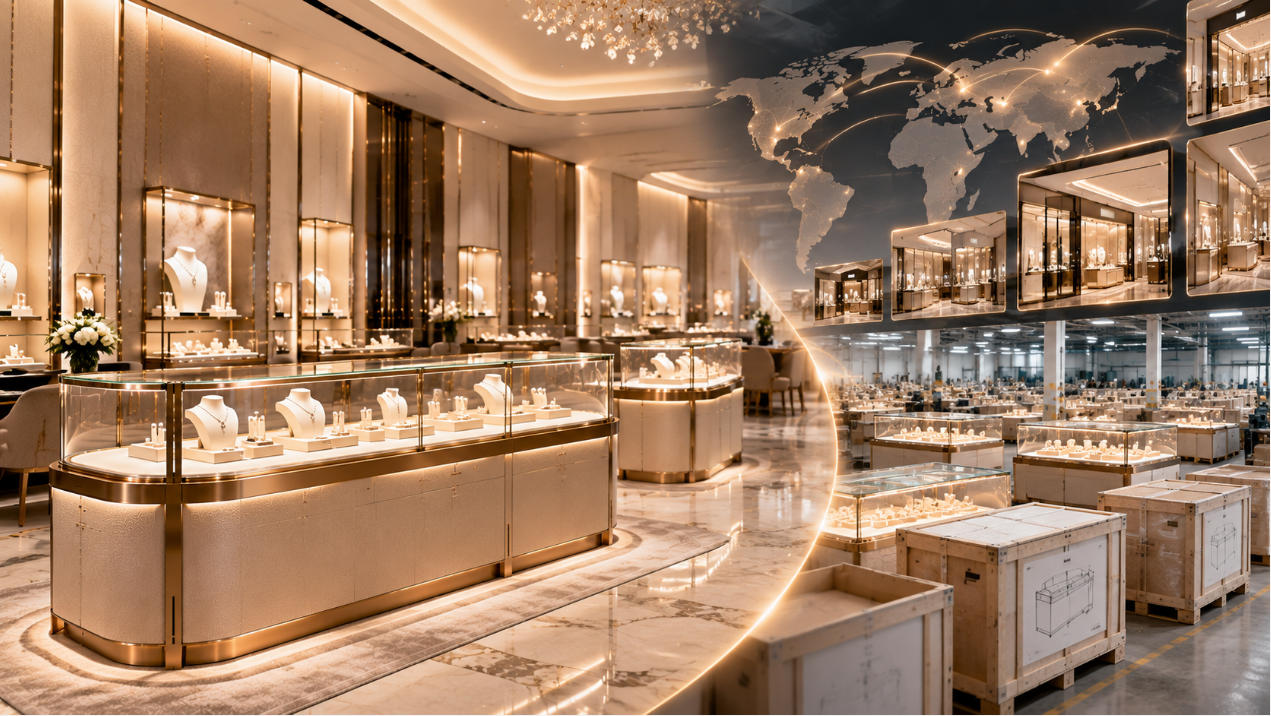
A Rollout Is More Than Repeating the Same Fixtures
A jewelry brand may begin with one approved store concept, but every new location introduces practical differences: floor area, storefront width, columns, circulation, local construction interfaces and opening schedules.
The objective is therefore not to copy one store exactly. It is to identify which parts of the fixture system must remain consistent and which parts can be adapted without weakening the brand.
For brands developing the broader store environment before rollout begins, jewelry store design can establish the spatial and presentation direction that the fixture program later carries into individual locations.
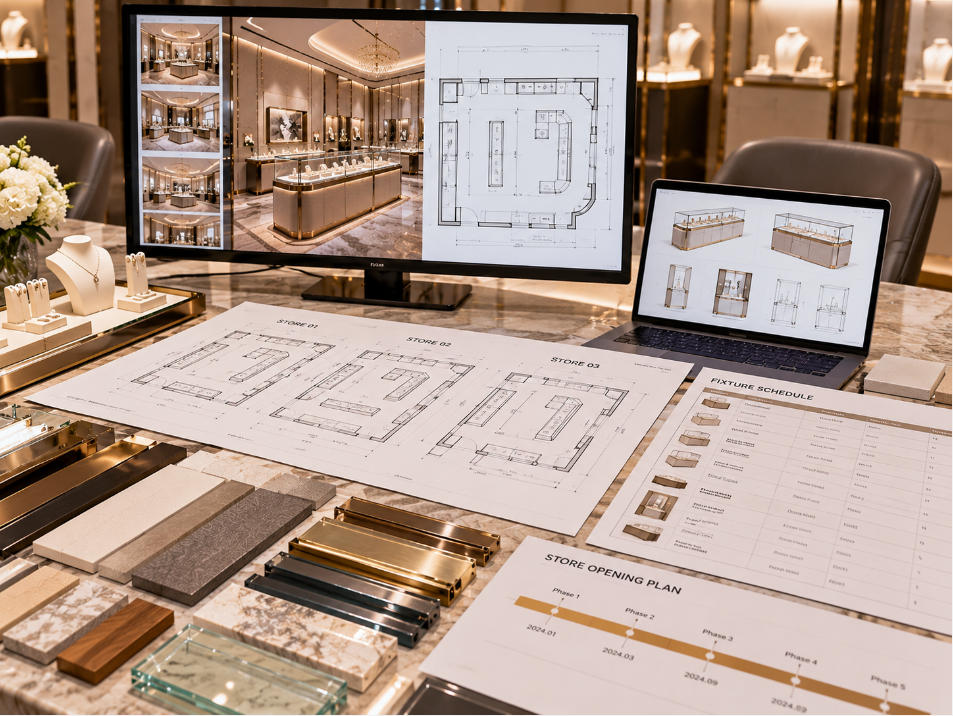
Define What Must Stay Consistent Across Every Jewelry Store
Before production expands across locations, the approved fixture family should be translated into a controlled set of references that separates fixed brand standards from store-specific variables.
Visual Identity
Maintain the approved fixture proportions, design language, customer-facing details and overall presentation character.
Finish Standards
Control metal tones, cabinet finishes, glass, interior surfaces and other materials that define the retail concept.
Display Performance
Preserve the intended jewelry illumination, fixture lighting positions and customer-facing presentation across production batches.
Staff Operation
Standardize access, locks, drawers, storage and operating details where consistent staff workflows are required.
Fixture Coding
Assign controlled fixture references so drawings, quantities, finishes and production information can be tracked accurately.
Store Adaptation
Allow approved dimensional and configuration changes where individual floor plans require a controlled variation.
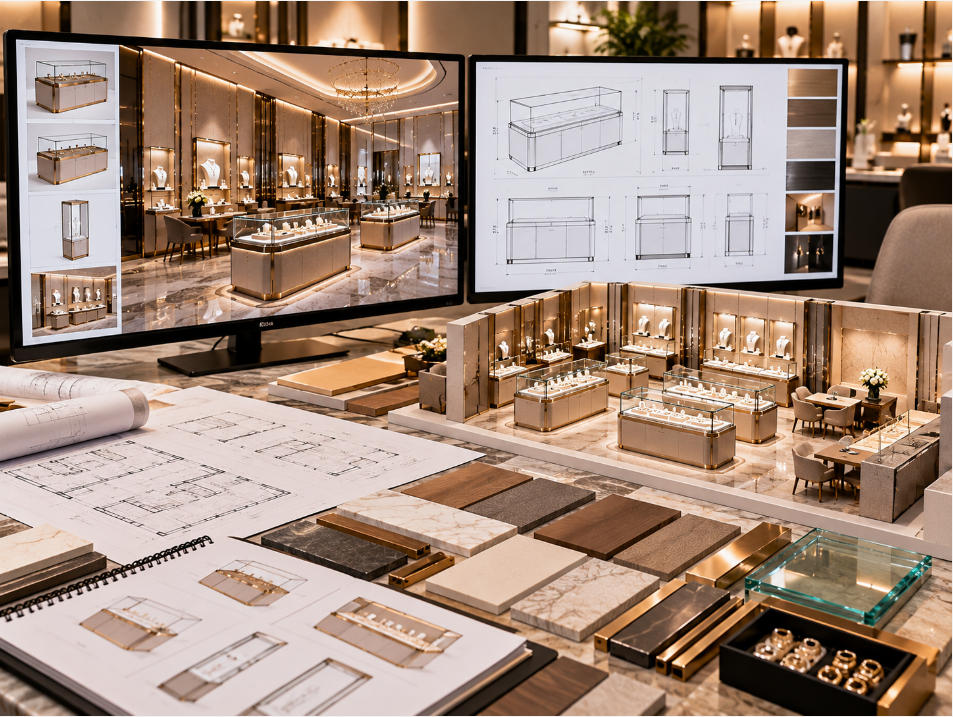
Adapt the Fixture Family Without Redesigning the Brand
Two jewelry stores may share the same retail identity while having very different floor plans. One location may require longer counters, another may need compact wall displays, and a flagship store may introduce additional island or consultation areas.
The rollout system should make these changes within controlled design boundaries. Approved dimensions, materials and construction principles provide the common foundation while selected modules are adjusted for each store.
This is where custom retail fixtures become especially valuable: the program can respond to real store conditions instead of forcing every location into a rigid standard package.
Organize the Store Around a Controlled Family of Fixtures
A rollout package should define the core fixture types that can be selected, repeated or adapted according to the needs of each location.
Customer Display Counters
Core assisted-selling fixtures can be standardized around common glass, lighting, storage and customer interaction requirements.
Wall Display Systems
Wall-mounted and integrated presentation units can be adjusted to different elevations while retaining the same visual language.
Island Fixtures
Freestanding display elements can be selected according to floor area, customer circulation and product presentation priorities.
Feature Showcases
Specialized vitrines can highlight bridal, high jewelry, watches or other priority collections within the wider fixture system.
Consultation Furniture
Tables and supporting furniture can carry the same material language into private selling and customer consultation areas.
Storage & Support
Integrated storage, staff-access components and operational furniture complete the practical store fixture package.
Brands that need a broader fixture system can also review our jewelry store fixtures capabilities for coordinated counters, wall displays, islands and supporting retail elements.
Connect Every Store Opening to One Controlled Production Process
A structured workflow reduces the risk of store-specific changes becoming uncontrolled design changes as the rollout grows.
Standardize
Confirm the approved fixture family, materials, finishes, construction principles and presentation standards.
Adapt
Review each store plan and identify the fixture quantities, dimensions and approved variants required for that location.
Code
Connect store codes, fixture references, quantities and revisions so the rollout can be tracked accurately.
Manufacture
Produce approved fixture families through coordinated material preparation, fabrication, finishing and assembly.
Inspect
Check dimensions, finishes, glass, lighting, hardware and store-specific requirements against controlled references.
Allocate
Pack and identify finished fixtures according to store destination, fixture code and rollout phase.
Choose a Manufacturer That Can Manage the Program, Not Only the Product
Rollout manufacturing introduces a different challenge from producing a single boutique. Drawings, revisions, quantities and production batches need to remain connected as additional locations enter the program.
A jewelry store fixture manufacturer supporting expansion projects should be able to translate the approved fixture family into controlled production references and manage variations without losing the original design direction.
Where the program contains specialist display vitrines, working with experienced jewelry showcase manufacturers also helps coordinate glass, metal structures, lighting, security hardware and presentation interiors.
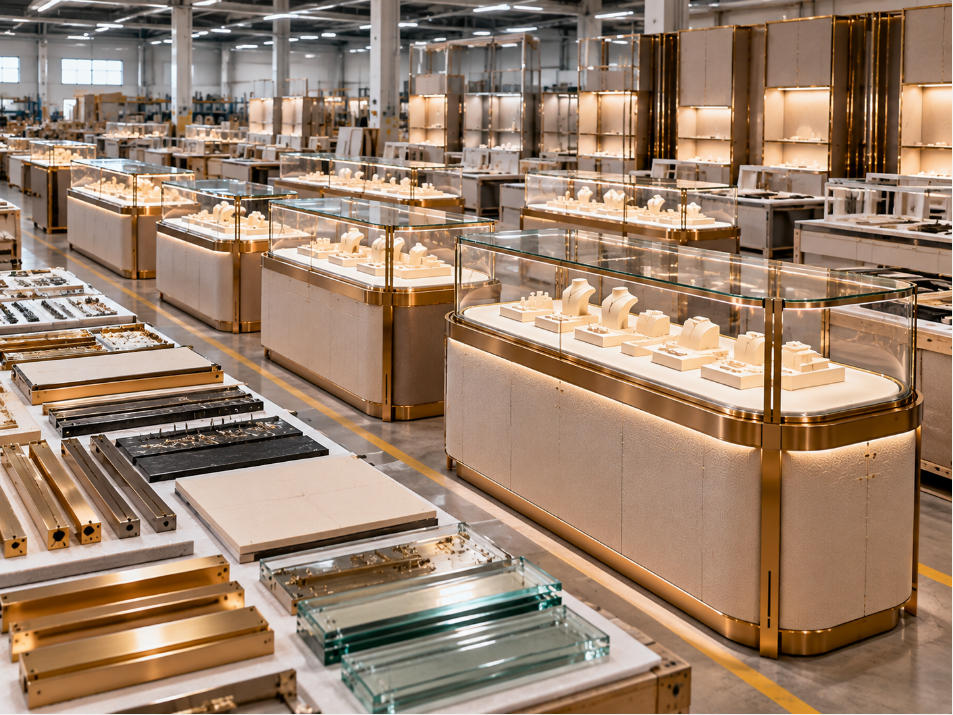
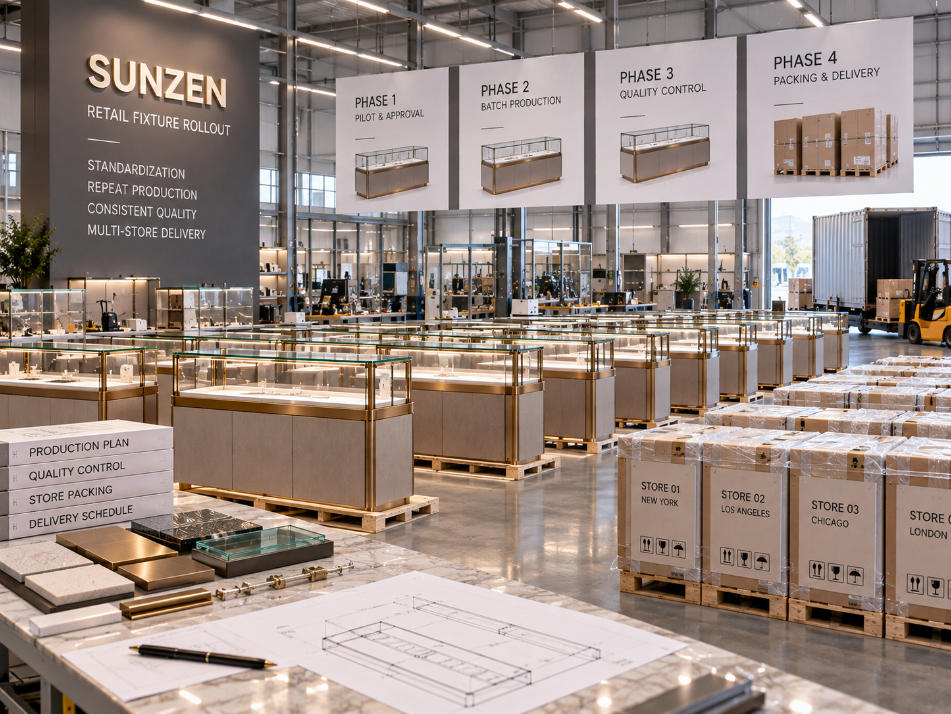
Maintain Fixture Consistency as Production Moves Through Different Batches
A rollout may not be manufactured as one single order. New stores can be released in phases over time, which makes controlled material and production references increasingly important.
SUNZEN coordinates cabinetry, metalwork, glass, finishing, lighting integration and assembly around the approved project references.
For jewelry projects requiring specialized showcase production, our jewelry showcase factory workflow provides a dedicated manufacturing path for custom display units and related fixture families.
Inspect the Fixture and Confirm Where It Belongs
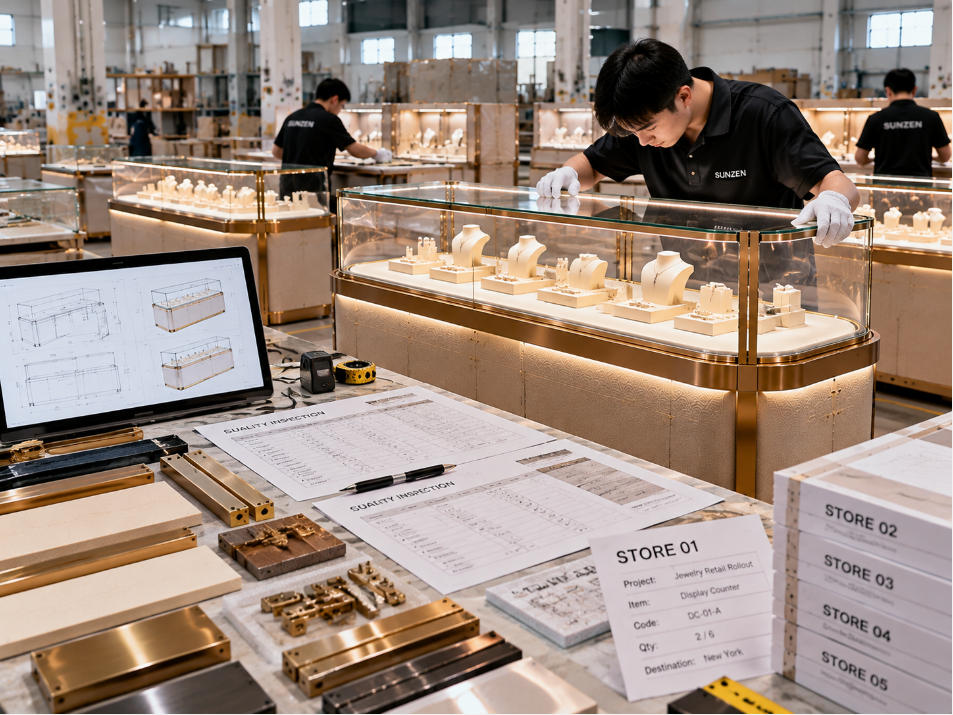
Rollout quality control has two jobs: confirm that the fixture meets the approved standard and confirm that the correct version is being prepared for the correct location.
Inspections can review dimensions, glass, material finishes, lighting, hardware, access and construction details against the approved fixture reference.
Store codes, fixture references, quantities and destination information then help separate similar units and controlled variants before packing.
When a location requires a specialized unit outside the standard family, a custom jewelry display case can be developed around its specific dimensions, security, access or presentation requirements while remaining visually connected to the wider program.
Organize Production Around the Retail Opening Schedule
The final stage of a rollout connects factory output with real store destinations, opening dates and project phases.
Destination Coding
Identify fixtures by store destination so similar units for different locations remain separated.
Reference Control
Match finished units with the correct fixture reference, drawing revision and approved configuration.
Production Sequencing
Organize manufacturing and packing around priority locations and phased store-opening schedules.
Pack by Location
Prepare finished fixture packages according to destination and project requirements for easier site coordination.
For broader programs involving several retail categories or a larger branded network, our retail fixture rollout solution extends the same controlled approach beyond jewelry-specific environments.
Different Stores, One Recognizable Jewelry Brand
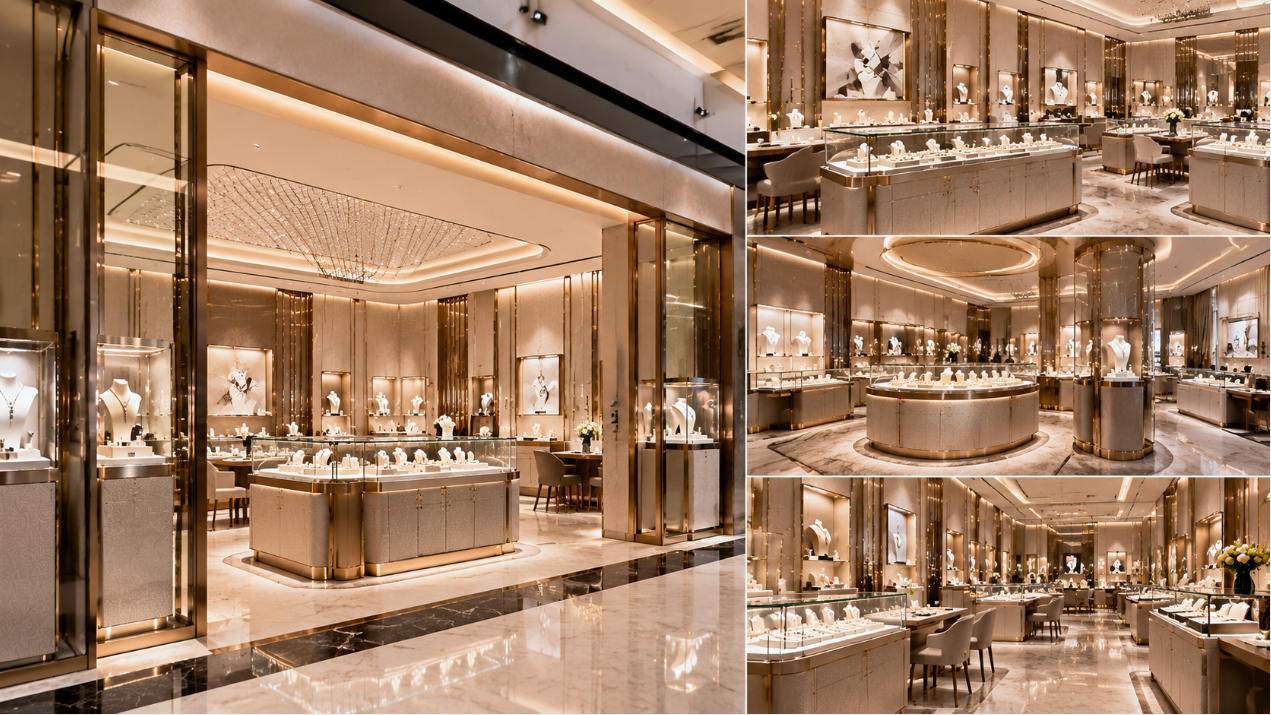
A successful jewelry store fixture rollout does not make every location identical. It creates enough control to make the brand recognizable while giving each store enough flexibility to work within its actual space.
The result is a scalable fixture system that can support ongoing store openings without restarting the complete design and manufacturing process for every new location.
Brands managing significant location-to-location variation can also explore multi location jewelry display cases for a deeper focus on adapting coordinated display cases to different retail environments.
Jewelry Store Fixture Rollout FAQs
Key questions for jewelry brands planning fixture standardization, multi-store production and phased retail expansion.
What is a jewelry store fixture rollout?
A jewelry store fixture rollout is a coordinated program for developing, adapting, manufacturing and delivering approved retail fixtures across multiple jewelry store openings or renovations. It connects common brand standards with the specific requirements of each location.
How is a fixture rollout different from ordering fixtures for one jewelry store?
A single-store project focuses on one location, while a rollout requires controlled fixture references, store-specific quantities, approved variants, production phases and destination information so multiple locations can be managed consistently.
Do all stores in a jewelry fixture rollout need identical fixtures?
No. Core proportions, materials, finishes and presentation standards can remain consistent while selected dimensions and configurations are adapted to different floor plans, store sizes and operational requirements.
What fixtures can be included in a jewelry store rollout program?
A rollout can include jewelry display counters, wall fixtures, island showcases, feature vitrines, consultation furniture, integrated storage and other supporting retail components required by the store concept.
How can fixture consistency be maintained across different production batches?
Consistency can be supported through approved drawings, fixture codes, material and finish references, controlled construction details and quality inspections that remain connected to the original design standard.
Can production be phased according to different jewelry store opening dates?
Yes. Fixture quantities can be organized by store destination and rollout phase so manufacturing, inspection and packing can follow different opening schedules rather than requiring every location to be produced at the same time.
What information is needed to plan a jewelry store fixture rollout?
Useful information includes the approved store concept, fixture drawings or references, individual store layouts, required quantities, material standards, store codes, opening schedules and any location-specific dimensional or operational requirements.
Turn Your Approved Jewelry Store Concept Into a Scalable Fixture Rollout
Share your fixture drawings, store plans, brand standards, quantities and opening schedule with SUNZEN.
We can help organize the fixture family, store-specific variations, manufacturing references, quality control and phased production required for a growing jewelry retail network.

