
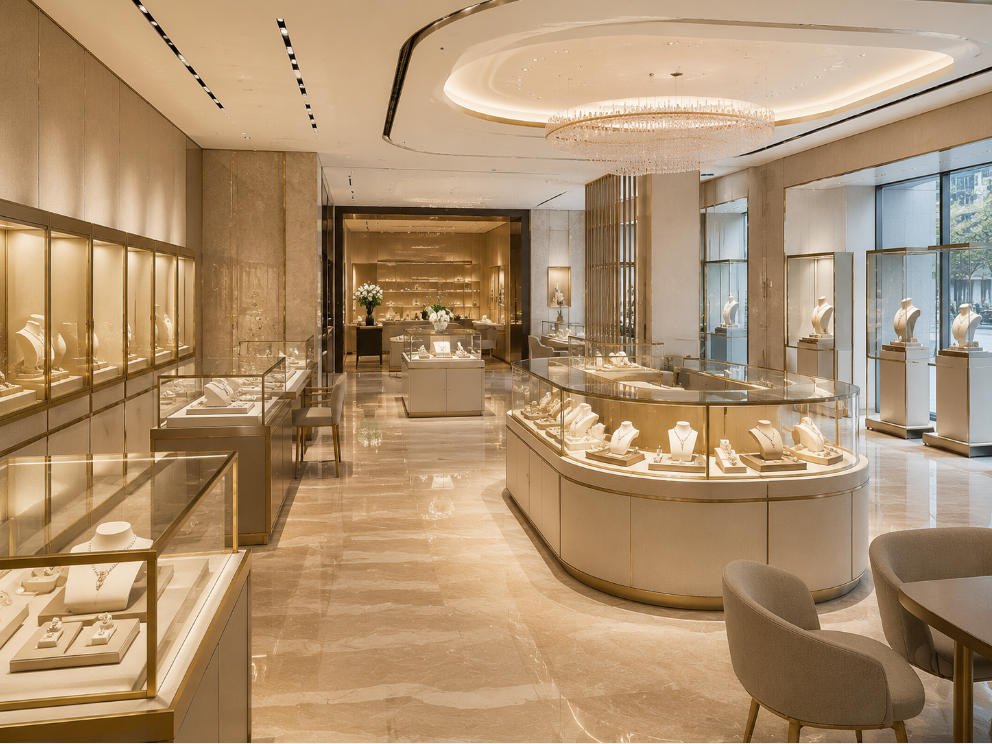
Jewelry Store Design From Initial Concept to Complete Retail Environment
Professional jewelry store design is not simply about selecting attractive display cabinets. A successful jewelry retail environment must coordinate store layout, customer circulation, showcase positioning, lighting, materials, security, brand identity and daily sales operations as one complete system.
SUNZEN develops jewelry stores from early floor-plan planning and visual concepts through 3D rendering, CAD engineering and custom jewelry display case manufacturing. Connecting retail design with production engineering from the beginning helps transform creative concepts into practical, buildable and consistent store environments.
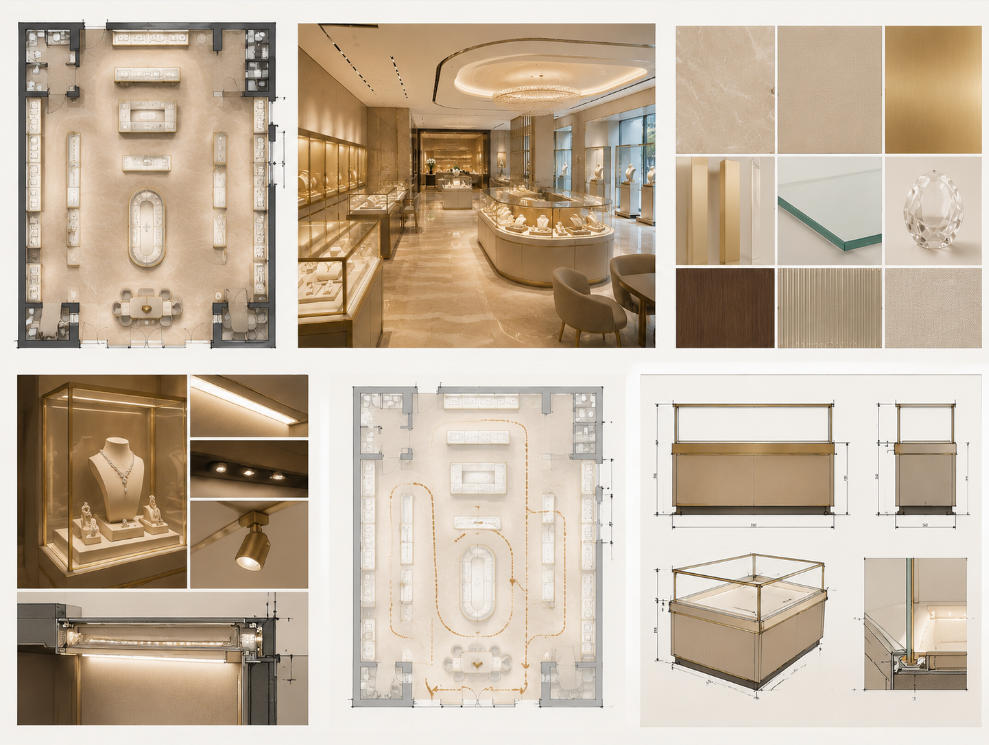
What Is Included in Professional Jewelry Store Design?
Jewelry store design combines interior planning, merchandise presentation and retail functionality. The objective is to create a space where customers can move comfortably, products can be viewed clearly and staff can conduct consultation, sales and security operations efficiently.
Understand the Brand, Products and Commercial Goals Before Drawing the Store
Before developing the floor plan, the design process should define what the retail space must achieve. A bridal jewelry boutique, luxury diamond store, fashion jewelry shop and watch-jewelry concept store may require very different display densities, consultation areas and visual atmospheres.
What Should the Store Feel Like?
Luxury, contemporary, minimalist, classic or fashion-oriented positioning influences the spatial language, materials, lighting and fixture detailing.
What Jewelry Must Be Presented?
Rings, necklaces, diamonds, bracelets, bridal collections and high-value pieces require different display densities, viewing angles and security conditions.
How Will Customers Shop?
Browsing habits, consultation time, appointment-based service and purchase behavior should shape the relationship between open display, assisted selling and private presentation.
Different Store Formats Require Different Design Priorities
Flagship stores, compact boutiques, mall stores, shop-in-shop environments and kiosk formats each operate under different spatial and commercial constraints. The same brand identity can remain recognizable while the fixture architecture changes according to the location.
An enclosed boutique can use architectural walls, controlled entrances and private consultation areas, while an open mall format depends more heavily on furniture, branding and 360-degree visibility. For this reason, the store format should be defined before detailed fixture planning begins.
Build the Jewelry Store Layout Around How Customers Move and Shop
A strong jewelry store layout guides visitors naturally through the space without making circulation feel forced. Displays should create clear visual zones while maintaining comfortable movement and good visibility for both customers and staff.
| Store Zone | Main Function | Typical Fixture Type |
|---|---|---|
| Entrance & Window | Create the first visual impression and highlight key collections | Window showcases and feature displays |
| Central Display Area | Encourage browsing and product discovery | Jewelry island showcases and display tables |
| Perimeter Walls | Organize collections and maximize vertical display capacity | Jewelry wall showcases and upright displays |
| Consultation Zone | Support detailed product presentation and customer interaction | Jewelry counter showcases and consultation furniture |
| Feature Collection Zone | Create visual focus around high-value or signature products | Pedestal, tower and vertical feature showcases |
| Cash & Service Area | Support payment, packaging and staff operations | Cash counters and concealed storage |
The goal is not to make customers follow a route—it is to make the right route feel natural.
Entrance visibility should immediately communicate where the strongest merchandise or brand statement is located. Central fixtures should preserve visual depth, while perimeter displays can increase collection capacity without restricting circulation.
Consultation areas should sit far enough from high-traffic zones to support longer purchasing decisions but remain visually connected to the main retail floor. This transition from browsing to assisted selling is especially important in fine jewelry retail.
Create One Interior Language Across Architecture, Materials and Display Fixtures
Once the layout is established, the project moves into visual development. Materials, colors, fixture forms, ceiling elements, flooring and lighting should work together rather than being designed independently.
Clean & Controlled
Clean geometry, restrained detailing, neutral colors and refined metal accents create a quiet background for high-value jewelry.
Soft & Welcoming
Natural wood, warm stone, soft fabrics and balanced architectural lighting introduce a more comfortable boutique atmosphere.
Precise & Luxurious
Champagne gold, brushed bronze, stainless steel and clear glass can be coordinated as one refined material system.
Dramatic Product Focus
Deep wall tones and controlled illumination create stronger contrast around jewelry and illuminated showcases.
Elegant & Timeless
Decorative paneling, balanced proportions and traditional detailing can support heritage and bridal jewelry brands.
Built Around Identity
Custom colors, logo elements, signature materials and fixture geometry can be developed directly from an existing brand language.
Select Jewelry Showcases According to Their Retail Function
A jewelry store rarely performs well when every display cabinet follows the same format. Different areas of the store require different relationships between merchandise visibility, customer access, staff operation and security.
The objective is to build a coordinated family of showcases that performs different retail tasks while maintaining one consistent design language across the complete store.
Island Showcases
Low-profile island cases support browsing from multiple directions and help preserve open sightlines across the retail floor.
Wall Showcases
Integrated wall systems organize larger collections vertically while keeping valuable floor area available for circulation.
Counter Showcases
Counter displays combine product visibility with secure staff-side access, storage and close customer interaction.
Upright Showcases
Freestanding vertical vitrines create stronger focal points for selected collections while using relatively little floor space.
Pedestal Showcases
Focused single-position displays give signature pieces, diamonds and limited collections greater visual authority.
Window Showcases
Window displays communicate brand positioning and selected merchandise before customers enter the store.
Not Every Showcase Should Demand the Same Level of Attention
Visual hierarchy helps customers understand which merchandise is most important. High-value or signature pieces can be isolated in dedicated feature displays, while broader commercial collections can be presented more efficiently in perimeter or counter systems.
This approach also prevents the store from becoming visually repetitive. Changing fixture height, display density and product grouping creates rhythm while the use of consistent materials and details keeps the complete environment unified.
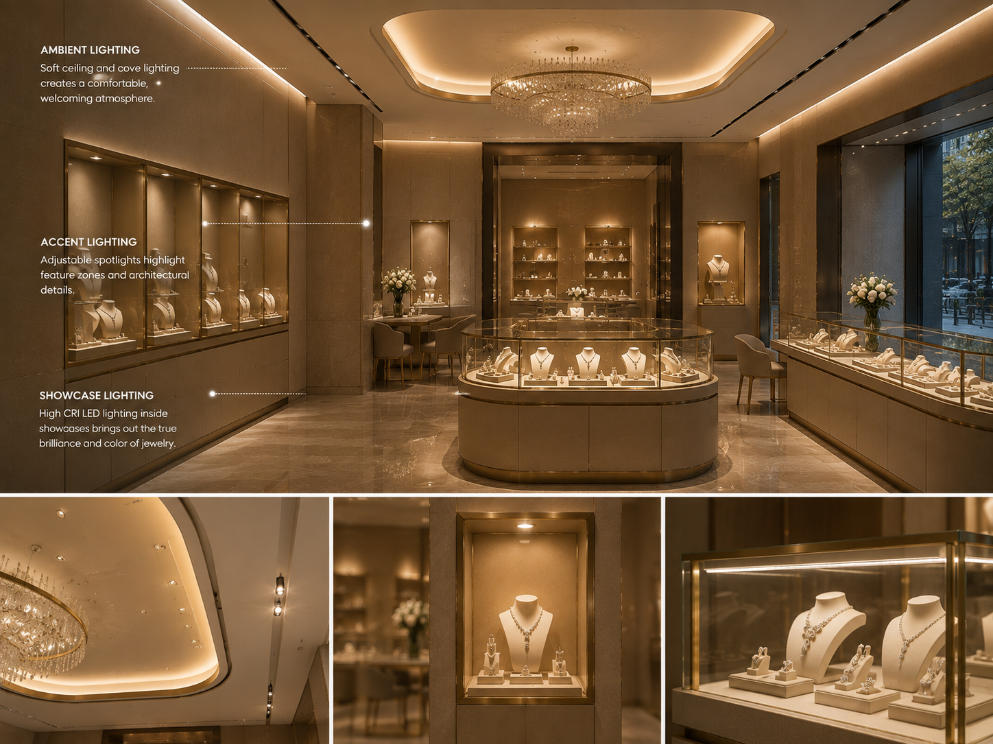
Design the Store Lighting and Showcase Lighting as One System
Jewelry lighting should create visual hierarchy rather than simply making the entire store brighter. Ambient light establishes the atmosphere, architectural light gives depth to the interior and integrated showcase lighting provides the final emphasis around the merchandise.
Different Jewelry Categories Need Different Lighting Priorities
Brilliance & Sparkle
Controlled directional highlights can emphasize brilliance while the surrounding lighting remains balanced enough for comfortable viewing.
Color Accuracy
High-quality light sources help preserve natural gemstone colors and reduce misleading color shifts during product evaluation.
Surface & Tone
Gold, platinum and polished metal surfaces benefit from lighting that reveals texture and finish without producing excessive glare.
Good jewelry lighting depends on the cabinet geometry around it.
Integrated lighting should be considered before the showcase structure is finalized. Glass height, frame position, LED channel location and customer viewing angle all influence how light reaches the jewelry and where reflections appear.
Drivers, wiring and access panels should remain concealed from customers while still being accessible for maintenance. Resolving these details during engineering produces a cleaner finished fixture and reduces changes during installation.
Use 3D Renderings to Evaluate the Store Before Manufacturing Begins
Once the layout, showcase system and visual direction are established, 3D visualization allows the complete retail environment to be reviewed before production.
Renderings help evaluate fixture proportions, material combinations, lighting atmosphere, circulation, sightlines and brand presentation. They also provide a clearer communication tool between the retailer, designer and manufacturing team.
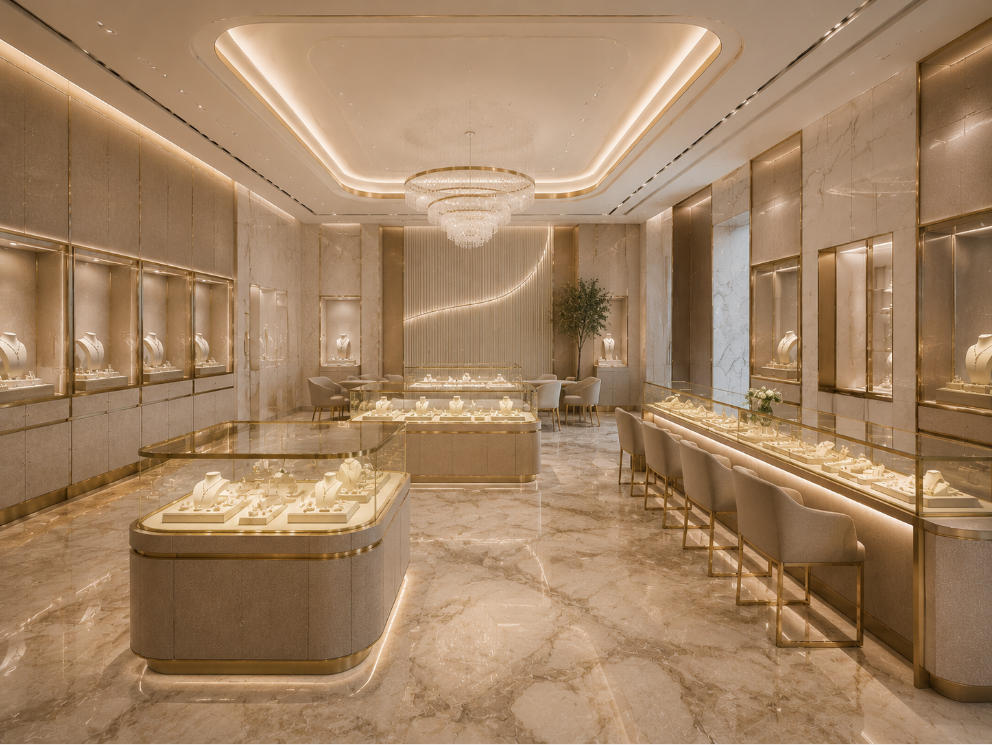
Turn the Approved Store Design Into Production-Ready Details
A visual rendering communicates the design intention, but manufacturing requires a different level of information. Showcase dimensions, materials, glass construction, doors, drawers, locks, lighting channels and installation details must be translated into technical drawings.
Construction Details
Define cabinet structures, metal frames, glass assemblies, internal panels and connection methods.
Functional Details
Resolve drawers, hinges, locks, sliding systems, staff access and concealed storage.
Electrical Details
Coordinate LED profiles, cable routing, drivers, switches and maintenance access.
Create a Consistent Material Language Across the Complete Jewelry Store
Material selection should be considered at store level rather than cabinet by cabinet. Repeating a controlled family of finishes helps wall showcases, islands, counters and architectural elements feel like parts of one complete retail environment.
Glass
Clear and low-iron glass supports product visibility and refined presentation.
Metal
Stainless steel, champagne, bronze and other finishes provide structural and decorative detailing.
Wood
Natural veneer and engineered wood finishes introduce warmth and architectural continuity.
Stone
Natural or engineered stone can create visual weight at counters, bases and feature areas.
Soft Finish
Leather, velvet and fabric provide controlled backgrounds around jewelry and consultation surfaces.
Choose Materials for Appearance, Durability and Production Consistency
A material that looks attractive in a rendering must also perform under daily retail use. Counter surfaces are touched repeatedly, metal finishes must remain consistent across multiple fixture types and showcase interiors need to tolerate frequent merchandise changes.
For multi-store projects, repeatability becomes especially important. Approved samples and finish standards help ensure that fixtures manufactured at different stages maintain a consistent visual identity.
Integrate Security Without Making the Jewelry Store Feel Defensive
Fine jewelry retail requires controlled access and secure storage, but visible security hardware should not dominate the customer experience. Locks, glass specifications, staff-side access and concealed storage should therefore be integrated into the showcase architecture.
Controlled Product Access
Opening systems and locks should give staff practical access while maintaining secure product presentation.
Efficient Daily Selling
Drawers, trays and stock storage should remain close to consultation areas without interfering with customer circulation.
Serviceable Components
Lighting, electrical systems and hardware should remain accessible for maintenance after the store is installed.
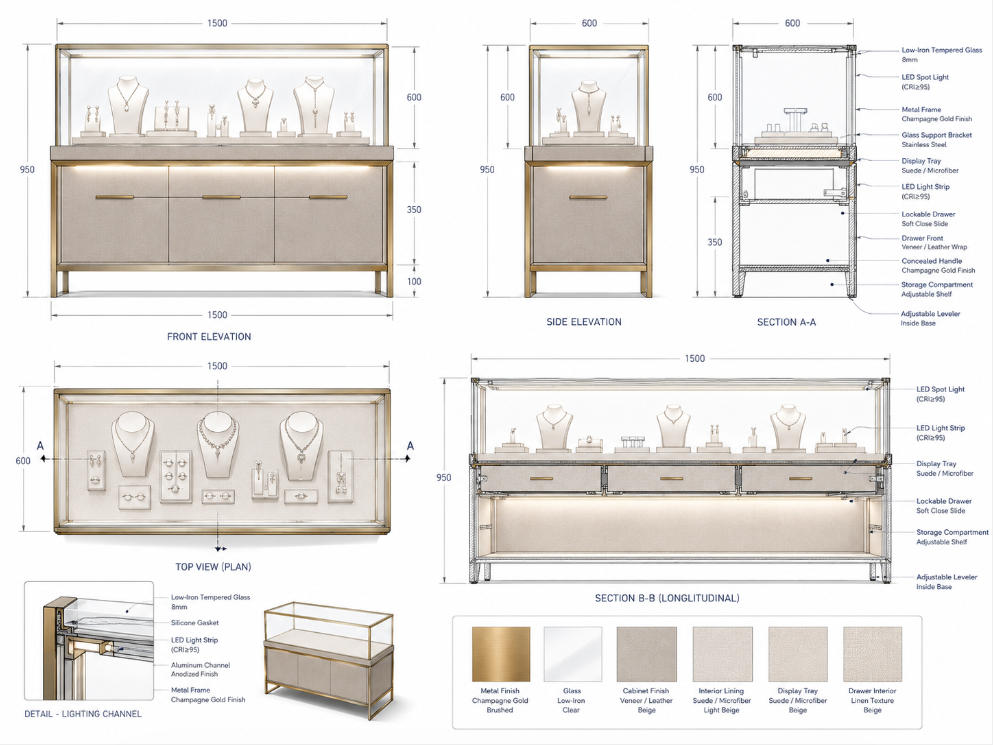
Connect Jewelry Store Design With Custom Showcase Manufacturing
One of the most important transitions in a jewelry store project happens between approved design and physical production. Attractive renderings must be converted into structures that can be manufactured accurately, transported efficiently and installed correctly on site.
SUNZEN’s custom showcase connect design development with engineering and manufacturing, allowing glass, metal, cabinetry, lighting, hardware and finishes to be coordinated across the complete fixture package.
Why Connect the Designer and Showcase Manufacturer Early?
Better Feasibility
Potential structural, material and installation issues can be identified before the design reaches production.
Better Consistency
Different showcase types can share the same metal tones, glass details, lighting language and construction quality.
Better Cost Control
Engineering decisions can be reviewed before production rather than corrected after fixtures have already been manufactured.
Better Installation
Module sizes, electrical connections, wall conditions and site access can be considered during technical development.
Better Operation
Storage, locks, drawers and staff access remain part of the design instead of becoming last-minute additions.
Better Brand Control
The visual language approved during design is more likely to remain consistent in the completed physical store.
Adapt the Jewelry Store Design to the Size and Commercial Model
A successful jewelry store concept should not simply be enlarged or reduced to fit different locations. Store size, merchandise volume, customer service model and available frontage all change the way display fixtures and circulation should be organized.
Maximize Space Without Creating Visual Clutter
Compact stores benefit from integrated wall displays, lower central fixtures, efficient concealed storage and carefully controlled circulation.
Priority: useful merchandising capacity with an open visual environment.
Balance Browsing With Assisted Selling
Medium-sized stores can combine central product discovery, perimeter collections, feature displays and dedicated consultation areas.
Priority: clear zoning and a natural transition from browsing to consultation.
Create Multiple Levels of Customer Experience
Larger stores can support stronger architectural features, dedicated collections, private consultation areas, VIP rooms and signature display installations.
Priority: brand experience, hierarchy and premium clienteling.
Flagship Stores and Multi-Store Programs Require Different Development Strategies
Flagship Jewelry Store
A flagship location can use highly customized architectural elements, special showcase structures and unique material combinations to express the strongest version of the brand.
Best suited to: signature interiors, VIP environments, hero displays and project-specific fixture engineering.
Multi-Store Rollout
A rollout program requires a more standardized fixture system that can maintain brand consistency while adapting to different store dimensions and local conditions.
Best suited to: repeatable showcase families, controlled material specifications and modular design variations.
From Initial Brief to Complete Jewelry Store Production
A structured workflow helps connect creative decisions with technical development and manufacturing. Each stage should resolve enough information for the next stage to proceed without unnecessary redesign.
What Information Helps Start a Jewelry Store Design Project?
A complete design brief is useful, but a project does not need to be fully developed before discussion begins. Existing information can be reviewed first and the missing design or engineering details can then be developed progressively.
Connect Jewelry Store Design, Engineering and Manufacturing
The value of an integrated jewelry store project is not simply that one supplier performs several tasks. The real advantage is continuity between the decisions made during design and the details ultimately manufactured in the factory.
Retail-Oriented Layout
Fixture positions are considered together with circulation, merchandise zoning, consultation and daily staff operation.
Coordinated Visual Language
Architecture, showcases, materials and lighting are developed as one retail environment rather than unrelated design elements.
Production-Ready Details
Approved concepts are translated into practical structures, dimensions, opening systems, lighting details and material specifications.
Finish Consistency
Glass, metal, wood, stone and soft finishes can be coordinated across different fixture families.
Complete Fixture Production
Different display types can be manufactured as one coordinated store package rather than sourced as unrelated cabinets.
Project-Level Inspection
Dimensions, finishes, lighting, hardware and assembly can be reviewed against approved project requirements before delivery.
Different Projects Need Different Levels of Design Development
This jewelry store design guide provides the overall framework—from brand strategy and layout through showcase engineering and manufacturing. More specialized projects can then move into deeper planning according to store positioning and design requirements.
Interior Design & Display Integration
For projects requiring deeper coordination between interior architecture, spatial hierarchy and display systems, explore our jewelry store interior design and display solutions.
Boutique Layout & Lighting
For detailed guidance on customer circulation, retail zoning, fixture selection and product illumination, see our jewelry boutique design, layout and lighting guide.
Luxury Store & Bespoke Showcases
For flagship and high-end projects focused on premium materials, clienteling and bespoke fixture engineering, explore our luxury jewelry store design and custom showcase solutions.
Choose the Right Design Resource for Your Project
| Resource | Main Focus | Best For |
|---|---|---|
| Jewelry Store Design | Complete process from planning to manufacturing | Buyers starting a new jewelry store project |
| Jewelry Store Interior Design & Display Solutions | Interior architecture, spatial hierarchy and display integration | Complete store interior development |
| Jewelry Boutique Design | Layout, circulation, lighting and fixture selection | Boutiques requiring detailed retail planning |
| Luxury Jewelry Store Design | Premium materials, luxury clienteling and bespoke showcases | Flagship and high-end jewelry environments |
See How Jewelry Display Concepts Are Applied in Real Projects
Design principles become more useful when viewed alongside completed retail environments. Store size, merchandise positioning, fixture combinations and material choices vary from project to project, but the same fundamental relationship between design and manufacturing remains.
Explore SUNZEN’s jewelry showcase projects for examples of custom display systems and completed jewelry retail applications.
Design the Store as One System From the Beginning
Jewelry store design works best when layout, customer flow, interior style, lighting, showcases, security and manufacturing are considered together. Decisions made in one area inevitably influence the others.
For retailers, designers and jewelry brands, integrating these disciplines early creates a clearer path from initial concept to a finished store that supports merchandise presentation, customer experience and daily operation.
Jewelry Store Design FAQs
Q1 What is included in jewelry store design?
Jewelry store design can include space planning, customer flow, showcase layout, interior style, lighting, materials, 3D visualization, fixture engineering and coordination with manufacturing requirements.
Q2 What is the first step in designing a jewelry store?
The first step is usually to understand the store dimensions, brand positioning, jewelry categories, target customers, operational requirements and overall project objectives.
Q3 How should jewelry showcases be arranged in a store?
Showcases should follow customer circulation and merchandising priorities. Wall displays, islands, counters, feature displays and window showcases can be combined according to the store layout.
Q4 Why is 3D rendering important for jewelry store design?
3D visualization helps review fixture positions, proportions, colors, materials, lighting and overall space relationships before production begins.
Q5 Are CAD drawings necessary for custom jewelry showcases?
Detailed engineering drawings are important for custom manufacturing because they define dimensions, structures, materials, glass, hardware, lighting and installation details.
Q6 What materials are suitable for luxury jewelry stores?
Common materials include low-iron glass, stainless steel, aluminum, wood veneer, lacquer, natural or engineered stone, velvet, fabric and leather. Final selections should match the brand concept and project requirements.
Q7 How important is lighting in a jewelry store?
Lighting is essential because it affects product visibility, gemstone brilliance, color perception and the overall atmosphere of the store. Ambient, accent and showcase lighting should be planned together.
Q8 Can a jewelry store be designed around an existing brand identity?
Yes. Store colors, material finishes, logo elements, fixture geometry and visual details can be developed around an existing brand guideline.
Q9 Can existing architectural drawings be used for the design?
Yes. Floor plans, elevations, CAD drawings, site measurements and architectural models can provide the starting point for retail layout and fixture development.
Q10 Can one supplier coordinate the complete fixture package?
A coordinated fixture manufacturer can develop wall showcases, island cases, counters, feature displays and other store furniture according to one approved material and design system.
Q11 How should a small jewelry store be designed?
Small stores usually benefit from careful use of wall displays, compact islands, controlled fixture depth, clear circulation and a limited number of strong visual focal points.
Q12 What makes a luxury jewelry store design successful?
A successful luxury jewelry store balances product visibility, comfortable customer interaction, brand identity, material quality, precise detailing, appropriate lighting and practical staff operations.

