
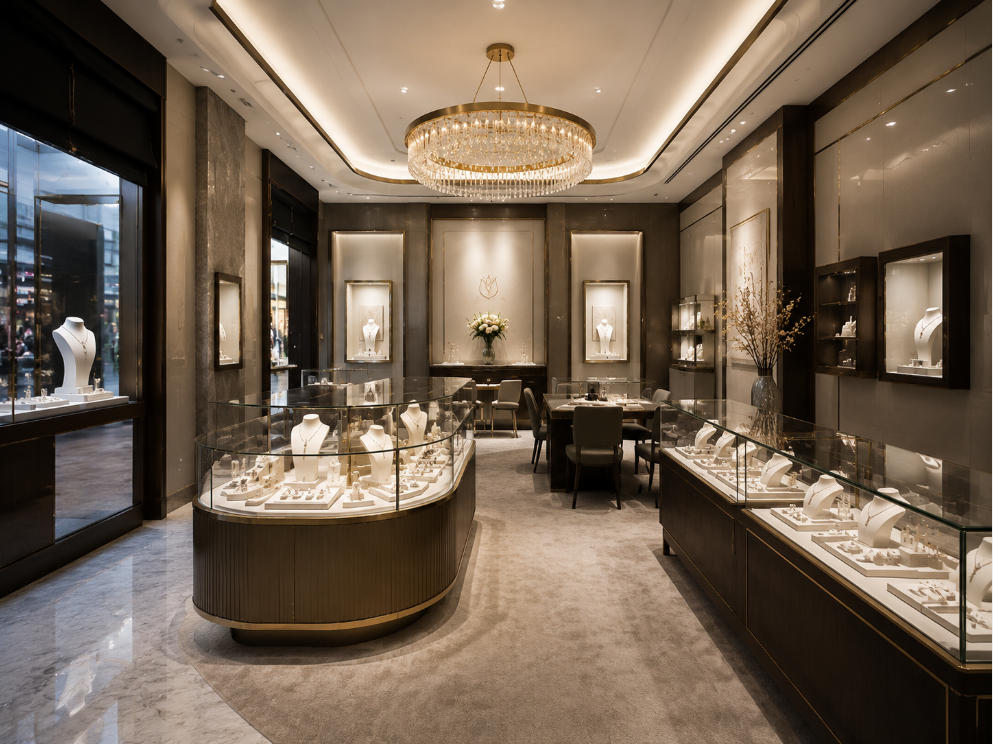
Jewelry Store Interior Designed Around How Customers See, Move and Buy
High-end jewelry retail requires more than attractive decoration. Interior architecture, showcase placement, sightlines, lighting, security and merchandising must operate as one connected system.
SUNZEN combines interior design thinking with custom jewelry display cases, engineering and manufacturing, helping jewelry retailers translate brand identity into spaces that are visually refined, commercially practical and ready for production.
Interior design is the framework; display is the retail engine.
A successful jewelry interior should make the architecture feel quiet while making the merchandise feel important.
Customers rarely evaluate a store as separate components. They experience the entrance, lighting, displays, materials and staff interaction as one continuous environment. For this reason, jewelry display planning should begin at the same time as the interior concept rather than after architectural finishes have already been selected.
For SUNZEN, this integrated approach is especially important because the design must eventually become manufacturable furniture. As a custom display fixture manufacturer, we consider structural logic, glass, lighting channels, access, storage and installation while the visual concept is still being refined.
Four Principles That Connect Interior Design With Jewelry Display
Make Important Merchandise Easy to Discover
Display position, fixture height and lighting should establish clear visual priorities without overwhelming the customer.
Guide Customers Without Creating a Forced Route
Circulation should feel intuitive while allowing customers to move naturally between discovery, comparison and consultation.
Support Browsing, Consultation and Purchase
Different stages of the buying journey require different relationships between customers, staff and display fixtures.
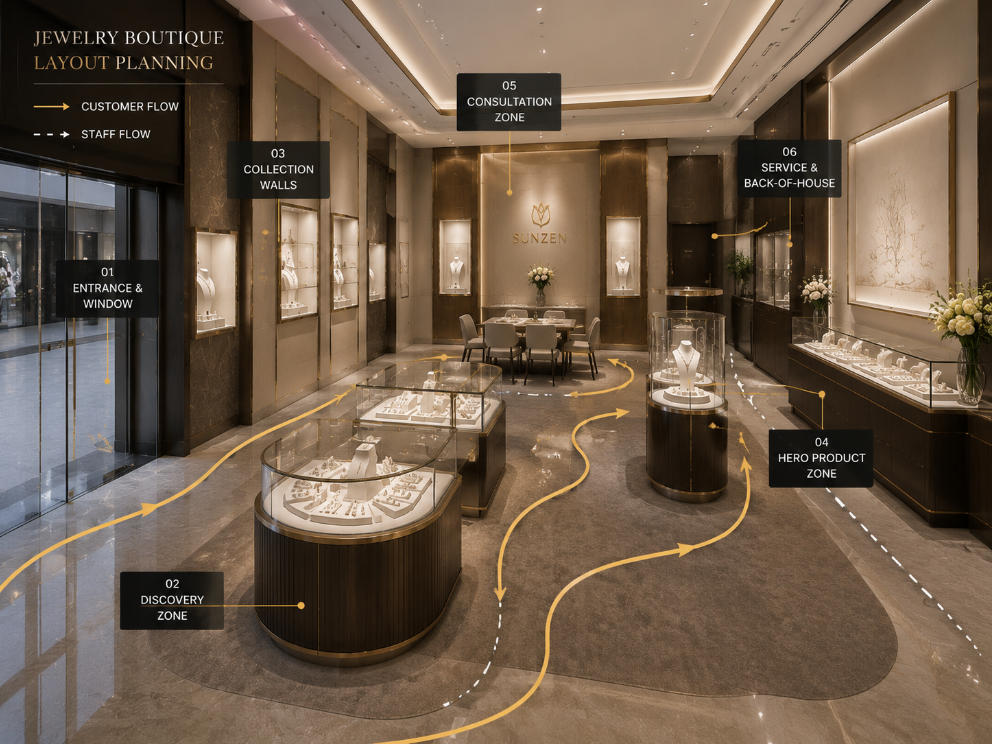
Design the Store as a Sequence of Visual Priorities
Not every square meter should demand equal attention. Premium interiors use hierarchy to decide what visitors should notice first, what they discover next and where deeper product interaction happens.
Six Interior Zones That Shape the Jewelry Shopping Experience
Instead of filling a store with display cases first and solving circulation later, each zone should be given a clear commercial role.
Threshold & Window
The transition from mall or street into the brand environment. Window displays should communicate product positioning before customers enter.
Discovery Zone
Central islands or low display tables encourage natural browsing without immediately requiring staff assistance.
Collection Walls
Vertical showcases create category structure and help the customer understand the breadth of the collection.
Hero Product Zone
A carefully isolated display area gives rare, high-value or signature pieces stronger visual authority.
Consultation Zone
Comfort, privacy, appropriate lighting and controlled product access become more important than display density.
Service & Back-of-House
Payment, stock access, packaging and staff circulation should function efficiently while remaining visually discreet.
The Window Should Introduce the Interior, Not Compete With It
The best jewelry storefronts create visual continuity between exterior attraction and interior experience. Materials, display heights and lighting seen through the window should provide a preview of the brand environment inside.
A custom jewelry window showcase can coordinate transparent glass, concealed lighting, security, rear access and architectural detailing with the wider store concept.
For luxury stores, restraint is often more effective than filling the window with merchandise. A limited number of products with stronger visual spacing can communicate exclusivity more clearly.
Match the Display Type to the Customer Interaction
A showcase should be selected according to how the customer encounters the product—not simply according to available floor space.
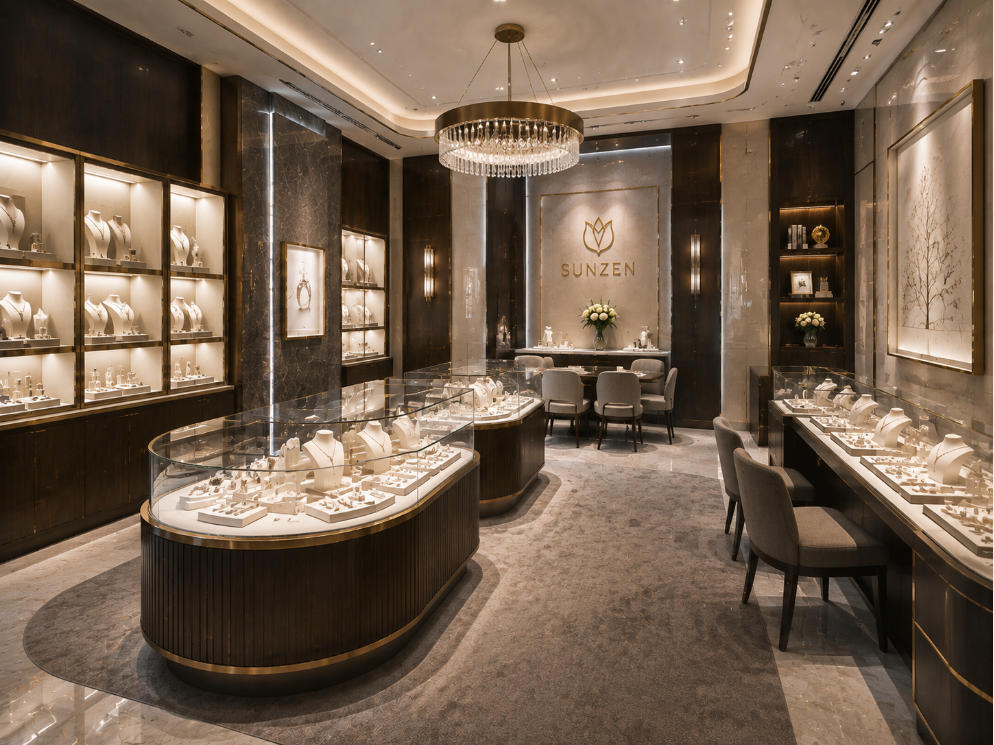
Control Sightlines Before Adding More Fixtures
Entrance Visibility
A customer standing outside the store should be able to understand the interior hierarchy without seeing every product at once.
Open Visual Depth
Lower central fixtures preserve views toward rear focal points and prevent smaller stores from feeling compressed.
Controlled Discovery
Some collections should reveal themselves gradually as customers move deeper into the store, creating a richer browsing experience.
Luxury Is Often Created by What You Choose Not to Display
Display density has a direct effect on perceived value. High-end jewelry stores generally benefit from stronger spacing between products, clearer category boundaries and fewer competing visual messages.
However, low density does not mean low commercial efficiency. The interior can use concealed stock storage, interchangeable trays and flexible display decks so staff can adapt assortments without redesigning the fixture.
Visual Breathing Space
Allow sufficient space around high-value and signature pieces.
Collection Hierarchy
Separate hero products from higher-volume merchandise groups.
Coordinated Heights
Keep adjacent display heights visually connected across the interior.
Build a Material System Instead of Selecting Finishes One by One
Luxury interiors feel coherent when materials repeat with controlled variation. A metal finish may appear on showcase frames, door details and architectural trims; the same stone family may connect counters with wall elements; soft interior linings can repeat brand colors without dominating the space.
Glass
Clarity, reflection control, safety and frame integration.
Metal
Brushed, polished or plated finishes used as precise visual accents.
Wood
Warmth, acoustic softness and architectural continuity.
Stone
Visual weight and premium tactile character for counters and bases.
Soft Finish
Velvet, leather or fabric used close to the jewelry itself.
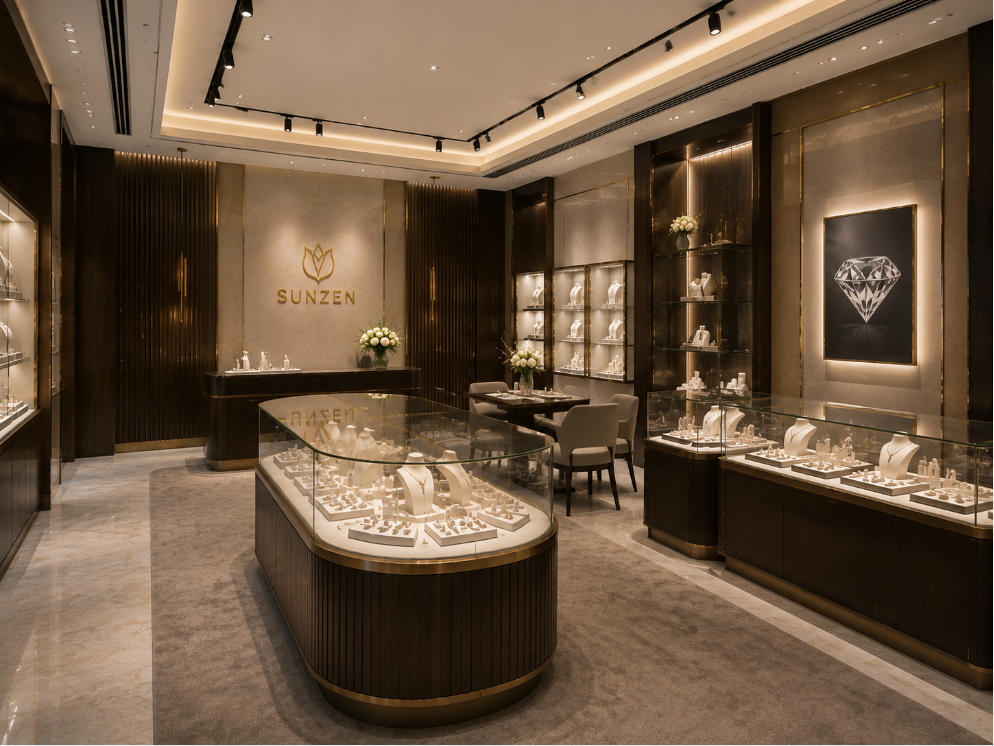
Make the Store Comfortable, Then Make the Jewelry Brilliant
Jewelry lighting is most effective when it creates contrast. If every surface is equally bright, the merchandise loses visual priority.
The engineering of the fixture matters because LED channels, drivers, ventilation and maintenance access should be resolved before the showcase enters production.
Design Different Interior Conditions for Different Buying Behaviors
| Customer Behavior | Interior Requirement | Recommended Display Approach | Design Priority |
|---|---|---|---|
| Quick Browsing | Open circulation and immediate visibility | Low islands and accessible perimeter displays | Discovery |
| Collection Comparison | Clear category organization | Wall systems and coordinated counters | Navigation |
| High-Value Purchase | Privacy and longer interaction time | Consultation counter with controlled display access | Trust |
| Hero Product Viewing | Focused attention with reduced visual noise | Pedestal or isolated feature vitrine | Exclusivity |
| Brand Discovery | Strong architectural identity | Feature wall, window and curated display sequence | Brand Memory |
Security Should Be Strong Without Making the Store Feel Defensive
High-value retail requires controlled access, secure storage and carefully engineered display enclosures. The challenge is to integrate these functions without introducing unnecessary visual heaviness.
Locks, sliding systems, concealed drawers, staff-side access and secure glass configurations should therefore be coordinated during fixture engineering rather than added after the interior design is complete.
The same principle applies to wiring, ventilation, maintenance access and stock storage: technical functions should remain easy for staff to use while staying visually discreet to the customer.
Product Category Changes the Fixture Logic
Luxury retail fixtures should never be designed with a universal cabinet formula. Merchandise size, customer interaction, replenishment frequency and security requirements change significantly between industries.
Jewelry
Requires controlled access, close viewing, precise lighting and a high degree of visual refinement around small products.
Fashion & Footwear
Products are larger and interaction is more open, so systems such as shoe display fixtures rely more on flexible shelving, vertical merchandising and faster product handling.
Beauty & Salon Retail
High SKU density, replenishment and product accessibility make hair display fixtures structurally different from secure fine-jewelry vitrines.
Interior Solutions Must Change With the Store Format
An enclosed boutique can use walls, ceiling architecture and controlled entrances to shape the experience. An open mall environment must communicate the same brand identity through furniture alone.
This is why compact mall kiosk fixtures typically require 360-degree presentation, clear perimeter access, integrated storage and stronger fixture-level branding.
Understanding these differences allows the same jewelry brand to maintain recognizable visual identity across flagship stores, standard boutiques, shop-in-shop locations and mall formats without forcing identical layouts into very different spaces.
Luxury Interior Concepts Must Survive the Transition to Production
A store rendering can look elegant while still containing details that are difficult to manufacture, install or maintain. Manufacturer involvement helps identify these issues before production.
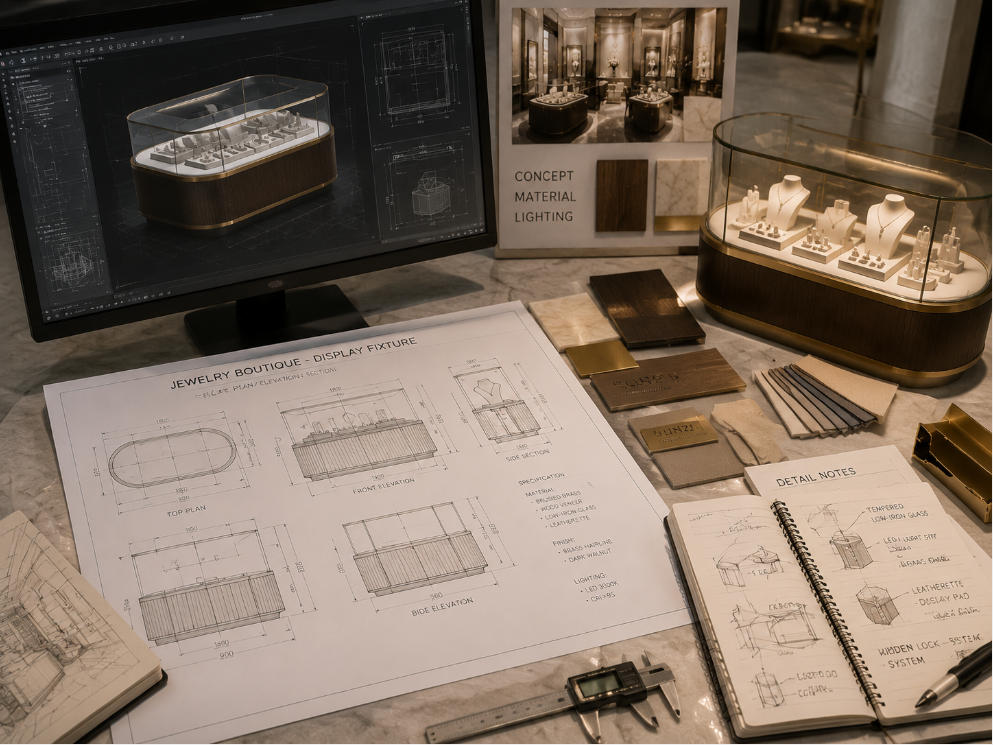
What Should Be Resolved Before Fixture Production?
| Design Item | Interior Question | Manufacturing Question |
|---|---|---|
| Fixture Size | Does it preserve comfortable circulation? | Can it pass through access points and be installed efficiently? |
| Glass | Does it maintain transparency and visual lightness? | What structure, thickness and opening method are required? |
| Metal Finish | Does the tone support the brand palette? | Can the same finish remain consistent across all fixtures? |
| Lighting | Does it create the intended visual hierarchy? | Where are drivers, channels and maintenance access located? |
| Storage | Is it visually concealed? | Is there enough practical internal capacity and hardware clearance? |
| Installation | Does the fixture integrate cleanly with walls and floors? | How will modules connect, level and receive electrical supply? |
From Interior Intent to a Manufacturable Display System
Why Interior Designers and Jewelry Retailers Work With a Fixture Manufacturer Early
Design Feasibility
Visual ideas can be reviewed against real material, structural and production limitations before final approval.
Fixture Consistency
Wall cases, islands, counters and feature displays can share controlled materials and detailing.
Engineering Continuity
CAD development connects the approved interior concept directly with factory production requirements.
Material Coordination
Glass, metal, wood, stone and soft finishes are reviewed as one complete specification system.
Operational Detail
Storage, locks, staff access, electrical systems and maintenance remain part of the design discussion.
Full-Store Manufacturing
A coordinated manufacturer can produce multiple fixture families while preserving one consistent retail identity.
See how these principles are translated into completed retail environments in our jewelry showcase projects.
Jewelry Store Interior Design & Display Solutions FAQs
What is the difference between jewelry store interior design and jewelry showcase design?
Interior design addresses the entire retail environment, including space planning, architectural finishes, lighting, customer circulation and atmosphere. Showcase design focuses on the furniture and display systems used to present, secure and store merchandise. The strongest projects coordinate both disciplines from the beginning.
How should a jewelry store be divided into display zones?
Typical zones include storefront attraction, central browsing, perimeter collections, feature products, consultation, payment and back-of-house operations. The exact balance depends on store size, merchandise mix and service model.
Should jewelry display cases all have the same height?
No. Different heights can create useful visual hierarchy, but adjacent fixtures should still feel coordinated. Lower central fixtures often preserve sightlines, while taller perimeter or feature displays can provide stronger visual emphasis.
How much merchandise should be displayed in a luxury jewelry store?
There is no universal quantity. Premium environments often use lower display density and stronger spacing around important pieces, while higher-volume collections can be grouped more efficiently in secondary zones.
Why should fixture manufacturing be considered during interior design?
Early manufacturing input helps ensure that dimensions, glass, opening systems, materials, lighting, storage and installation details can be produced reliably without weakening the approved visual concept.
Can an existing jewelry brand guideline be translated into store fixtures?
Yes. Brand colors, metal tones, geometry, logo elements, material language and lighting character can be translated into a coordinated family of display fixtures and architectural details.
What materials are commonly used in high-end jewelry interiors?
Projects may combine low-iron glass, stainless steel or aluminum, natural veneer, lacquer, stone, marble, leather, fabric and premium lighting components. The final palette should support both brand identity and daily commercial use.
How can a small jewelry store feel more luxurious?
Prioritize clear sightlines, fewer but stronger focal points, controlled display density, integrated storage, consistent materials and layered lighting rather than filling the space with additional cabinets.
How should security be integrated into luxury jewelry store design?
Security should be planned through showcase structures, locks, controlled staff access, secure storage and appropriate glass configurations while keeping visible hardware and operational elements as discreet as possible.
Can the same jewelry store concept be adapted for a mall kiosk?
Yes, but the fixture architecture must change. A kiosk depends more heavily on 360-degree visibility, compact storage, fixture-level branding and open customer circulation because it does not have conventional walls or a controlled entrance.
Can SUNZEN manufacture fixtures from an interior designer’s existing concept?
Yes. Interior drawings, 3D renderings, material references and fixture concepts can be developed further into production-ready CAD details and custom fixture specifications according to project requirements.
What makes a jewelry display solution successful?
A successful display solution balances product visibility, brand expression, customer interaction, security, lighting, staff operation and manufacturing feasibility rather than optimizing only one of these factors.

