
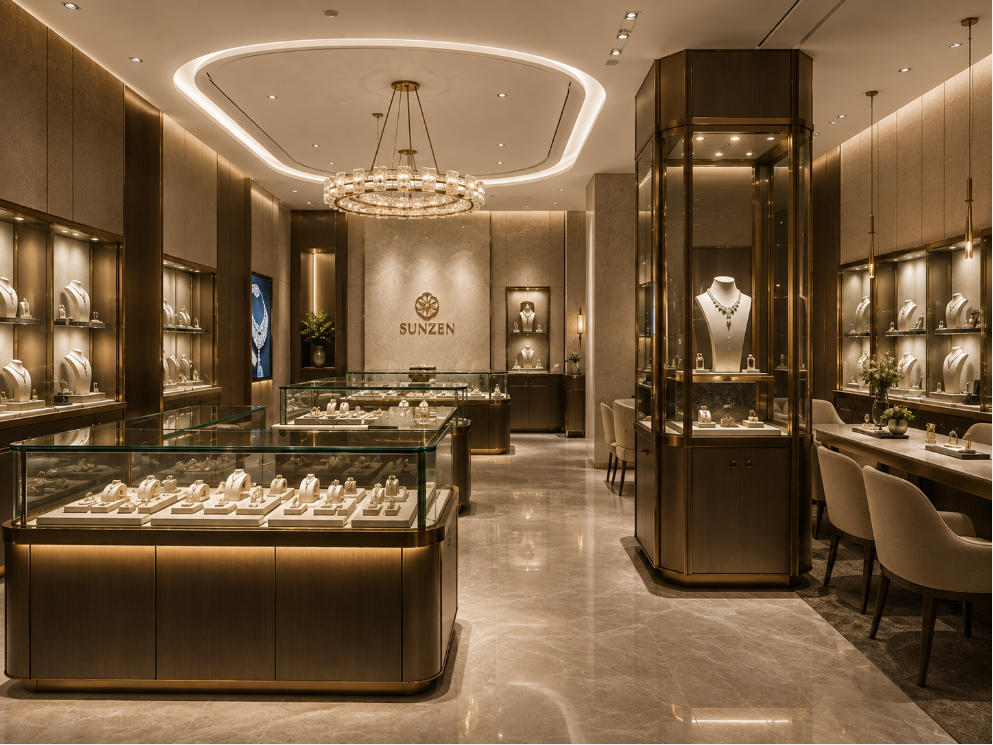
Jewelry Boutique Design Built Around How Customers See, Move and Buy
Effective jewelry boutique design combines spatial planning, product presentation and daily retail operation. The boutique should guide customers naturally, make jewelry visually compelling and give staff practical control over presentation, storage and security.
SUNZEN connects boutique planning with custom jewelry display cases, lighting integration, material selection and production engineering so the finished environment can move smoothly from design intent to manufacturing.
Layout, lighting and showcases should be developed as one retail system—not as three independent design decisions.
A jewelry boutique layout determines where customers enter, pause, browse and interact with staff. Showcase dimensions then affect sightlines and circulation, while lighting determines what attracts attention and how accurately customers perceive diamonds, colored stones and precious metals.
When these elements are developed separately, stores can suffer from blocked views, oversized counters, unwanted glass reflections or poor staff access. Coordinating them early creates a more refined customer experience and a more practical manufacturing plan.
Three Questions to Answer Before Planning a Jewelry Boutique
How Should Customers Shop?
Open browsing, assisted selling, appointment-based consultation and VIP service each require different spatial relationships.
What Must the Boutique Display?
Rings, necklaces, bridal collections, watches and high-value signature pieces require different viewing angles and display densities.
How Will Staff Operate?
Showcase access, secure stock, replenishment, consultation and checkout should influence the floor plan from the beginning.
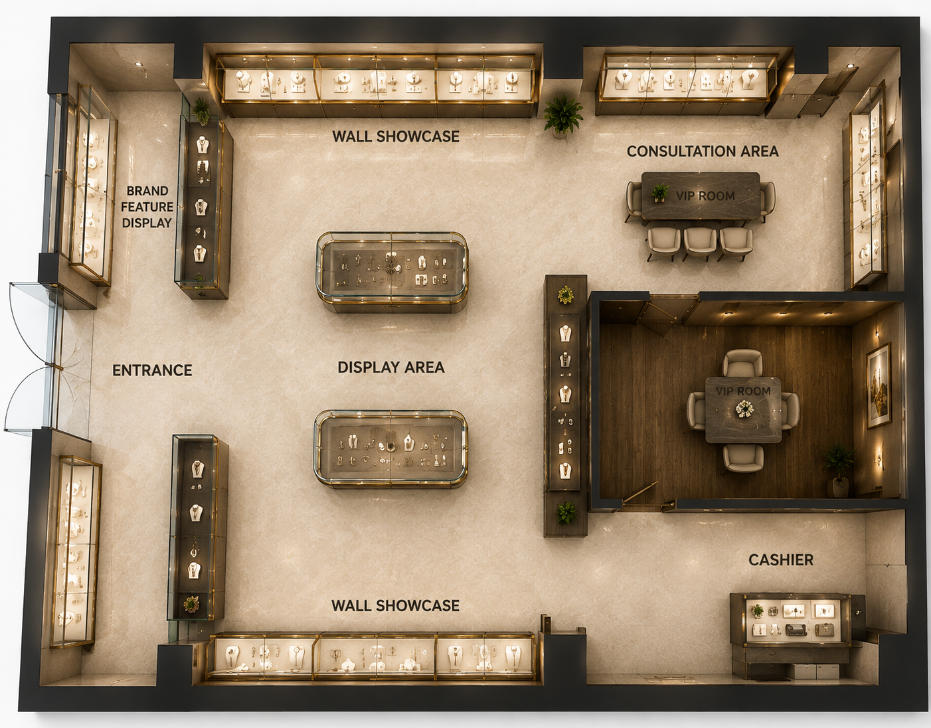
Build the Floor Plan Around Customer Flow and Selling Behavior
A strong jewelry boutique layout creates an understandable journey without forcing shoppers along an obvious path. The entrance should feel open, central fixtures should preserve long sightlines and consultation zones should create a natural transition from browsing to assisted selling.
Give Every Boutique Zone a Clear Commercial Purpose
Window & Attraction
Introduce brand positioning and selected hero pieces before customers enter. A purpose-built jewelry window showcase can connect this first impression with the materials and display language used inside the boutique.
Discovery
Give customers intuitive access to the main merchandise categories.
Consultation
Support seated comparison and detailed product presentation.
VIP
Provide greater privacy for appointments and high-value purchases.
Checkout
Integrate payment, packaging and final service discreetly.
Fixture Height Changes How Large and Open the Boutique Feels
Central showcases usually benefit from lower proportions because customers can see across them. Taller structures work well as focal points, but too many vertical cabinets in the center of a compact boutique can fragment sightlines and make the space feel smaller.
A dedicated jewelry upright showcase can therefore be particularly effective when used selectively for feature collections rather than repeated throughout the store.
Separate Store Lighting From Product Lighting
Professional jewelry store lighting design should create several visual layers. Ambient lighting establishes comfort, architectural lighting gives the boutique depth, and showcase lighting is engineered around the jewelry itself.
The objective is not maximum brightness. The objective is controlled contrast that directs attention toward merchandise while keeping the surrounding environment comfortable.
Ambient Light
Supports overall visual comfort and circulation.
Architectural Light
Defines materials, walls and major features.
Showcase Light
Is coordinated with jewelry, glass and customer viewing angle.
Different Jewelry Categories Respond Differently to Light
Diamonds
Directional highlights can emphasize brilliance and sparkle, while glare and unwanted glass reflections remain controlled.
Gold & Precious Metals
Light quality should reveal surface finish and metal tone without creating an unnatural color cast.
Colored Gemstones
High color rendering helps customers evaluate gemstone color more naturally and consistently.
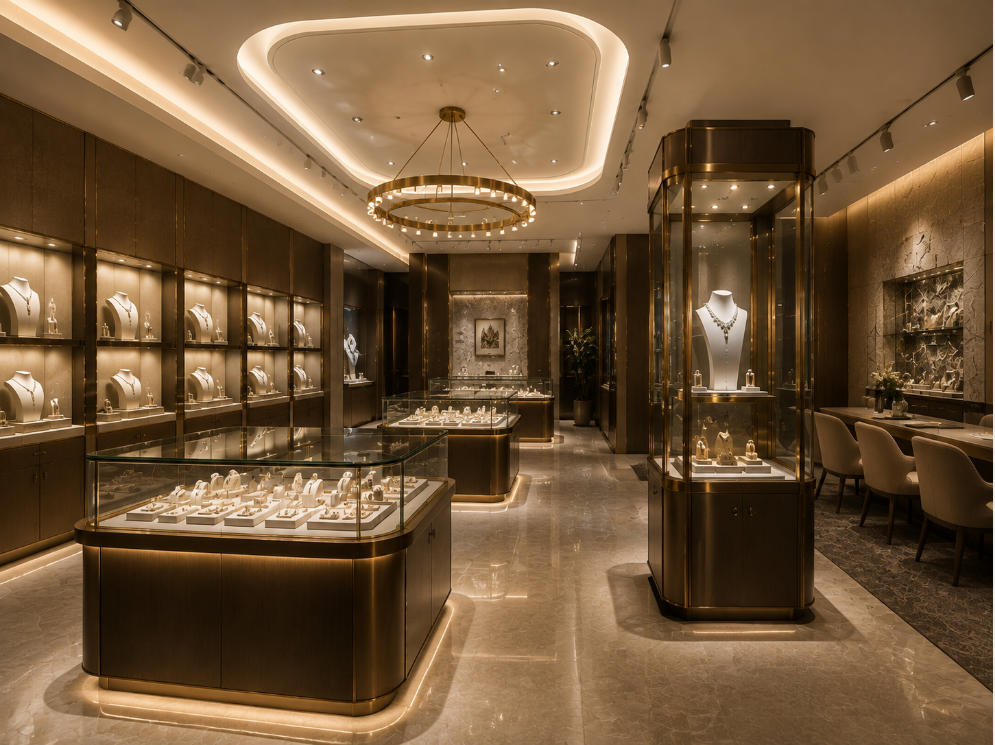
Design the Lighting With the Showcase Glass, Not After It
Jewelry is normally viewed through glass, which means showcase geometry, customer viewing position and lighting angle all influence reflections. The lighting concept should therefore be coordinated with the fixture itself.
Use Different Fixture Types for Different Retail Tasks
Effective jewelry boutique display fixtures should be selected according to merchandising function rather than simply filling available floor space. A boutique normally performs better when several complementary fixture types are coordinated within one design language.
Island Showcases
Support central browsing and flexible circulation while maintaining open sightlines across the boutique.
Wall Showcases
Increase collection capacity while preserving floor area and integrating merchandise into the surrounding architecture.
Counter Showcases
Support assisted selling, secure staff-side access and close customer interaction.
Upright Showcases
Create vertical focal points for premium collections without occupying a large floor footprint.
Pedestal Showcases
Isolate hero or exceptionally valuable pieces where visual focus is more important than display density.
Use the Walls to Increase Display Capacity Without Crowding the Floor
For compact and medium-sized boutiques, perimeter display is one of the most efficient ways to expand merchandise capacity while maintaining open central circulation.
Integrated wall display systems can combine product lighting, secure access and storage while becoming part of the architectural treatment rather than appearing as standalone furniture.
Match the Showcase Type to the Retail Function
| Fixture Type | Best Use | Layout Effect | Key Consideration |
|---|---|---|---|
| Island Showcase | Central collections | Encourages circulation | Height and aisle clearance |
| Wall Showcase | Broad collections | Preserves floor area | Viewing height |
| Counter Showcase | Assisted sales | Defines service interaction | Staff-side access |
| Upright Showcase | Feature collections | Adds vertical emphasis | Sightline placement |
| Pedestal Showcase | Hero jewelry | Creates strong focus | Display density |
Retail Fixtures Should Follow the Product, Not a Universal Cabinet Formula
The engineering logic of jewelry fixtures differs from other retail categories because product scale, access, security and lighting requirements change significantly.
Jewelry
Requires secure access, close-range product viewing, precise glass detailing and highly controlled illumination.
Footwear
Typically prioritizes open access, larger merchandise dimensions, adjustable shelving and faster replenishment.
Apparel
Relies more heavily on hanging systems, flexible merchandising and direct customer product handling than secure glass enclosures.
A Beautiful Jewelry Boutique Still Has to Work Every Day
Secure display is only one part of boutique operation. Staff also need efficient access to stock, trays, packaging and maintenance components without repeatedly crossing customer circulation.
Secure Access
Staff-side showcase access and integrated lock systems should support daily selling without distracting from the customer-facing design.
Concealed Storage
Stock, trays and packaging can remain close to selling areas while staying visually discreet.
Maintenance
Lighting, hardware and service components should remain accessible after installation.
Small Boutiques and Flagship Stores Need Different Layout Priorities
Compact Jewelry Boutique
Prioritize circulation efficiency, integrated wall displays, lower central showcases and flexible consultation positions.
Objective: maximize useful merchandising capacity without making the boutique feel crowded.
Scale the Fixture System With the Space
Display density, fixture height and zoning should change with the available floor area instead of simply reducing or enlarging the same layout.
Large / Flagship Boutique
Use stronger zoning, feature vitrines, dedicated collection areas, consultation spaces and private VIP environments.
Objective: create hierarchy and multiple levels of customer experience.
Connect the Boutique Design to Manufacturing Before Construction Begins
For SUNZEN, custom showcase solutions are developed as part of the retail environment rather than decorative furniture added after the interior is complete. Fixture structure, glass, lighting, locks, hardware, material transitions and installation requirements are evaluated during engineering development.
This is especially important for custom jewelry showcases, where small differences in display height, glass alignment, drawer operation or lighting position can affect both customer experience and daily use.
Connecting design and factory engineering early helps maintain consistent dimensions, materials and finishes across the complete jewelry boutique fixture package.
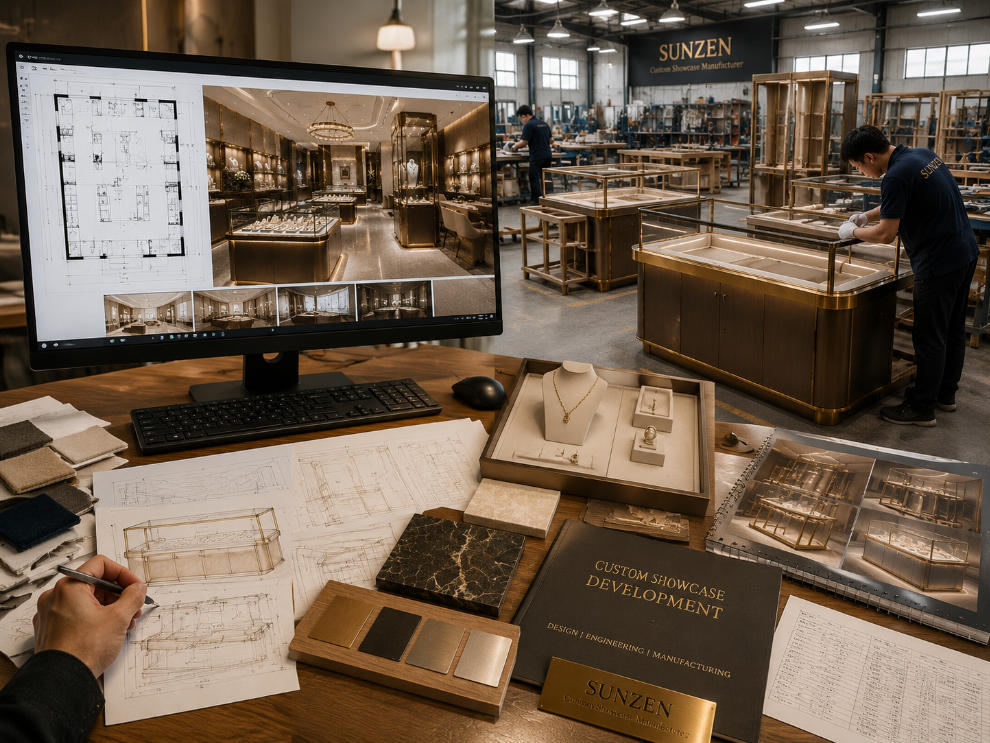
A Practical Jewelry Boutique Design and Fixture Development Process
For examples of how these planning, display and manufacturing principles are translated into completed retail environments, explore SUNZEN’s jewelry showcase projects.
Jewelry Boutique Design FAQs
What should be considered when planning a jewelry boutique design?
Jewelry boutique design should consider customer circulation, merchandise categories, fixture heights, sightlines, lighting, staff access, consultation areas, secure storage and checkout requirements.
How should a jewelry boutique layout be planned?
A jewelry boutique layout should provide clear entrance visibility, comfortable circulation, efficient perimeter merchandising and natural transitions between browsing, consultation and purchase.
What jewelry boutique display fixtures are commonly used?
Common jewelry boutique display fixtures include island showcases, wall showcases, counter cases, upright vitrines, pedestal cases, window showcases and consultation furniture.
How should jewelry store lighting design be coordinated with showcases?
Jewelry store lighting design should account for merchandise type, glass reflections, viewing angles, integrated LED positions and surrounding ambient lighting before fixture production begins.
Why are custom jewelry showcases useful for boutique projects?
Custom jewelry showcases allow dimensions, glass, lighting, storage, security, materials and visual details to be coordinated with the specific boutique layout and merchandising strategy.
How can a small jewelry boutique feel more spacious?
Lower central fixtures, integrated wall displays, controlled materials, open sightlines and efficient circulation can make compact boutiques feel larger and less crowded.
Can SUNZEN manufacture fixtures from an existing boutique design?
Yes. Existing floor plans, CAD drawings, 3D renderings and material specifications can be developed into production-ready custom showcase solutions according to project requirements.
How are security requirements integrated into jewelry showcases?
Security can be integrated through appropriate glass specifications, discreet locks, controlled staff-side access and secure storage while keeping visible hardware visually refined.

