
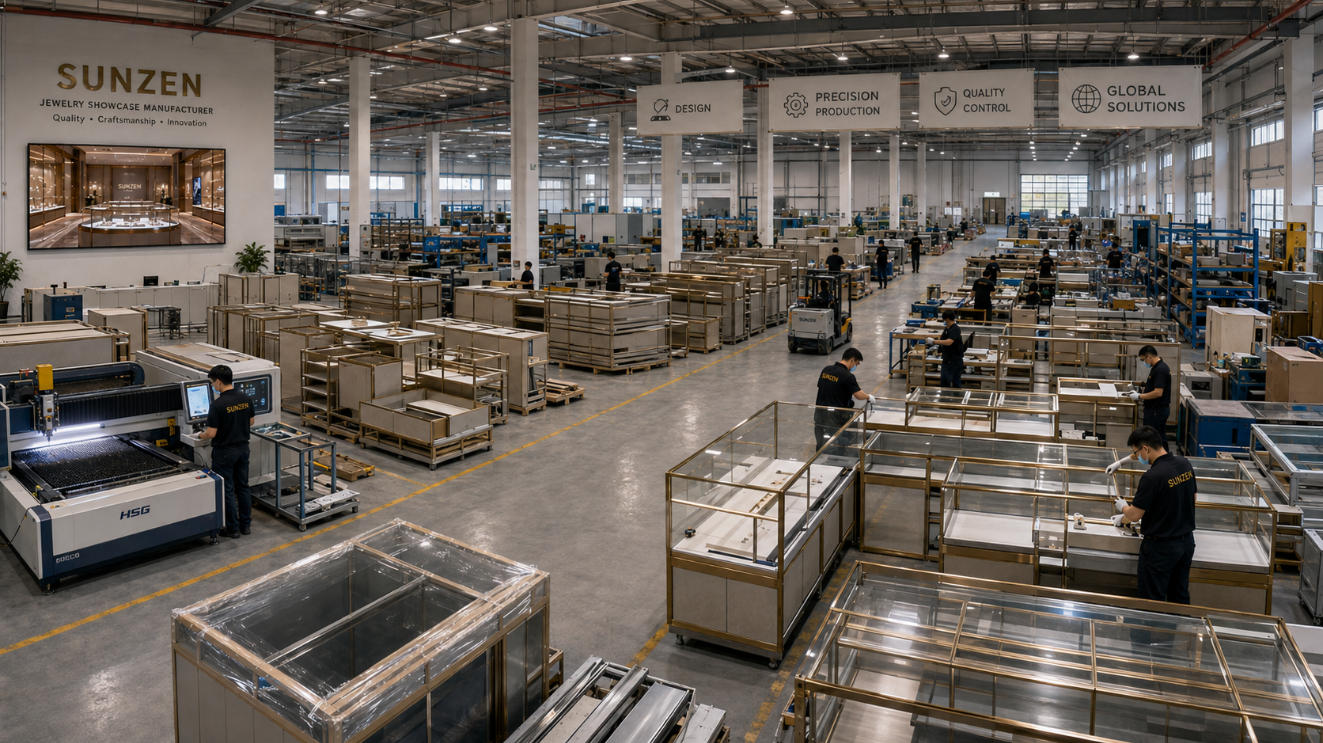
Custom Jewelry Showcase Factory & Manufacturing
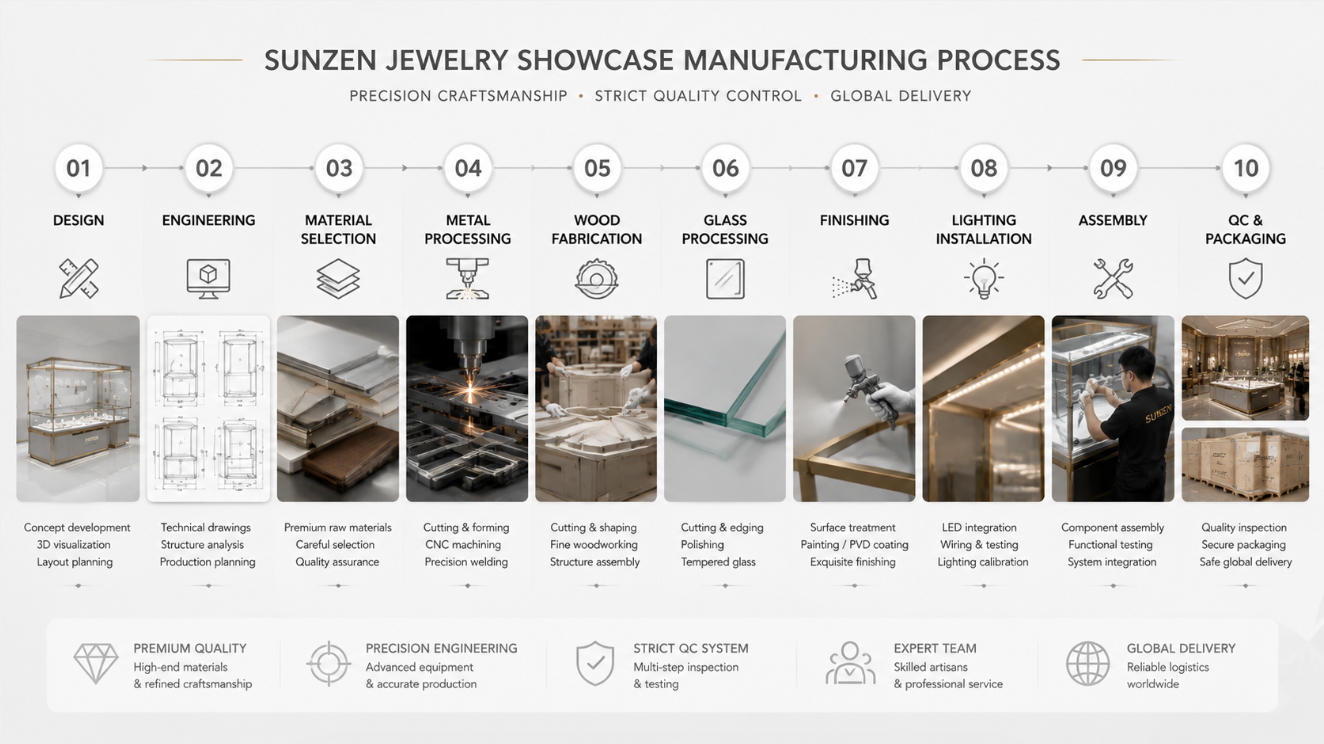
Inside the SUNZEN custom jewelry showcase factory, bespoke display cases move from approved store concepts and CAD engineering through material preparation, metal fabrication, woodworking, glass processing, finishing, lighting integration, assembly and strict quality control.
Our manufacturing process is developed for individual custom showcases as well as coordinated full-store jewelry fixture packages, helping maintain consistent dimensions, materials, finishes and lighting across the complete boutique.
Explore our complete range of custom jewelry display cases for different retail layouts and merchandising requirements.
How Are Custom Jewelry Showcases Made?
A custom jewelry showcase is the result of a coordinated manufacturing process rather than a single cabinet assembly operation.
Production begins after the store concept, showcase dimensions, materials and engineering details have been approved. From that point, metal, wood, glass, lighting, hardware and decorative finishes move through specialized manufacturing stages before final assembly.
For complete jewelry boutique projects, related showcase families can be pre-assembled and inspected together before shipment to review alignment, finish consistency and lighting performance across the full fixture package.
From Design Engineering to QC & Export Packaging
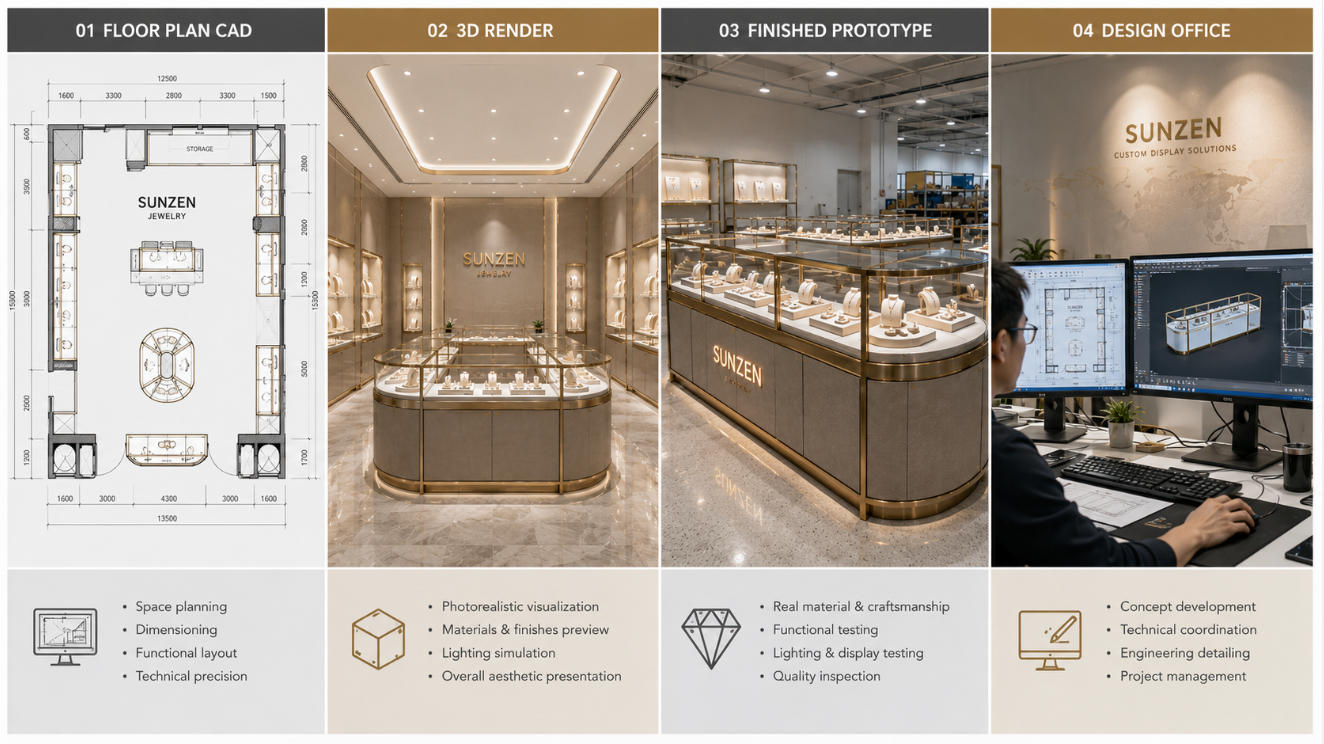
Start With Store Planning and Production-Ready CAD Drawings
Professional jewelry showcase manufacturing begins before materials reach the production floor. The boutique layout, product categories, customer circulation and fixture dimensions first need to be translated into a coordinated design and engineering system.
After the visual direction is approved, technical drawings define the dimensions and construction information required for manufacturing.
What Should Be Defined Before Manufacturing Begins?
Fixture Geometry
Overall length, depth, height and internal display dimensions need to match the approved store layout.
Internal Construction
Metal frames, cabinet structures and glass relationships are engineered around the intended showcase configuration.
Doors & Drawers
Hinges, slides, access directions, drawers and locks are coordinated with daily staff operation.
Electrical Layout
LED positions, cable routing, drivers and maintenance access are planned before assembly.
Finish Specification
Glass, metal, wood, stone, lining and decorative surfaces are confirmed against the approved design.
Manufacturing Reference
Approved engineering drawings provide a consistent reference across different workshop processes.
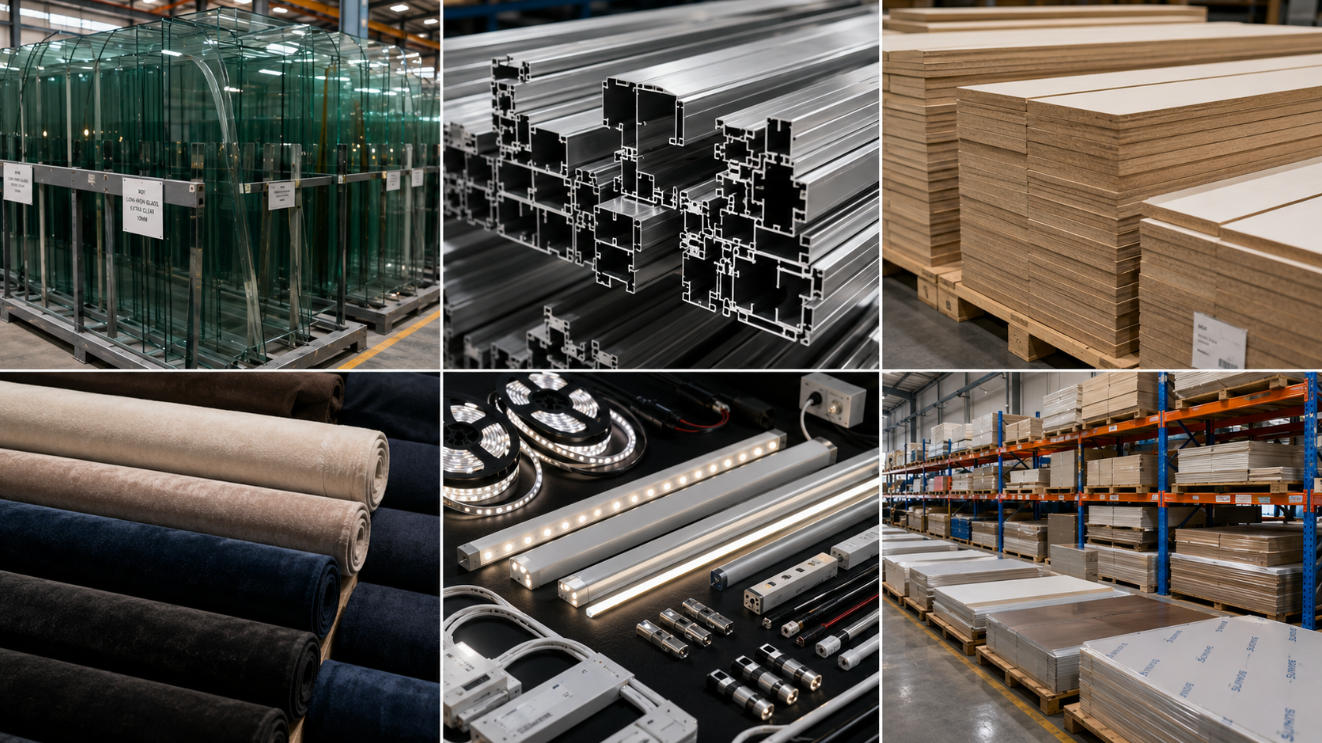
Select and Inspect Materials Before They Enter Production
Jewelry showcase manufacturing combines multiple material systems within one fixture. Their dimensions, finishes and technical properties need to be coordinated before fabrication begins.
Build the Showcase as a Complete Material System
Visual Quality
Glass clarity, metal tone, wood finish and interior lining should support the jewelry rather than visually compete with it.
Manufacturing Compatibility
Different materials need accurate dimensional coordination so glass, metal, cabinetry and lighting assemble correctly.
Batch Consistency
For complete-store orders, approved finish references help maintain consistent appearance across multiple showcase types.
Build the Structural Framework With Precision Metal Processing
Metal fabrication forms the structural foundation of many premium jewelry showcases. Profiles and sheet components move through cutting, forming, welding, grinding and finishing before they are integrated with cabinetry and glass.
Accurate metalwork affects structural stability, glass alignment, door operation and the visual consistency of finished frame details.
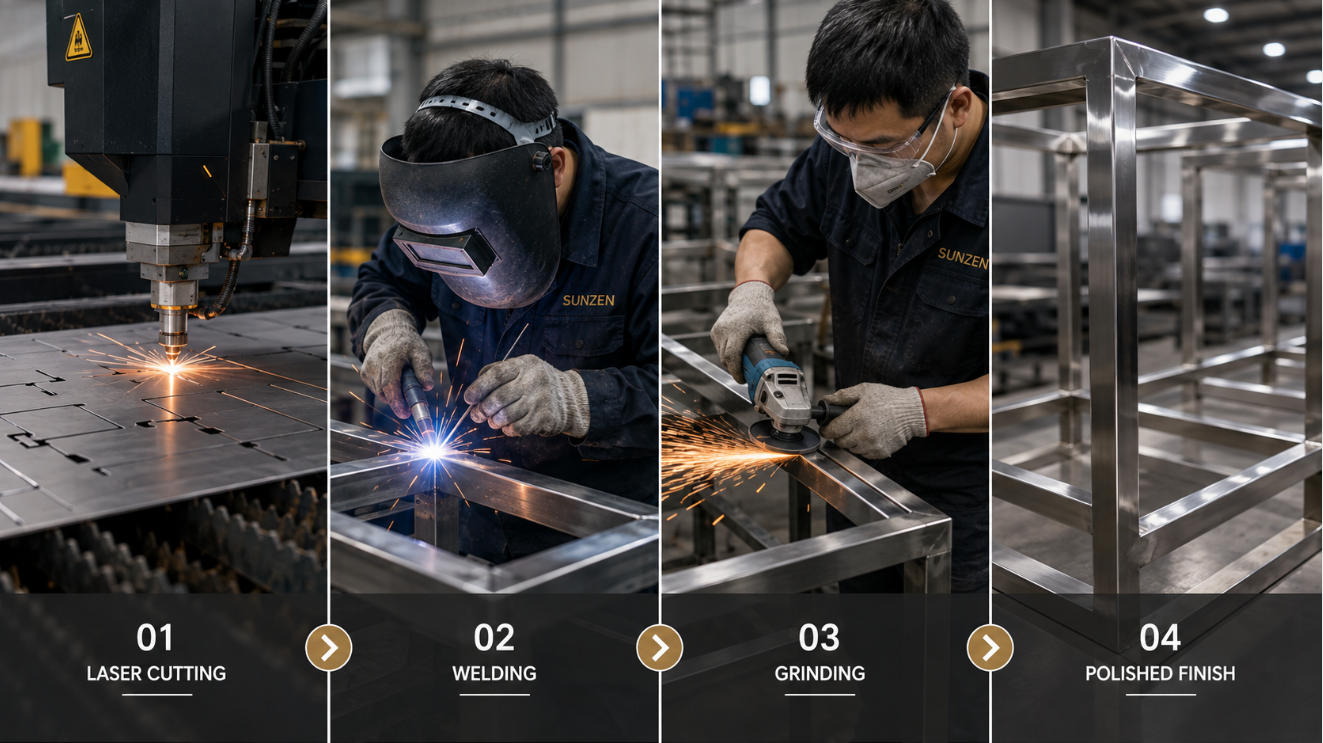
Why Metal Fabrication Accuracy Matters
Structural Stability
The internal framework needs to support glass, cabinetry and daily retail operation without unwanted movement.
Glass Alignment
Accurate frame dimensions help glass panels meet surrounding structures with consistent joints.
Door Accuracy
Well-controlled fabrication contributes to smoother opening systems and more consistent door gaps.
Finish Quality
Grinding and surface preparation influence the final appearance of polished, brushed or plated metal.
Fixture Consistency
Repeatable fabrication is particularly important when several showcases form one coordinated boutique package.
Long-Term Operation
Structural and dimensional accuracy supports reliable everyday use after the showcases are installed.
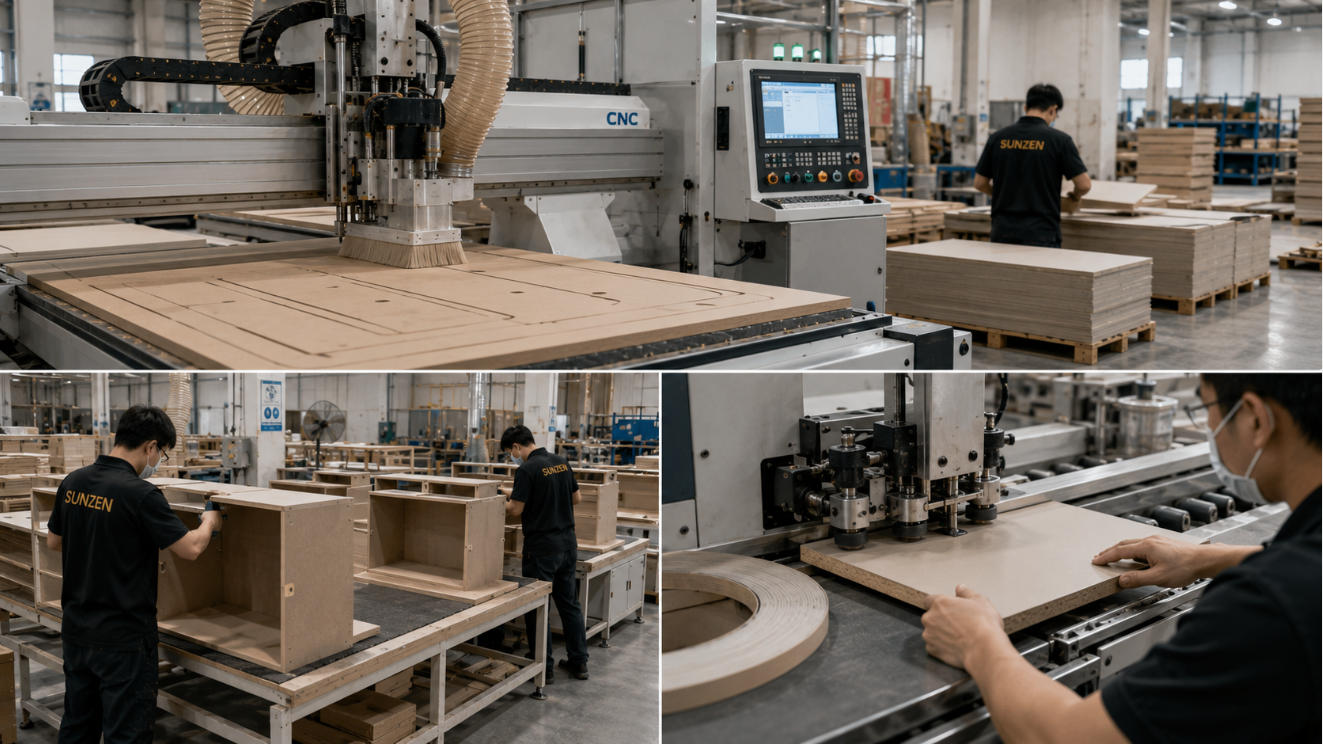
Manufacture Cabinet Bodies, Bases, Back Panels and Storage
Woodworking creates the cabinet architecture that supports storage, decorative surfaces and the upper display structure. CNC processing helps translate approved CAD dimensions into repeatable cabinet components.
Accurate woodworking is especially important because doors, drawers, metal frames, glass and lighting components eventually need to meet within the same finished showcase.
Prepare High-Visibility Glass for Premium Jewelry Presentation
Glass quality has a direct influence on how jewelry is perceived inside a showcase. Clarity, edge quality, dimensions and installation accuracy all affect the final visual result.
After cutting and edge processing, glass components are prepared according to the approved showcase dimensions and opening system.
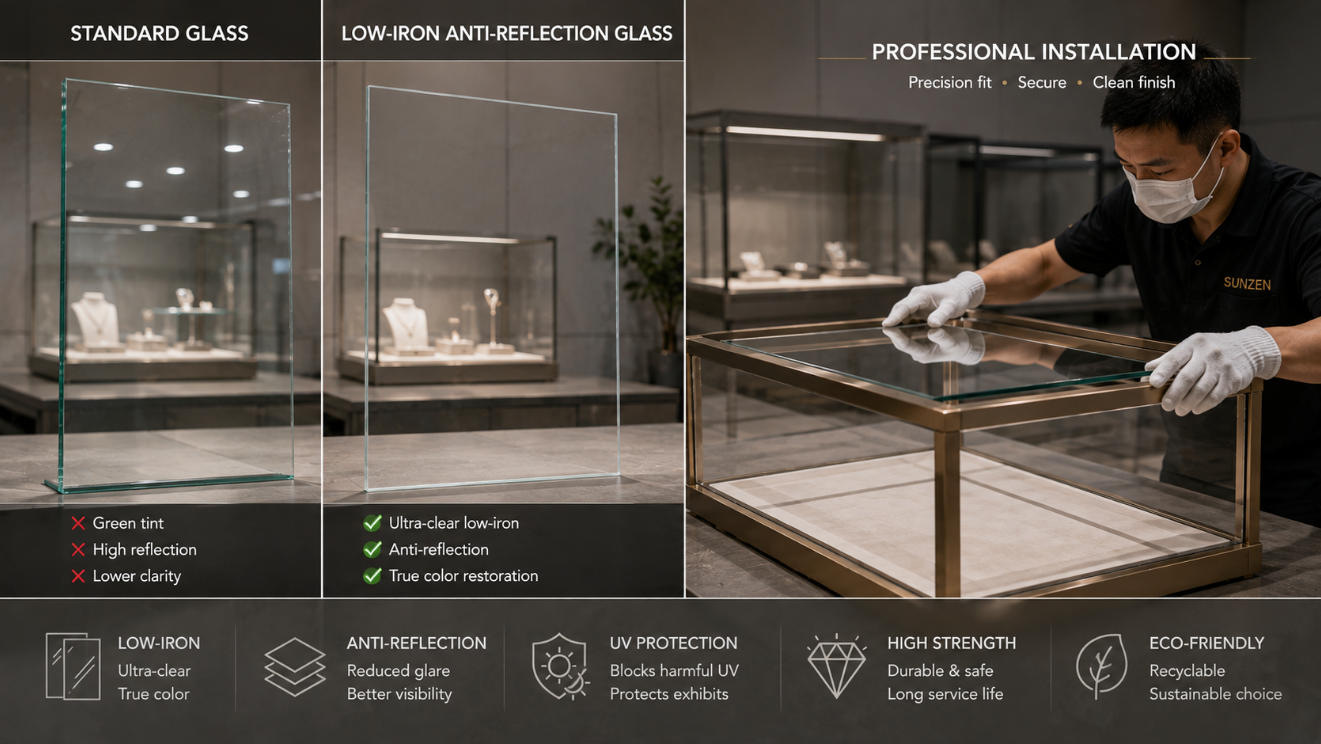
Reduce Visual Interference Between the Customer and the Jewelry
Clarity
High-clarity glazing helps reduce unwanted color cast and keeps the merchandise visually prominent.
Precision Fit
Accurate dimensions help glass align cleanly with metal frames, doors and adjoining panels.
Clean Presentation
Refined edges and controlled joints contribute to the premium appearance expected from luxury jewelry showcases.
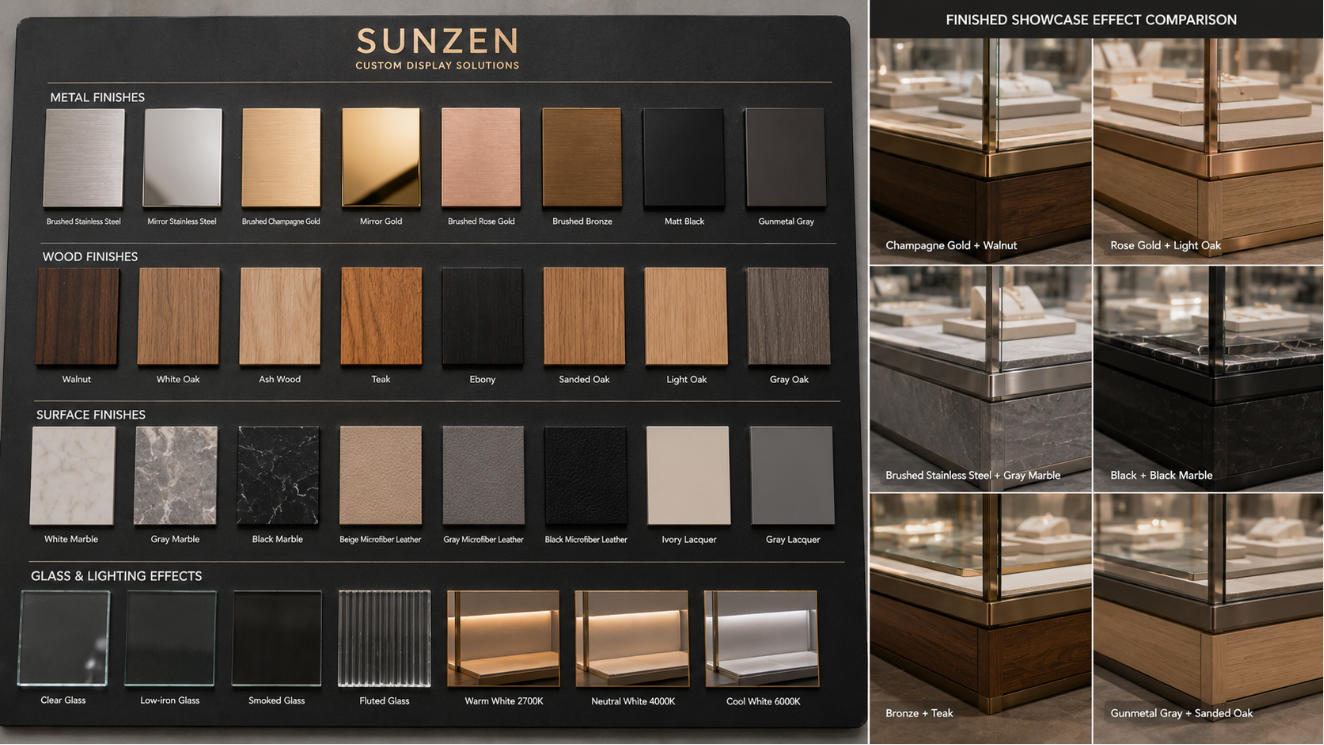
Control Color, Texture and Finish Consistency Across the Showcase Package
Surface finishing determines much of the visible character of a jewelry showcase. Brushed metal, plated surfaces, lacquer, veneer and soft interior finishes need to match the approved retail design rather than vary from cabinet to cabinet.
For multi-fixture projects, finish references and approved samples provide a visual benchmark before final production.
Why Sample Approval Matters Before Batch Production
Color Consistency
Approved samples create a visual reference for metal, lacquer, veneer and interior finishes.
Surface Character
Brushed direction, gloss level, grain and soft-touch materials all influence the final luxury effect.
Fixture-to-Fixture Matching
Full-store projects require different showcase families to maintain one consistent finish language.
Engineer the Lighting Before Final Showcase Assembly
Jewelry showcase lighting should be integrated into the cabinet architecture rather than added as a separate decorative feature after construction.
LED position, beam direction, wiring, drivers and maintenance access are coordinated with the glass, frame and interior display area.
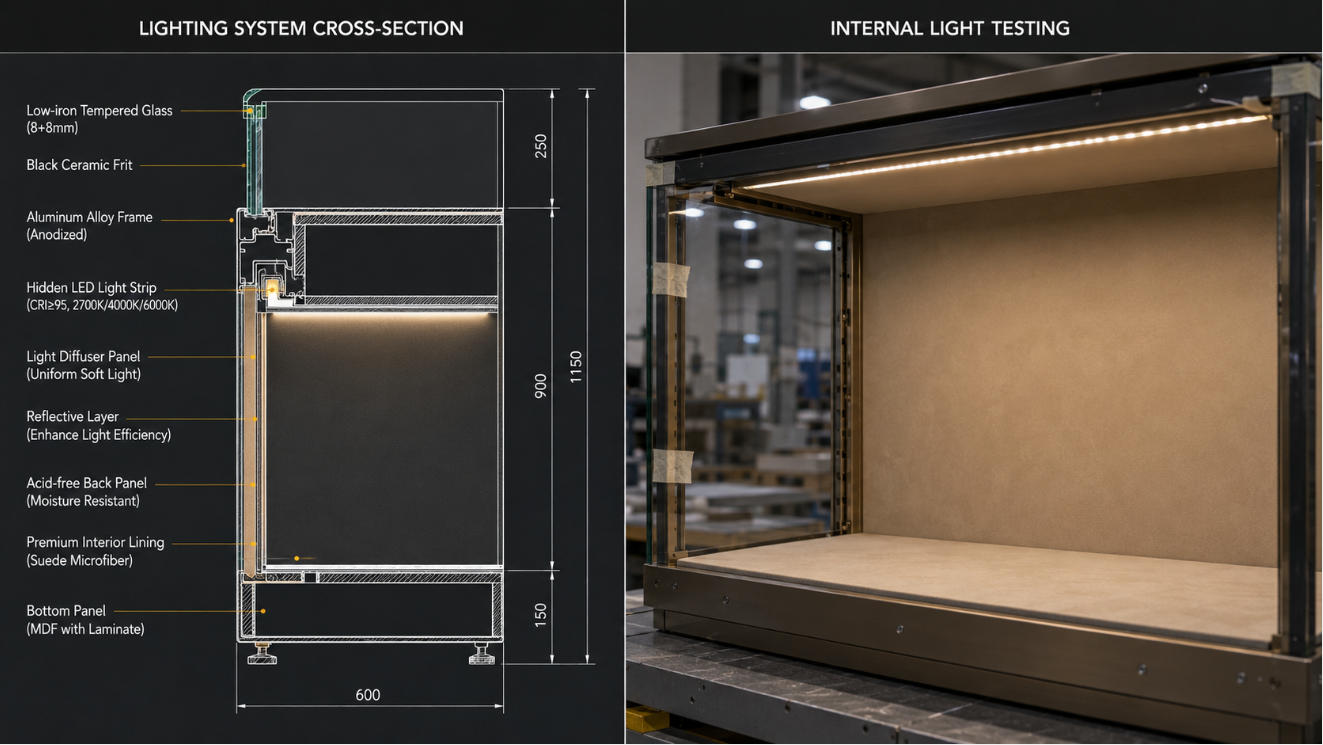
Lighting Performance Depends on the Showcase Around It
Viewing Angle
Light positions are coordinated with the way customers view merchandise through the showcase glass.
Reflection Control
Lighting and glass relationships should be reviewed together to reduce distracting reflections.
Visual Hierarchy
Focused illumination can help separate hero products from broader merchandise collections.
Concealed Components
LED channels, wiring and drivers are integrated so technical components do not dominate the display.
Maintenance Access
Lighting components should remain serviceable after the showcase is installed.
Consistency
For complete store packages, multiple showcases should deliver a coordinated lighting character.
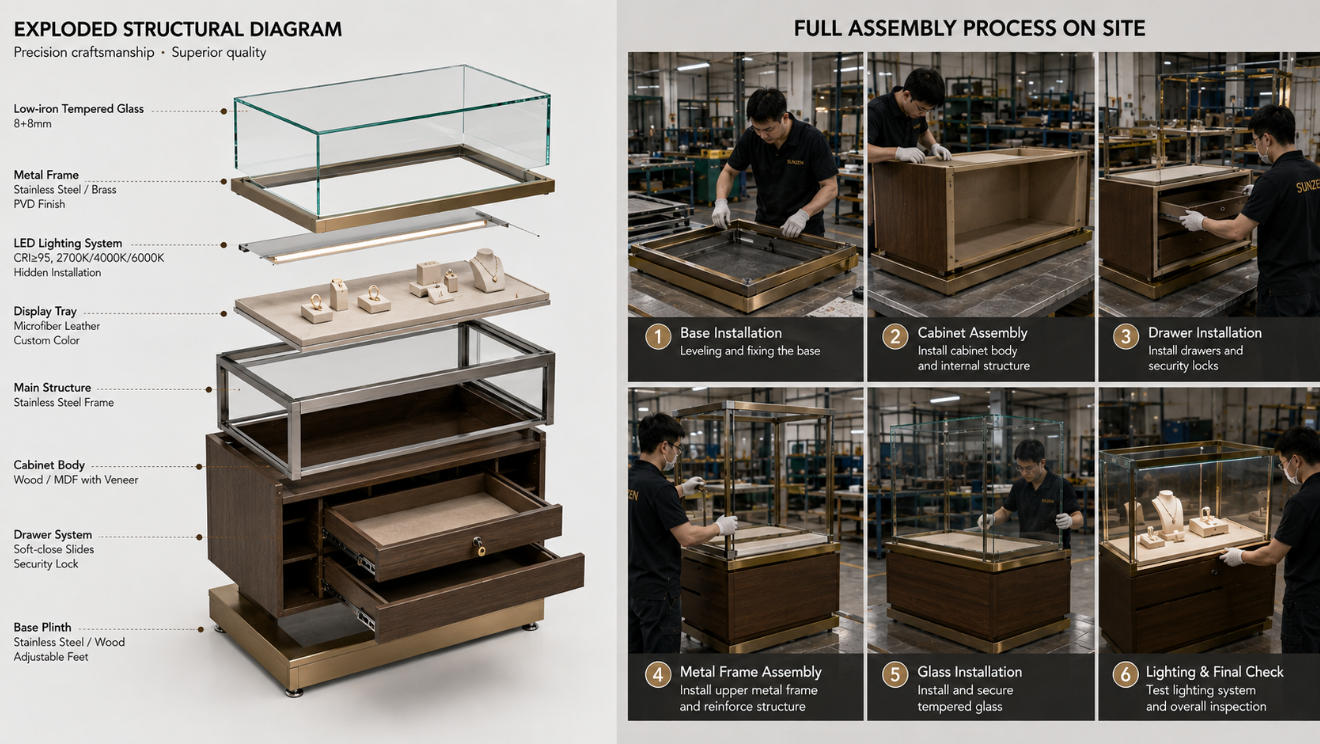
Bring Metal, Wood, Glass, Lighting and Hardware Together
Final assembly is where the individual production systems become one complete jewelry showcase. Metal frames, cabinet bodies, glass, drawers, doors, locks, lighting and decorative finishes all need to align correctly.
Assembly technicians adjust moving parts, verify gaps and connections, test lighting and complete the visible finish details before the showcase moves to quality inspection.
Small Alignment Errors Become Highly Visible in Premium Showcases
Glass Gaps
Consistent joints help the upper display enclosure feel visually precise.
Door Alignment
Doors and drawers should operate smoothly while maintaining consistent visible gaps.
Material Transitions
Metal, glass, wood and stone interfaces should meet cleanly without unnecessary visual interruptions.
Inspect Each Showcase Before It Leaves the Factory
Quality control verifies the finished showcase against approved drawings, material references and project requirements. Inspection includes both visible quality and functional operation.
For coordinated boutique projects, individual fixtures can also be compared with one another to review finish and lighting consistency across the complete package.
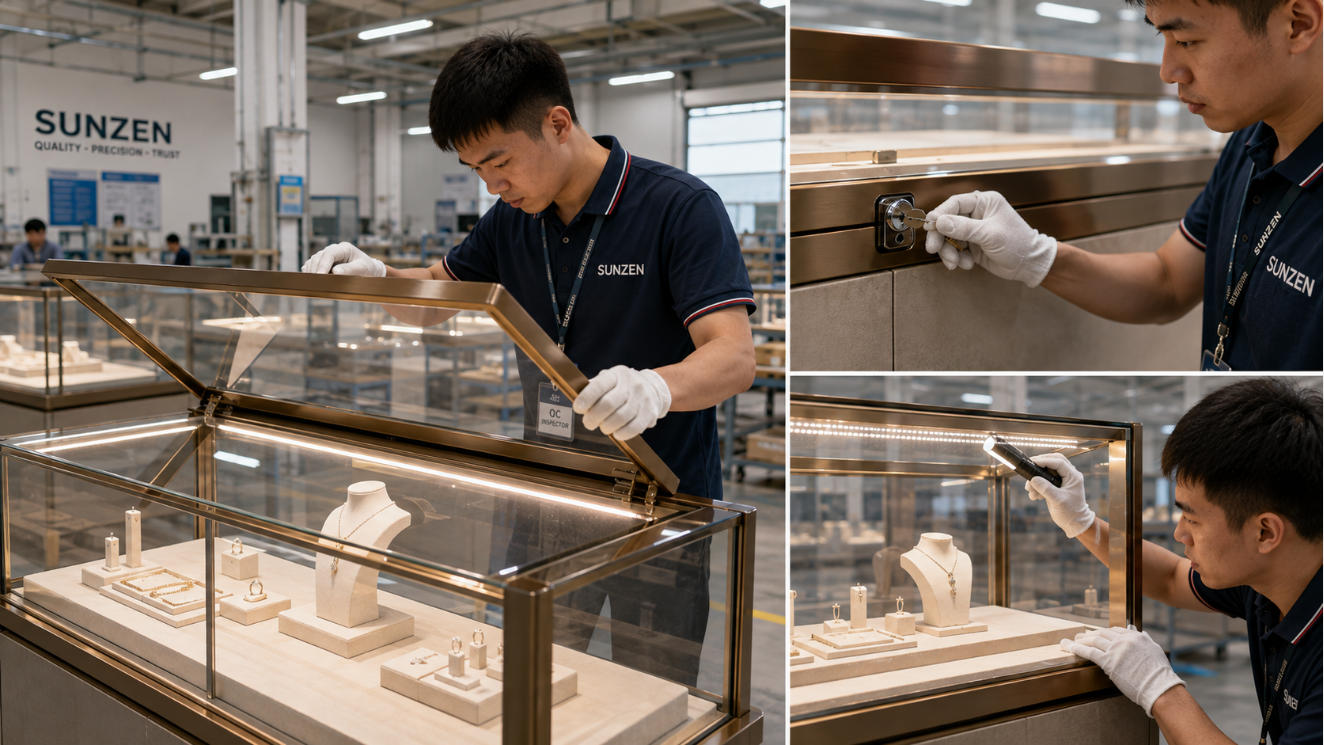
What Is Reviewed Before Packaging?
Dimensions & Alignment
Overall size, frame alignment and relationships between adjoining components are checked.
Doors, Drawers & Locks
Opening systems are tested for smooth operation and practical staff access.
Electrical Performance
Integrated lighting is tested for operation and visible consistency.
Surface Quality
Visible metal, wood, glass and interior finishes are reviewed under normal lighting.
Clarity & Installation
Glass surfaces, joints and alignment are reviewed before shipment.
Complete Fixture Consistency
Related showcases can be compared to verify shared material, finish and lighting standards.
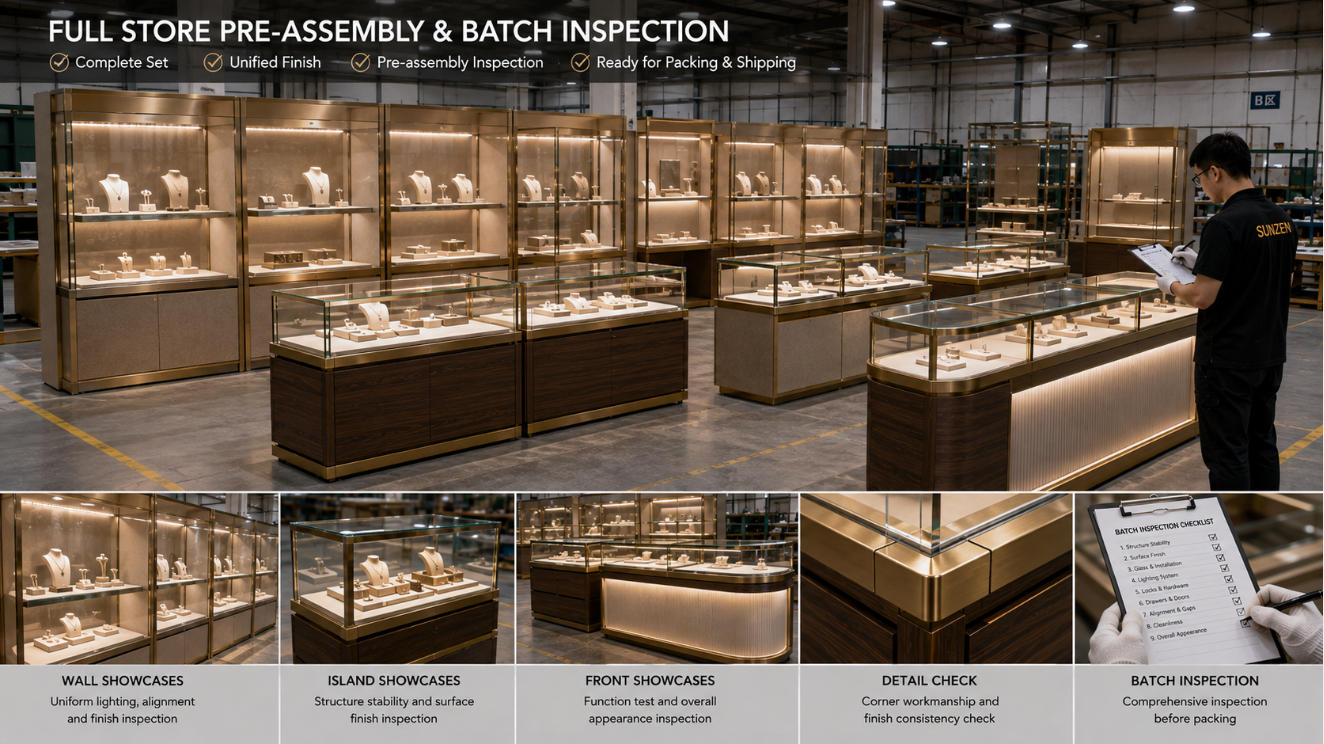
Review the Fixture Package Together Before Export
For complete jewelry store projects, pre-assembly allows different showcase types to be reviewed together before shipment. This can help identify inconsistencies that may be difficult to see when fixtures are inspected individually.
Manufacturing Strategy Changes With Project Scale
Individual Jewelry Showcase
A single display case can be engineered closely around one location, merchandise category or specific functional requirement.
Manufacturing priority: custom dimensions, materials, lighting and detailed product presentation.
Complete Jewelry Store Package
A complete boutique requires multiple showcase families to maintain common material, finish, engineering and lighting standards.
Manufacturing priority: project-wide consistency, coordination and repeatability.
Protect Finished Jewelry Showcases for International Delivery
After final inspection, showcases are prepared for transport according to their structure, glass content and project destination. Packaging should reduce the risk of movement, impact and surface damage during handling and shipping.
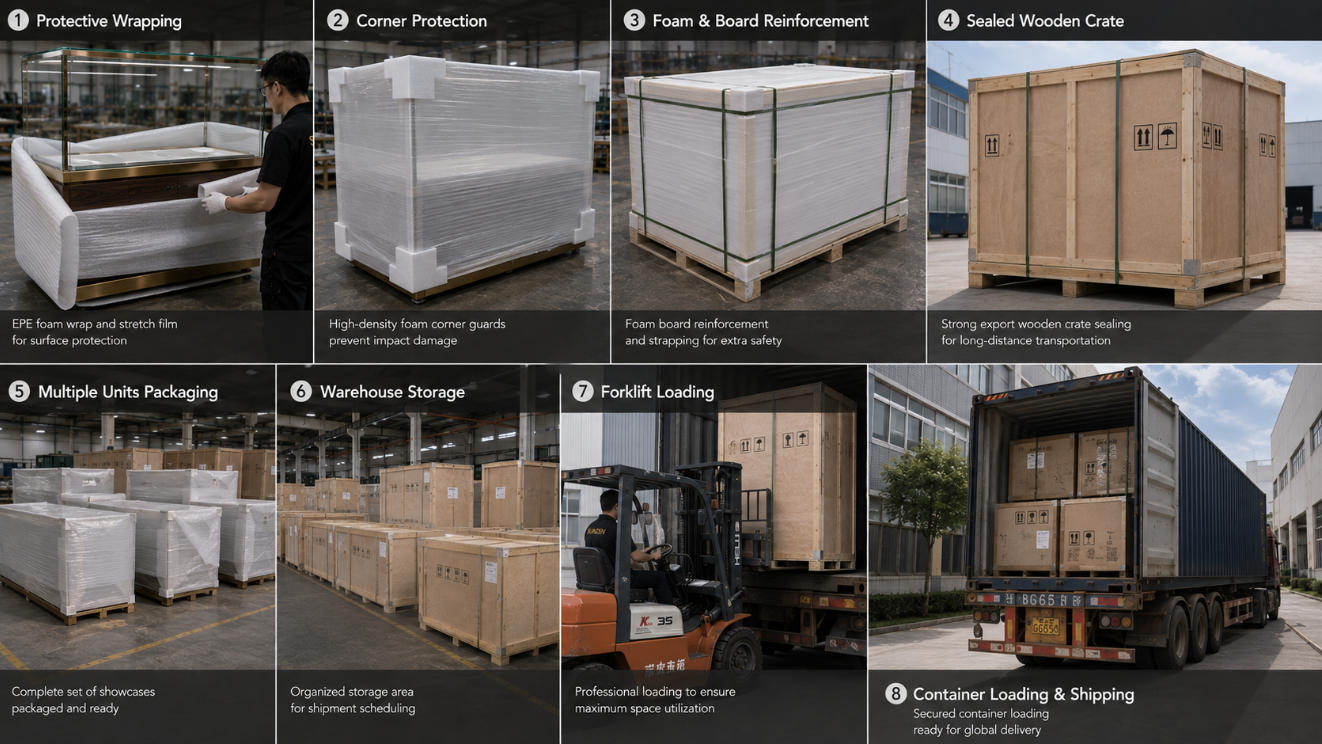
Manufacturing Is Complete Only When the Fixtures Are Ready for Installation
Module Identification
Fixture numbering helps match packaged units with the store layout and installation sequence.
Installation Information
Drawings and assembly information can support the site team during fixture installation.
Shipping Coordination
Packaging and loading should reflect fixture size, glass content and the agreed transport method.
What Can a Custom Jewelry Showcase Factory Produce?
A jewelry showcase factory needs to manufacture more than one cabinet style. Complete boutique projects often combine different showcase formats, dimensions and functions within the same retail environment.
SUNZEN develops custom jewelry display fixtures around store layouts, merchandise categories, customer interaction and brand requirements, allowing different showcase families to share a coordinated design language.
Jewelry Counter Showcases
Customer-facing glass display counters combining jewelry presentation, staff access and concealed storage.
Jewelry Island Showcases
Freestanding central displays designed for visibility and customer circulation from multiple directions.
Jewelry Wall Showcases
Integrated perimeter display systems that combine vertical merchandising, lighting and storage.
Jewelry Upright Showcases
Freestanding vertical vitrines developed for featured jewelry collections and high-visibility presentation.
Jewelry Pedestal Showcases
Focused display cases for individual statement pieces, premium collections and feature merchandise.
Jewelry Window Showcases
Storefront display fixtures developed to attract attention and present selected jewelry before customers enter the boutique.
Customize the Showcase Around the Jewelry Store
Custom production allows the showcase to respond to the actual retail environment instead of forcing the boutique to adapt to standard cabinet dimensions.
Manufacture Different Jewelry Showcase Types as One Coordinated Package
A complete jewelry boutique rarely uses only one type of showcase. Counter displays, islands, wall units, upright vitrines, feature displays and consultation furniture need to work together within the same store.
This changes the role of the manufacturer. Instead of producing individual cabinets independently, dimensions, materials, finishes, lighting and construction details need to be coordinated across the complete fixture package.
Shared Material Palette
Metal, wood, stone, glass and interior materials can follow common approved references across different fixtures.
Consistent Design Language
Proportions, details and finishes can connect different showcase families into one recognizable boutique environment.
Coordinated Engineering
Individual fixture drawings can be checked against the complete floor plan before manufacturing.
Lighting Consistency
Related showcases can use coordinated lighting specifications to maintain a consistent presentation character.
Pre-Assembly Review
Multiple fixture types can be reviewed together before packing where the project requires full-store coordination.
Installation Sequence
Fixture numbering and project drawings can help organize overseas installation and store setup.
Connect Factory Production With the Complete Boutique Design
Manufacturing quality is only one part of a successful jewelry store. Showcase dimensions, positions and materials also need to respond to customer circulation, merchandise hierarchy, consultation areas, lighting and the overall retail concept.
For projects that begin with the complete boutique rather than individual cabinets, explore SUNZEN’s jewelry store design solutions to see how layout planning, showcases and retail interiors can be developed together.
Why Integrate Design and Manufacturing?
Design Feasibility
Manufacturing considerations can be reviewed while the showcase concept and engineering details are being developed.
Material Coordination
Design intent can be translated into practical material and finish specifications before production.
Engineering Accuracy
CAD drawings provide a shared technical reference between design development and workshop manufacturing.
Fewer Interface Problems
Glass, metal, cabinetry, lighting and hardware relationships can be considered before final assembly.
Project Consistency
Complete-store packages can be reviewed as one system rather than a collection of unrelated cabinets.
Production Control
Approved drawings and material references create clearer benchmarks for manufacturing and QC.
Custom Manufacturing for Different Jewelry Retail Environments
Fine Jewelry Stores
Premium showcase systems developed around refined materials, controlled lighting and high-value jewelry presentation.
Branded Jewelry Boutiques
Custom fixture packages coordinated with specific brand colors, materials and retail design standards.
Flagship Stores
Complete fixture families developed for larger retail environments with multiple merchandising and consultation zones.
Shopping Mall Stores
Jewelry display systems designed around mall storefront visibility, circulation and compact retail footprints.
Jewelry Kiosks
Standalone display environments integrating showcases, storage, customer interaction and brand presentation.
Multi-Store Programs
Repeatable fixture specifications can support brands developing multiple stores from an approved design system.
From Factory Production to Completed Jewelry Stores
Completed projects show how engineering, materials, manufacturing and quality control come together in the final retail environment. The result should not look like a collection of independently produced cabinets, but like one coordinated jewelry store.
Explore SUNZEN’s completed showcase projects to see how custom display solutions are applied in real retail environments.
What Should You Look for in a Jewelry Showcase Factory?
Custom Engineering Capability
The manufacturer should be able to translate concepts and store layouts into production-ready technical information.
Multiple Material Processes
Jewelry showcases combine metal, wood, glass, lighting, hardware and decorative finishes that need coordinated production.
Finish Control
Approved material samples and references are important when several fixtures need a consistent appearance.
Quality Inspection
Finished fixtures should be reviewed for dimensions, visible quality, lighting and functional operation.
Full-Store Capability
A complete boutique requires coordination between multiple fixture families rather than production of one cabinet type.
Project Communication
Clear confirmation of drawings, materials, schedules and production details is important for international custom projects.
Custom Jewelry Showcase Manufacturing From Concept to Delivery
Project-Specific Development
Showcases can be developed around the store layout, jewelry categories and intended retail positioning.
Visualization Before Production
3D development helps review fixture proportions, materials and the overall boutique environment.
Production Engineering
Technical drawings connect the approved design with dimensions and construction information required for manufacturing.
Custom Manufacturing
Metal, wood, glass, lighting, hardware and finishes are coordinated through the production process.
Pre-Delivery Inspection
Finished showcases are reviewed against approved project requirements before packaging.
Complete Store Packages
Scope can extend from individual showcases to coordinated full-store jewelry fixture packages.
Why Manufacture Jewelry Showcases to Order?
Fit the Store
Dimensions can respond directly to the available floor plan and architectural conditions.
Fit the Jewelry
Display height, internal presentation, lighting and storage can respond to the actual merchandise.
Fit the Brand
Materials, finishes and visual details can be coordinated with the intended boutique identity.
Coordinate Fixture Types
Wall showcases, islands, counters and feature displays can share one design language.
Improve Store Operation
Staff access, drawers, locks, storage and customer interaction can be considered during engineering.
Support Future Stores
Approved specifications can provide a reference when similar fixture systems are required for later locations.
How to Start a Custom Jewelry Showcase Manufacturing Project
What Information Should You Send to the Factory?
Explore Jewelry Display Solutions Beyond Factory Production
Jewelry Display Cases
Explore different custom showcase formats for jewelry counters, islands, walls, windows and feature displays.
View our jewelry display cases for different boutique applications.
Jewelry Store Design
Learn how store planning, circulation, display fixtures and the complete retail environment can be developed together.
Explore our jewelry store design solutions.
Luxury Jewelry Store Design
Explore premium boutique development where materials, lighting and custom showcases are coordinated around luxury positioning.
Jewelry Boutique Design
Review how boutique layouts, lighting and display fixtures can work together as one customer-facing retail environment.
Explore our jewelry boutique design, layout and display fixture guide.
Custom Retail Display Fixtures
See SUNZEN’s broader custom manufacturing capability for different premium retail categories.
Explore our custom retail display fixture manufacturing solutions.
Completed Projects
See how custom showcases and fixture packages are applied in completed retail environments.
View our display showcase projects.
Turn the Approved Jewelry Store Design Into a Manufacturable Fixture System
A successful jewelry showcase depends on more than its final appearance. Dimensions, structure, glass, metal, cabinetry, lighting, hardware and surface finishes all need to work together during production and everyday store operation.
By connecting design development, CAD engineering, material confirmation, specialized manufacturing, assembly and quality control, custom showcases can be produced as coordinated parts of the complete jewelry retail environment.
For full-store projects, this approach also helps maintain a consistent design and manufacturing standard across different showcase families before they leave the factory.
Custom Jewelry Showcase Factory FAQs
What does a custom jewelry showcase factory manufacture?
A custom jewelry showcase factory can manufacture glass display counters, island showcases, wall showcases, upright vitrines, pedestal displays, window showcases, consultation furniture and coordinated full-store fixture packages according to project requirements.
Can jewelry showcases be manufactured to custom dimensions?
Yes. Showcase length, depth, height, internal display dimensions and overall geometry can be developed around the store layout, merchandise and functional requirements.
What materials are commonly used to manufacture jewelry showcases?
Custom jewelry showcases commonly combine glass, metal, engineered wood, veneer, lacquer, stone, decorative finishes, interior lining materials, lighting components and hardware. The exact material specification depends on the project design.
Does SUNZEN provide CAD drawings before jewelry showcase production?
Yes. Approved design concepts can be developed into technical drawings defining showcase dimensions, structures, glass, doors, drawers, lighting and other manufacturing details before production begins.
Can SUNZEN manufacture a complete jewelry store fixture package?
Yes. A complete package can include wall showcases, island displays, counters, upright vitrines, feature displays, consultation furniture, storage and other custom fixtures coordinated according to the jewelry store design.
How are jewelry showcases inspected before shipment?
Inspection can include finished dimensions, glass installation, surface finishes, lighting, doors, drawers, locks, hardware and overall appearance. Related fixtures can also be compared for consistency when they form part of a complete store package.
Can a complete jewelry store be pre-assembled before shipping?
For suitable full-store projects, different showcase types can be reviewed together before packing to check fixture relationships, finishes, lighting consistency and installation coordination.
Can SUNZEN manufacture jewelry showcases for overseas projects?
Yes. Custom jewelry showcases and complete fixture packages can be prepared for international projects with export packaging, fixture identification and relevant installation information according to the project scope.
What information should I provide for a custom jewelry showcase quotation?
Useful information includes the store floor plan, required fixture types, dimensions, design references, jewelry categories, preferred materials, brand requirements, project location and expected schedule.

