
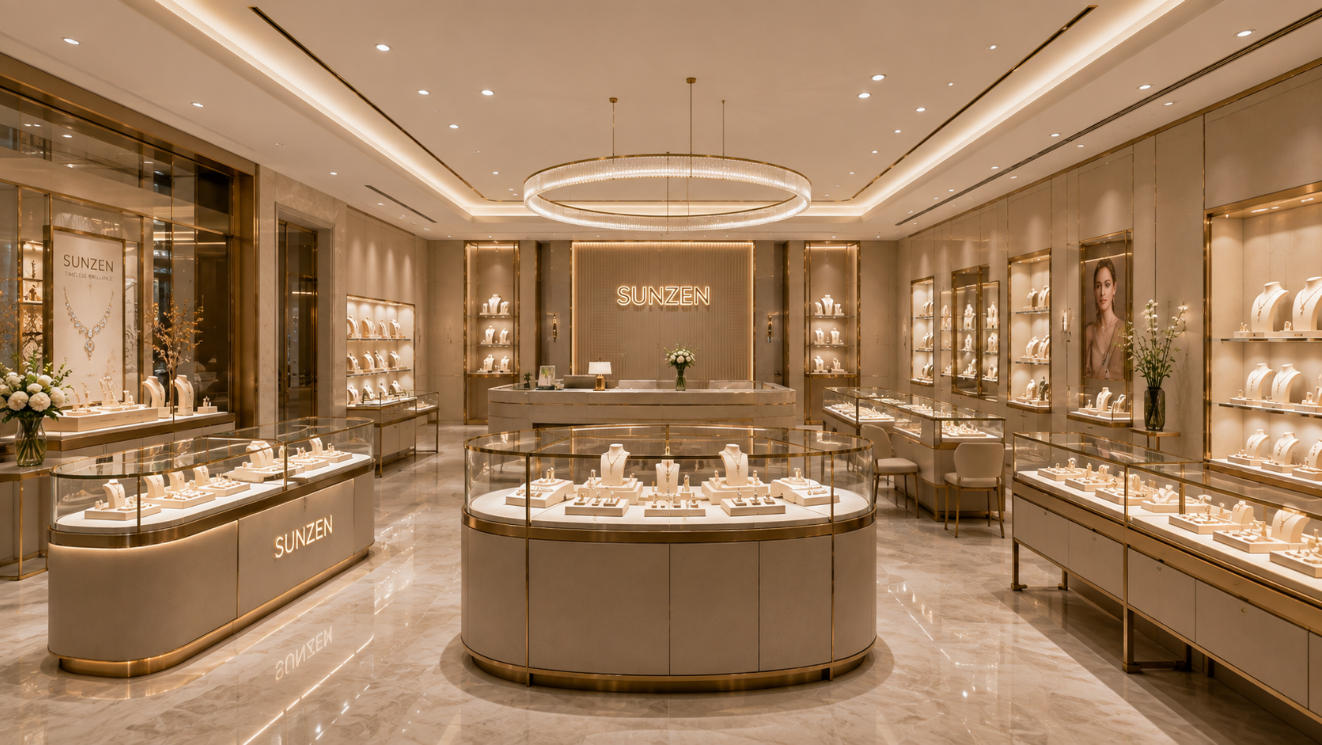
Jewelry Store Fixture Manufacturer for Complete Retail Projects
As a professional jewelry store fixture manufacturer, SUNZEN develops coordinated display furniture packages for luxury jewelry boutiques, flagship stores, shopping mall stores, shop-in-shop environments and other jewelry retail projects.
Our scope can include wall showcases, island displays, counter showcases, window displays, upright vitrines, consultation counters, cashier desks and storage fixtures—all developed around the same store layout, material palette and design language.
For individual showcase styles and configurations, explore our custom jewelry display cases.
What Does a Jewelry Store Fixture Manufacturer Provide?
A complete jewelry store requires different display fixtures to work together as one coordinated retail system.
A jewelry store fixture manufacturer does more than fabricate individual display cabinets. The complete project may require different fixture types for product presentation, consultation, transactions, storage and customer circulation.
For full-store projects, these fixtures should be developed around shared dimensions, materials, finishes, lighting principles and operational requirements so the finished boutique feels intentionally designed rather than assembled from unrelated furniture.
What Fixtures Can Be Manufactured for a Jewelry Store?
Jewelry Wall Showcases
Perimeter display systems that use vertical wall space for organized jewelry presentation while integrating lighting and lower storage.
Jewelry Island Showcases
Freestanding central fixtures designed for multi-directional viewing and natural circulation around featured collections.
Jewelry Counter Showcases
Customer-facing display counters combining protected merchandise presentation with staff access and storage.
Jewelry Window Showcases
Storefront display fixtures developed to create the first product impression and attract customers into the boutique.
Upright & Pedestal Showcases
Vertical and focused display cases for signature jewelry, limited collections and high-value feature pieces.
Service & Storage Fixtures
Cashier counters, consultation furniture and concealed storage developed around staff workflow and daily retail operation.
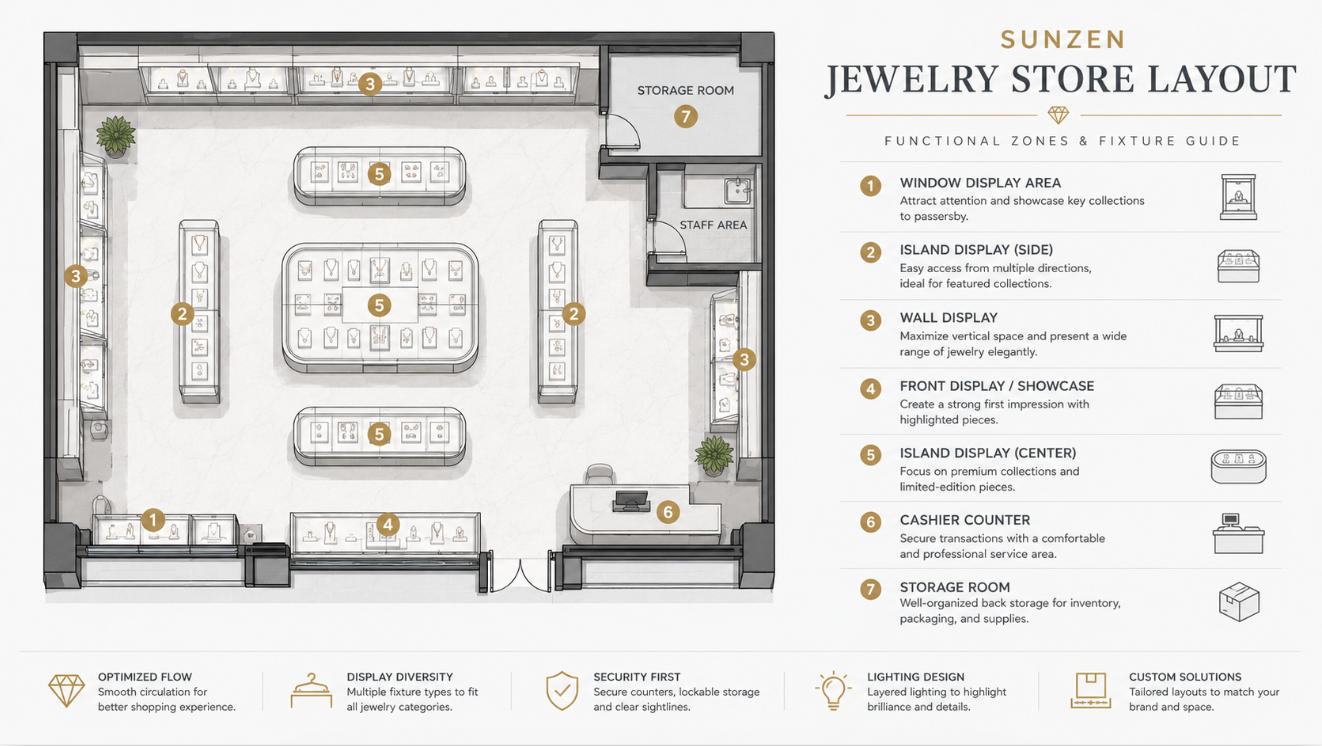
Plan the Fixture System Around the Complete Jewelry Store
Fixture manufacturing should begin with the actual retail space. Entrances, storefront visibility, customer circulation, merchandise categories, consultation areas, checkout and storage all influence where different fixtures belong.
A coordinated layout helps determine which areas require wall displays, central islands, lower counters, feature showcases or operational furniture before individual fixture dimensions are finalized.
Why Fixture Layout Should Be Resolved Before Production
Customer Movement
Fixture positions and dimensions influence aisle widths, viewing distance and movement through the boutique.
Product Hierarchy
Different fixture types can support hero collections, everyday merchandise and private consultation differently.
Store Visibility
Fixture heights and positions should maintain useful views between the entrance, central displays and perimeter merchandising.
Staff Access
Opening directions, drawers, storage and service zones need to support everyday store operation.
Display Coordination
Integrated showcase lighting needs to work with the surrounding architectural lighting rather than being considered separately.
Controlled Access
Display access, locks and storage requirements can be considered as part of the fixture system during engineering.
Turn the Jewelry Store Layout Into Production-Ready Fixtures
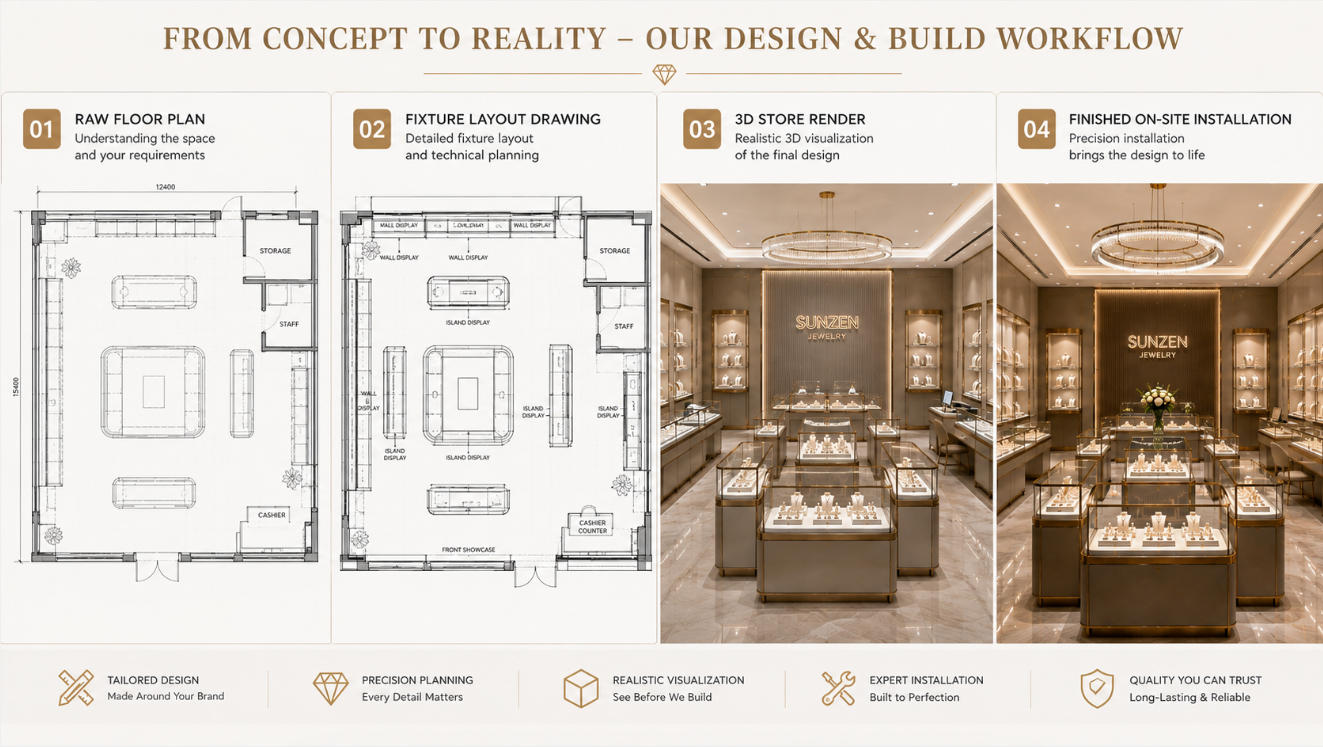
Once the store layout is established, the project moves from spatial planning into fixture development. The design needs to define how different display families relate visually before technical engineering begins.
3D visualization can be used to review the complete boutique, while CAD drawings translate the approved direction into dimensions, structures, glass, hardware, lighting and storage information for manufacturing.
For projects where the complete interior environment is still being developed, our jewelry store design service focuses more deeply on layout, circulation, materials, lighting and the overall boutique experience.
From Store Information to an Approved Fixture Package
Build the Fixtures Around the Store, Jewelry and Brand
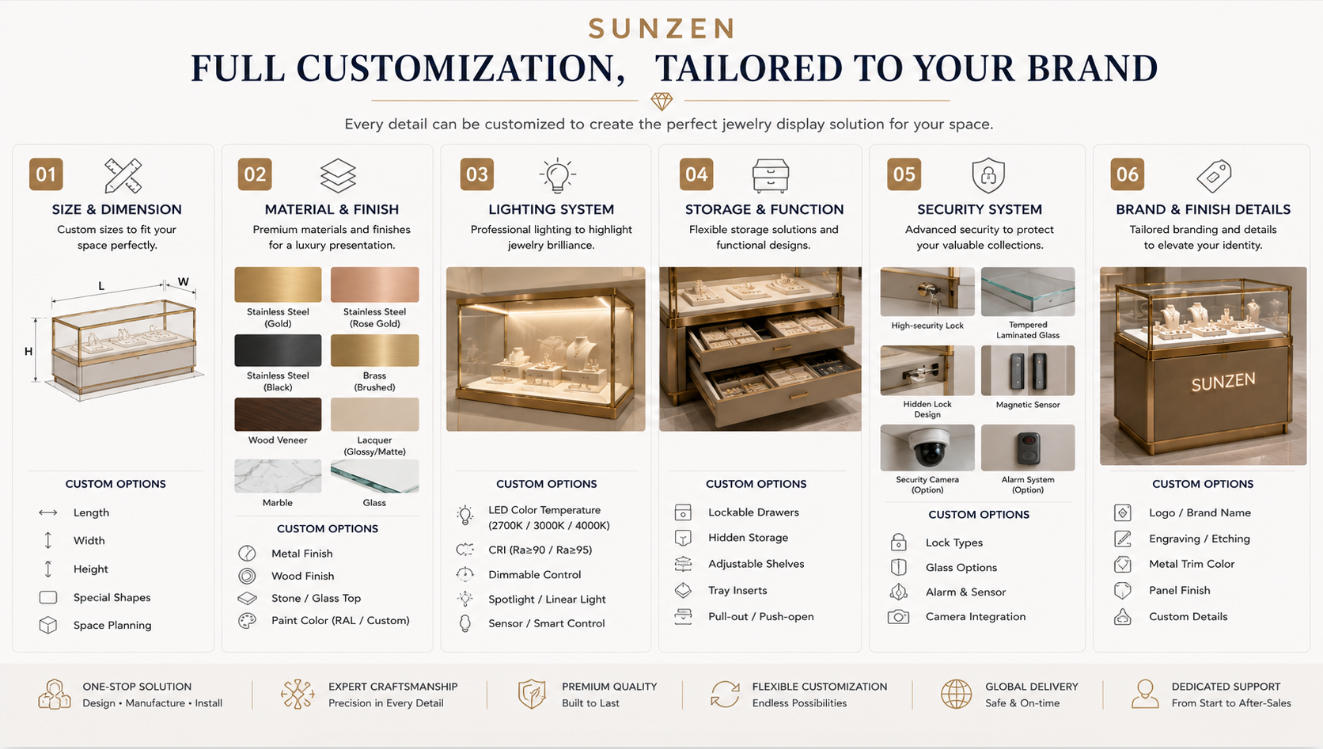
Custom manufacturing allows each fixture to respond to the actual boutique rather than forcing the retail space to accommodate predetermined furniture dimensions.
The degree of customization can extend beyond visible finishes to include internal storage, opening systems, lighting, hardware and other operational details.
Customize What Matters Instead of Adding Decoration Everywhere
Spatial Fit
Dimensions and fixture geometry should respond first to the actual store architecture and circulation requirements.
Merchandise Presentation
Display height, glass enclosure, lighting and internal presentation should support the jewelry being shown.
Brand Expression
Materials, proportions and selected details can communicate brand character without overwhelming the merchandise.
Keep Different Jewelry Fixtures Visually Consistent
One of the main advantages of developing a complete fixture package with the same manufacturer is the ability to coordinate different display types under one design and material system.
A wall showcase and an island display do not need to look identical, but they should feel like parts of the same boutique. Frame proportions, finish tones, glass details, lighting character and interior presentation can establish that relationship.
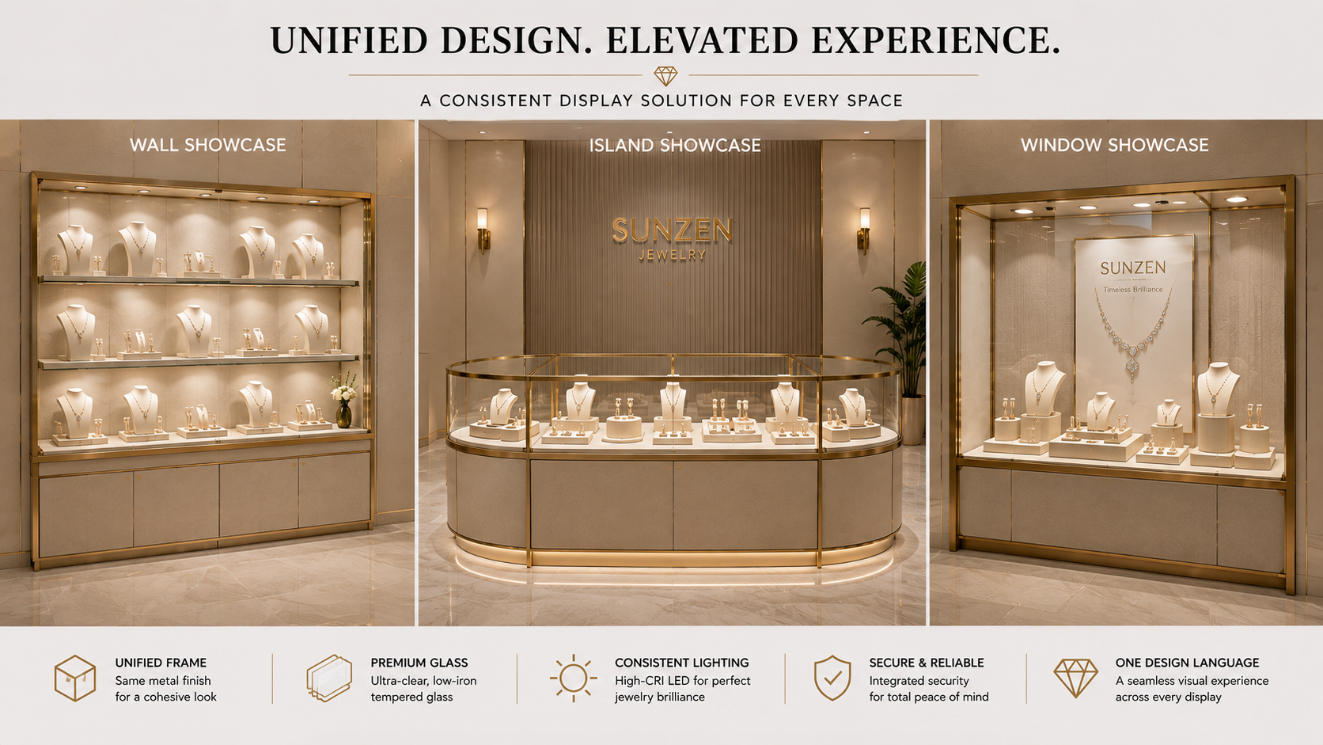
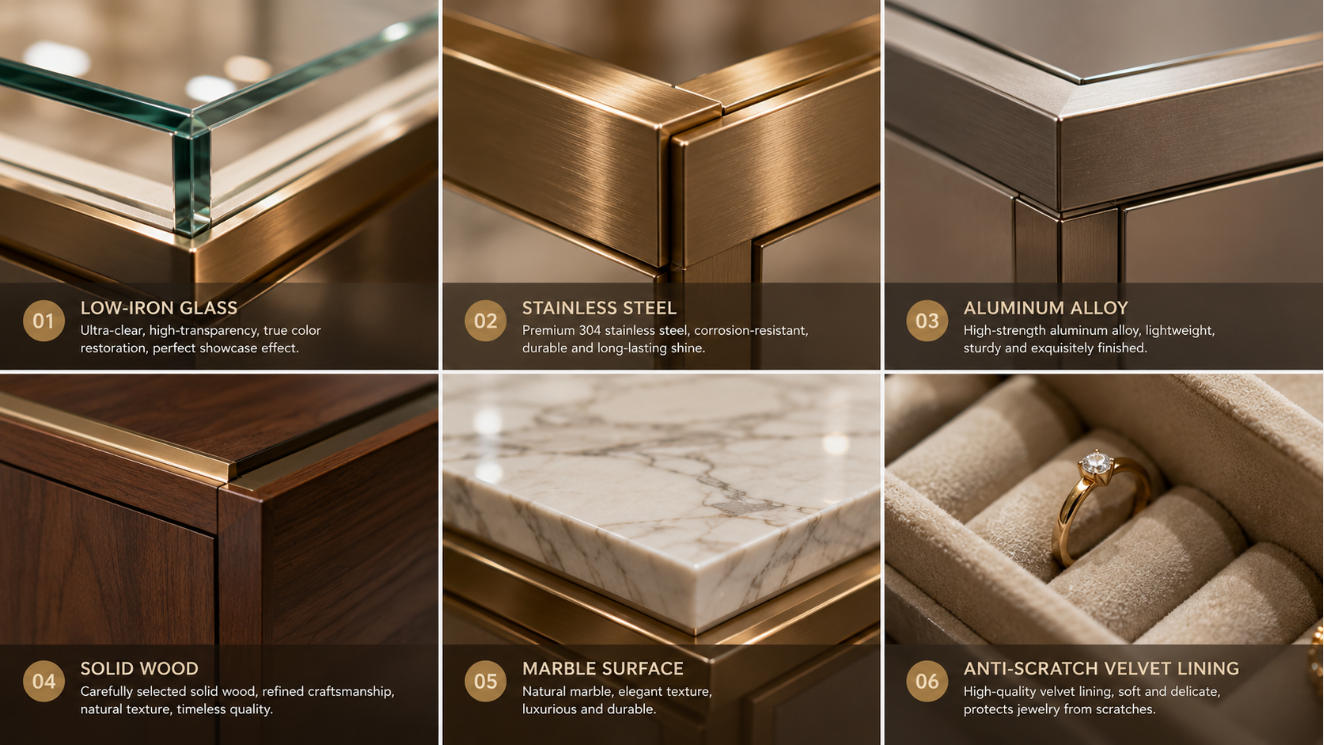
Coordinate Materials Across the Complete Jewelry Store Fixture Package
Material quality affects both the visual character and the daily performance of jewelry store fixtures. Glass, metal, cabinetry, stone, interior lining and lighting should be considered as parts of one coordinated material system rather than selected independently for each cabinet.
For complete-store projects, approved finish references help maintain a consistent appearance across wall showcases, island displays, counters and other fixture families.
Choose Materials for Appearance, Durability and Production Consistency
Support the Jewelry
Materials should create an appropriate visual background for the merchandise rather than compete with the products.
Support Retail Operation
Frequently touched counters, drawers, doors and staff-accessible areas should be selected with practical daily use in mind.
Support Full-Store Matching
Approved samples and finish references help keep different fixture types visually coordinated across the project.
From Approved Drawings to Complete Jewelry Store Fixture Production
Once the design, CAD drawings and material specifications are confirmed, different components move into production. Metal fabrication, cabinetry, glass preparation, surface finishing, lighting installation and hardware assembly need to remain coordinated throughout the process.
The objective is not only to produce each fixture correctly, but also to maintain a consistent standard across the complete store package.
Metal Fabrication
Structural frames and decorative metal elements are processed according to the approved engineering dimensions and finish requirements.
Cabinet Manufacturing
Wood structures, panels, drawers and storage systems are fabricated around the required fixture geometry.
Glass Processing
Glass dimensions and edges are coordinated with frames, doors, access systems and the display enclosure.
Surface Finishing
Metal, lacquer, veneer and other visible finishes are controlled against approved project references.
Lighting Installation
LED channels, wiring and drivers are integrated before final fixture assembly.
Final Assembly
Glass, frames, cabinets, hardware, lighting and decorative components are brought together and adjusted as one finished fixture.
Review the Jewelry Store Fixtures as a Complete Production Package
Full-store jewelry projects benefit from manufacturing coordination because different fixture families may share dimensions, materials, finishes and lighting standards.
Before packing, related fixtures can be assembled and reviewed together where the project requires more detailed store-wide coordination.
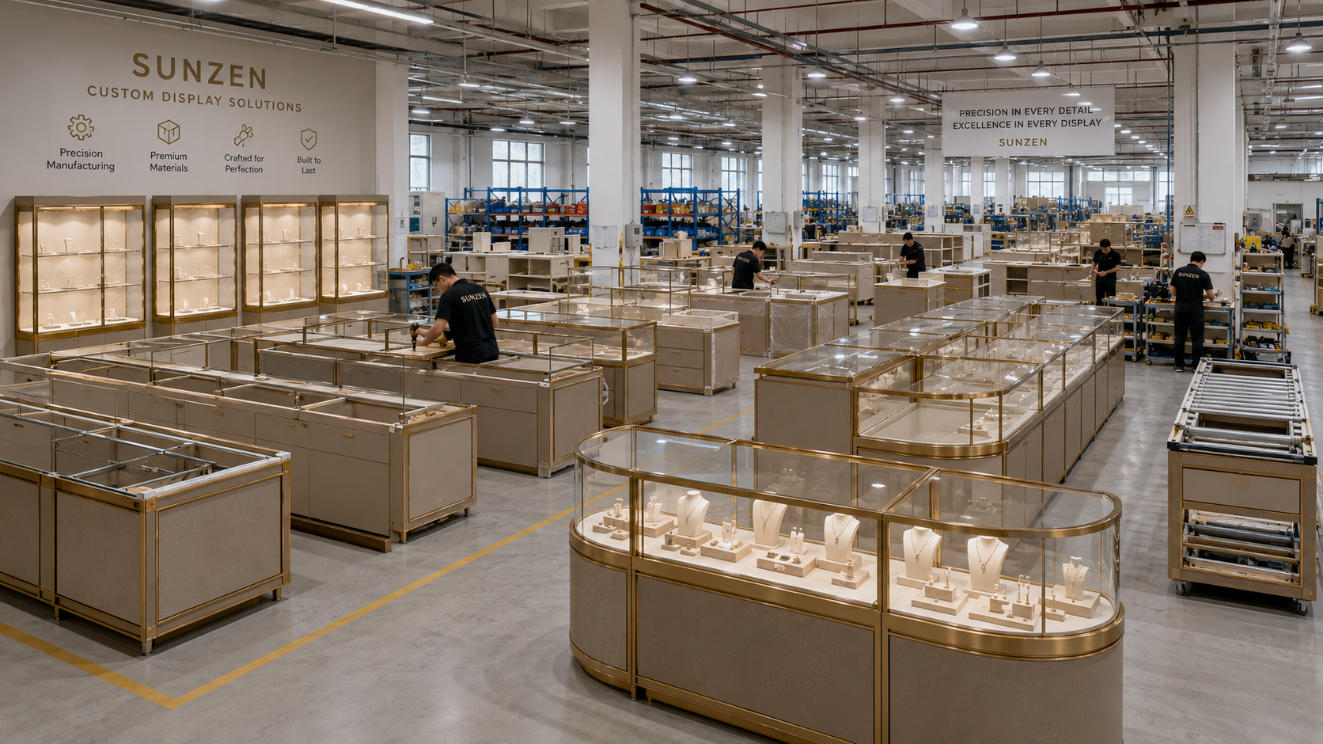
Why Manufacturing Different Fixtures Together Matters
Finish Consistency
Different fixture families can be compared against the same approved material references during production.
Lighting Consistency
Related showcases can be reviewed together to maintain a more coordinated product presentation.
Dimensional Coordination
Fixture sizes and relationships can be checked against the complete store layout before shipment.
Shared Engineering Standards
Common construction details can help unify wall, island, counter and feature display families.
Installation Organization
Fixture numbering and project documentation can make overseas installation easier to coordinate.
Project-Level QC
Quality inspection can evaluate the complete package instead of treating every cabinet as an isolated product.
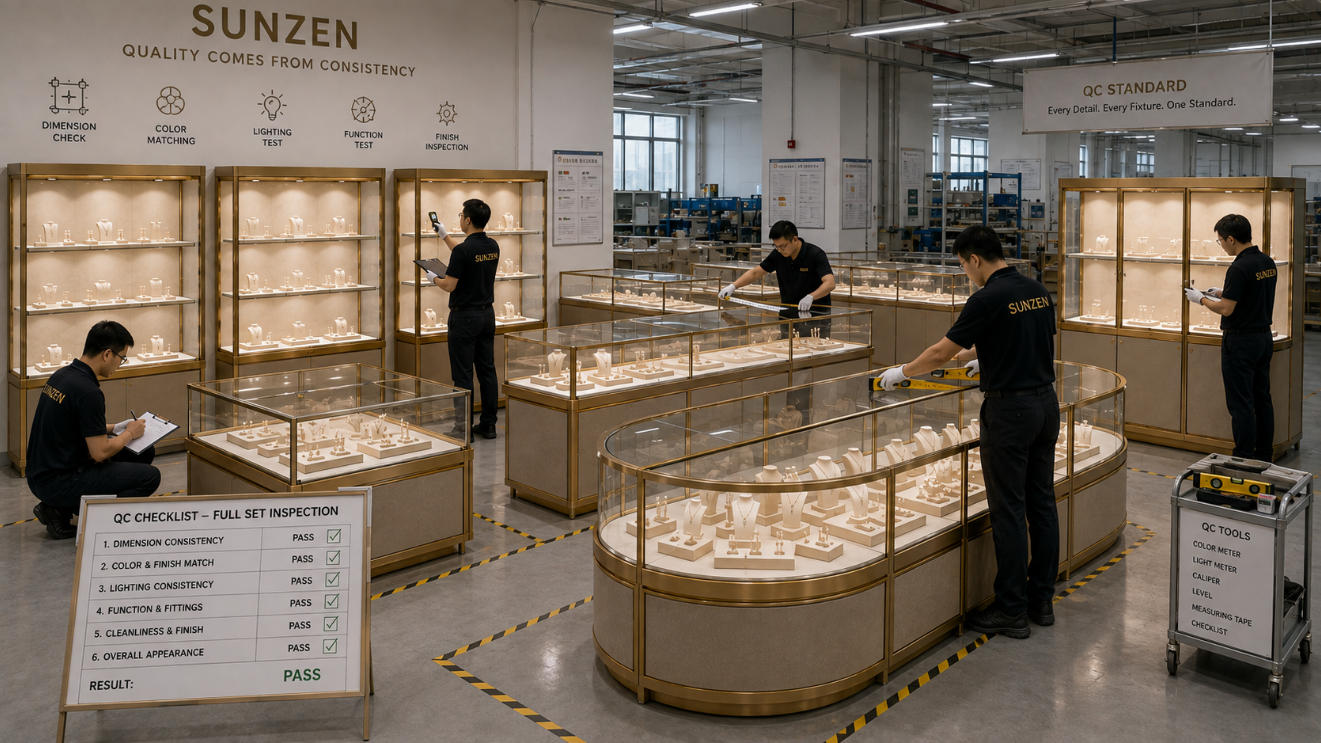
Inspect the Complete Jewelry Store Fixture Set Before Delivery
Quality control should review both individual fixture performance and consistency across the complete project. Dimensions, finishes, glass, lighting, hardware and visible details all contribute to the final boutique environment.
When multiple fixture types are part of one store package, comparing them together can help identify differences that may not be obvious when each unit is inspected separately.
What Should Be Checked Before the Fixture Package Leaves the Factory?
Dimensions & Alignment
Finished fixture sizes, glass alignment and visible component relationships should follow approved drawings.
Material Consistency
Metal, wood, lacquer and interior finishes should remain visually coordinated across the store package.
Doors & Drawers
Opening systems, locks, hinges and staff-accessible components should operate correctly.
Display Enclosure
Glass panels and joints should be reviewed for installation quality and visible condition.
Integrated Illumination
Lighting should be tested for operation and suitable visual consistency across related showcases.
Full-Set Review
Related fixtures can be evaluated together before packing where project-wide consistency is important.
Fixture Systems for Different Jewelry Store Formats
Fine Jewelry Stores
Premium display packages combining secure showcases, consultation areas and refined material finishes.
Flagship Jewelry Stores
Complete fixture families for larger stores with multiple merchandise zones, feature displays and private consultation areas.
Shopping Mall Jewelry Stores
Compact yet coordinated display systems developed around mall storefront visibility and efficient circulation.
Department Store Concepts
Brand-focused fixture packages designed for open retail environments where surrounding visibility is important.
Jewelry Kiosks
Standalone retail fixtures combining displays, storage, customer interaction and brand presentation in compact spaces.
Multi-Store Programs
Repeatable fixture specifications can support brands opening multiple locations with a consistent retail identity.
Single-Store Projects and Multi-Store Rollouts Need Different Manufacturing Strategies
Single Jewelry Store
A single boutique can use highly customized fixture dimensions, unique materials and project-specific engineering tailored to one location.
Priority: maximize design flexibility and fit the actual store conditions.
Multi-Store Rollout
A rollout program requires stronger standardization so fixture families can remain recognizable while adapting to different store dimensions.
Priority: repeatable engineering, controlled materials and consistent brand presentation.
Turn an Approved Fixture System Into a Repeatable Store Standard
For jewelry brands planning multiple locations, an approved fixture package can become the basis for later stores. The objective is not to make every site identical, but to establish repeatable standards that preserve the same brand and manufacturing language.
Standard Fixture Families
Develop repeatable wall, island, counter and feature display types that can be adapted to different floor plans.
Approved Materials
Maintain consistent finish references for metal, wood, glass, stone and display interiors across later locations.
Engineering Reference
Approved CAD details provide a starting point for adapting fixtures to different site dimensions and operational conditions.
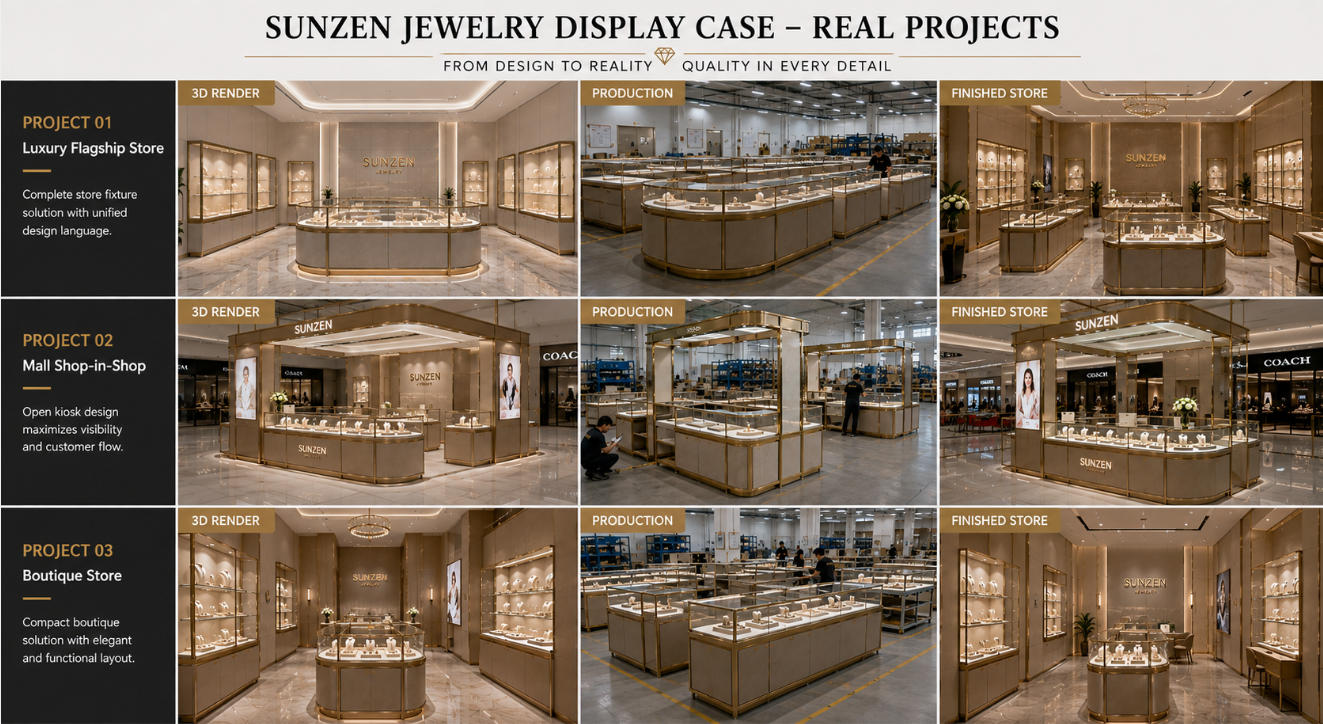
See How a Complete Jewelry Fixture System Performs in Real Stores
Completed projects show how layout planning, fixture engineering, material coordination and manufacturing come together in the final retail environment.
A well-developed jewelry store should not feel like a collection of unrelated cabinets. Wall showcases, island displays, counters, feature cases and service furniture should work together as one coordinated system.
Explore SUNZEN’s jewelry showcase projects to see different fixture combinations and completed boutique applications.
What Should You Look for in a Jewelry Store Fixture Manufacturer?
Layout Awareness
The manufacturer should understand how fixture dimensions and positions affect customer circulation, merchandise zones and store operation.
Production-Ready CAD
Approved concepts should be translated into practical dimensions, structures, glass details, hardware and lighting information before manufacturing.
Finish Coordination
Glass, metal, wood, stone and interior finishes should be controlled across different fixture families.
Full-Store Capability
The factory should be able to coordinate wall displays, islands, counters, feature showcases and operational furniture within one project.
Project-Level Inspection
Quality control should evaluate both individual fixtures and consistency across the complete store package.
International Project Support
Fixture identification, export packaging and installation information should be prepared according to project requirements.
Jewelry Store Fixture Manufacturing From Planning to Delivery
Store-Oriented Development
Fixture packages can be developed around the actual jewelry store layout, merchandise and retail positioning.
Visual Review Before Production
3D visualization helps evaluate fixture relationships, materials and the overall boutique environment before engineering is finalized.
Technical Engineering
Production drawings define the dimensions, structures, access systems, lighting and material relationships required for manufacturing.
Coordinated Manufacturing
Different fixture families can move through one manufacturing process using shared project specifications and finish references.
Full-Set Inspection
Related fixtures can be reviewed together before delivery where full-store consistency is important.
Complete Store Packages
Scope can extend from individual showcases to full jewelry store fixture systems with multiple display and service functions.
Why Connect Store Planning, Engineering and Manufacturing?
Better Spatial Fit
Fixture dimensions can be coordinated with the actual floor plan before production begins.
Better Material Consistency
Different fixture types can follow shared finish references across the complete boutique.
Better Engineering Control
Glass, metal, cabinetry, lighting and storage details can be resolved before final manufacturing.
Better Store Operation
Staff access, drawers, locks, customer interaction and service zones can be considered during fixture development.
Better Installation Coordination
Fixture numbering and drawings can make site installation and positioning easier to manage.
Better Brand Consistency
Wall, island, counter and feature fixtures can maintain one recognizable design language throughout the store.
What Information Helps Develop the Right Jewelry Store Fixture Package?
Explore SUNZEN Jewelry Store Solutions by Project Requirement
Jewelry Display Cases
Explore different showcase formats for counters, islands, walls, windows, upright displays and feature vitrines.
Browse our jewelry display cases.
Jewelry Store Design
Learn how layout planning, customer circulation, materials, lighting and fixtures can be developed as one complete retail environment.
Explore our jewelry store design solutions.
Jewelry Store Interior Design
Explore deeper coordination between interior architecture, display systems, material hierarchy and retail planning.
See our jewelry store interior design and display solutions.
Luxury Jewelry Store Design
Review premium boutique planning focused on luxury materials, clienteling and bespoke showcase development.
Explore our luxury jewelry store design and custom showcases.
Custom Jewelry Showcase Factory
See how individual custom showcases are engineered and manufactured through metal, wood, glass, lighting, assembly and QC processes.
Explore our jewelry showcase factory.
Jewelry Showcase Projects
View completed jewelry retail applications and different combinations of custom display fixtures.
Explore our jewelry showcase projects.
Develop the Complete Fixture System Around the Store From the Beginning
A successful jewelry store fixture package should support product presentation, customer circulation, consultation, staff operation and brand identity at the same time.
By coordinating the floor plan, fixture families, materials, lighting, engineering and manufacturing from the beginning, wall showcases, islands, counters and supporting furniture can become parts of one complete jewelry retail environment.
This approach is especially valuable for full-store projects and multi-location programs where consistency across different fixture types matters as much as the quality of each individual cabinet.
Jewelry Store Fixture Manufacturer FAQs
What fixtures are typically included in a complete jewelry store package?
A complete jewelry store package can include wall showcases, island showcases, counter displays, window showcases, upright or pedestal vitrines, consultation furniture, cashier counters, storage cabinets and other project-specific fixtures.
Can jewelry store fixtures be manufactured to custom dimensions?
Yes. Fixture length, depth, height, geometry, storage and display dimensions can be developed around the actual store layout, merchandise and operational requirements.
Can SUNZEN provide both design and manufacturing for a jewelry store?
Yes. Project scope can include layout development, 3D visualization, fixture design, CAD engineering, material confirmation, manufacturing and quality control according to the project requirements.
What materials are commonly used for jewelry store fixtures?
Jewelry store fixtures commonly combine glass, metal, engineered wood, veneer, lacquer, stone, interior lining materials, lighting components and hardware. The exact specification depends on the design and project requirements.
Can different jewelry showcase types be manufactured with the same design language?
Yes. Wall showcases, island displays, counters, upright vitrines and feature cases can share coordinated materials, finish tones, glass details, lighting character and design proportions while still performing different retail functions.
How are complete jewelry store fixture packages inspected?
Inspection can include finished dimensions, glass installation, material finishes, lighting, locks, doors, drawers and other functional components. Related fixtures can also be compared together for project-wide consistency before delivery.
Can SUNZEN support multi-store jewelry retail rollouts?
Yes. Approved fixture families, CAD details and material references can provide a repeatable basis for adapting the same retail identity to different store locations.
What information should I provide for a jewelry store fixture quotation?
Useful information includes the store floor plan, required fixture types, jewelry categories, design references, brand requirements, preferred materials, operational needs, project location and expected schedule.
Can jewelry store fixtures be prepared for overseas delivery?
Yes. Fixture packages can be prepared for international projects with protective export packaging, module identification and relevant installation information according to the agreed project scope.

