
What Makes a Display Case Manufacturer Suitable for Luxury Retail Projects?
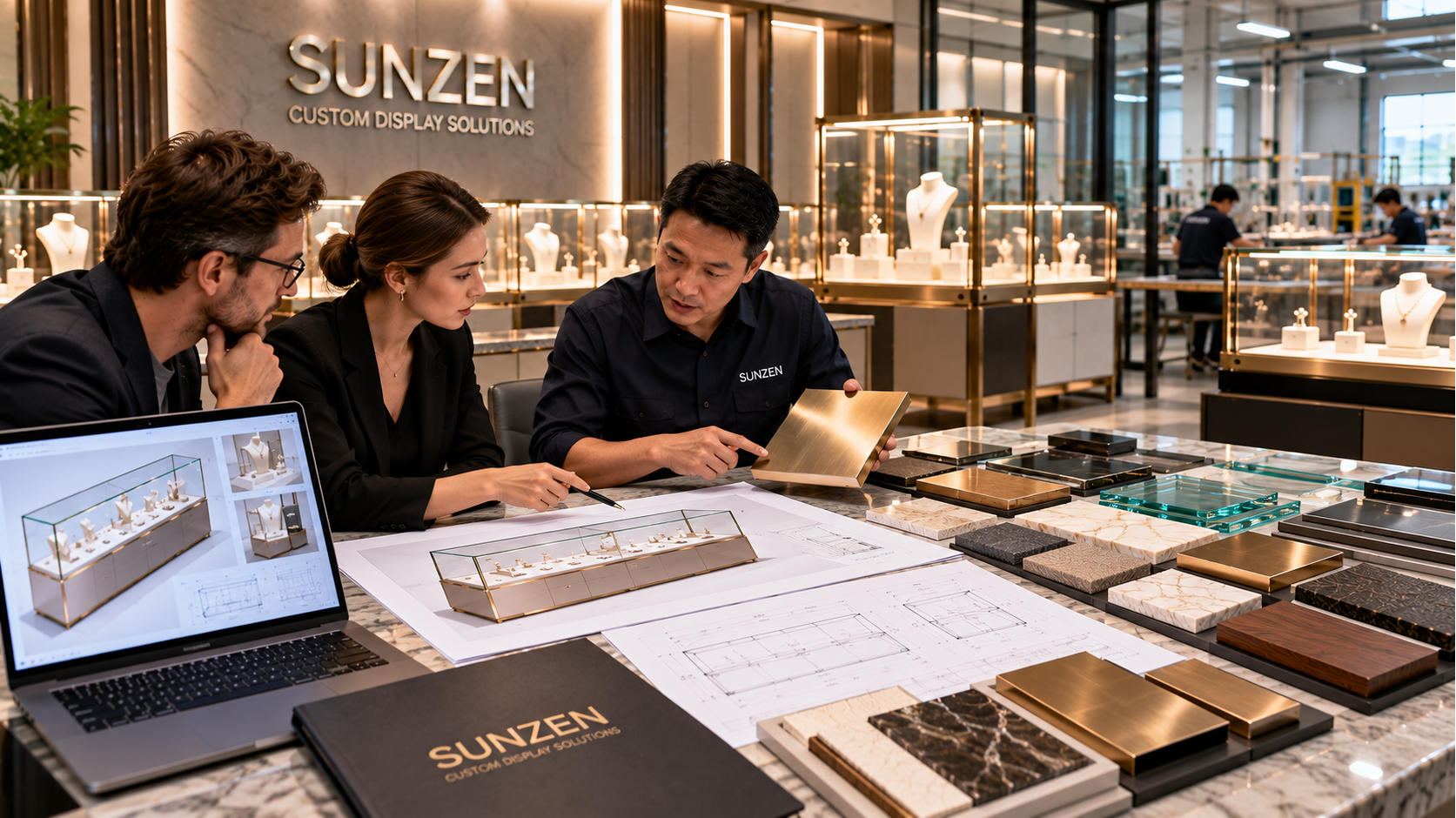
A display case manufacturer is suitable for a luxury retail project when it can do more than fabricate a cabinet that matches the basic dimensions.
Luxury execution requires the manufacturer to translate design intent into a buildable fixture while controlling proportions, glass, metal finishes, material transitions, lighting, hardware, tolerances and visual consistency throughout production.
For luxury brands and designers, the real question is therefore not simply, “Can this factory manufacture a display case?” It is, “Can this manufacturer reproduce the level of refinement the brand expects, consistently and at project scale?”
Luxury Retail Manufacturing Is Different From Ordinary Fixture Production
Two manufacturers may be capable of building the same basic glass-and-cabinet structure, yet produce very different results once the fixture is installed in a premium retail environment.
| Capability | Ordinary Fixture Production | Luxury Retail Execution |
|---|---|---|
| Design | Manufacture to basic dimensions | Preserve proportions, detailing and design intent |
| Materials | Use materials that meet general specification | Control visual quality, texture and material interaction |
| Metal Finish | Achieve an acceptable finish | Maintain controlled tone, sheen, direction and consistency |
| Glass | Fit transparent panels into the fixture | Control clarity, edges, joints, reflections and alignment |
| Lighting | Provide functional illumination | Integrate lighting into the visual merchandising experience |
| Assembly | Achieve functional operation | Control gaps, reveals, joints and visible transitions |
| QC | Check dimensions and basic function | Inspect technical performance and visual refinement |
This is why sourcing luxury retail display cases should involve evaluating execution capability rather than comparing factories only by machinery, capacity or quoted price.
1. Can the Manufacturer Translate Design Intent Into Production?
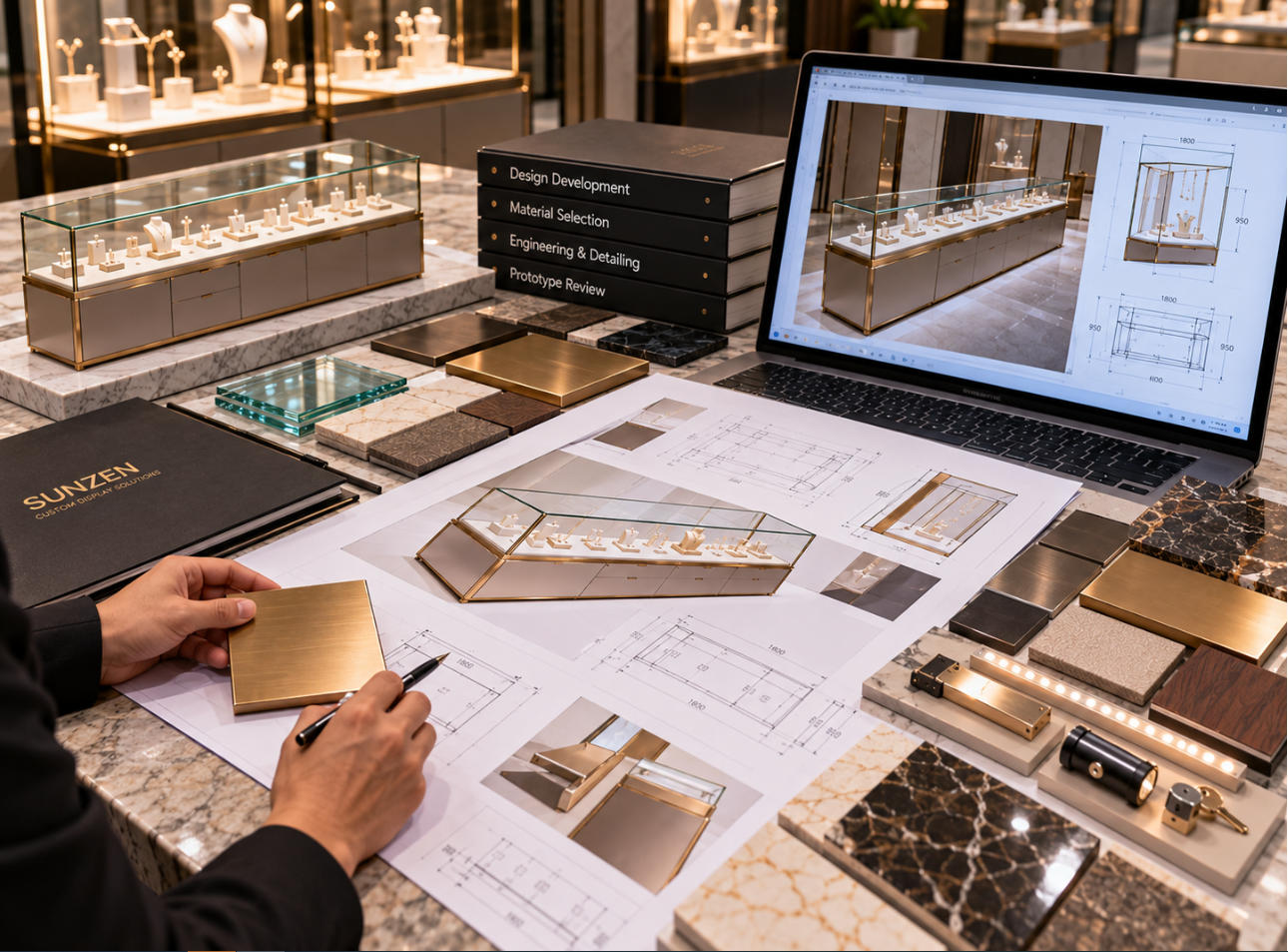
Luxury Details Must Survive Engineering
A visually strong concept can lose much of its character if proportions, edge details, reveals or material transitions are simplified during engineering.
From Concept Drawing to Buildable Fixture
Luxury brands and design firms often begin with renders, elevations, material palettes or architectural concepts rather than fully resolved manufacturing drawings.
The manufacturer needs to determine how the proposed glass, metal, cabinetry, stone, lighting and hardware can be integrated without unnecessarily changing the intended appearance.
This makes display case design and engineering coordination particularly important when a fixture includes concealed construction or complex material interfaces.
What Should Designers Look For?
- Clear shop drawings and sections
- Understanding of critical visual details
- Practical solutions for concealed construction
- Ability to identify manufacturing risks early
- Controlled revision and approval procedures
2. How Important Are Finishes in Luxury Display Case Manufacturing?
Finishes are one of the clearest differences between ordinary fixture manufacturing and luxury retail execution.
In a premium store, customers view fixtures from short distances under controlled lighting. Small variations in metal tone, sheen, texture, joints or material transitions can therefore become highly visible.
Metal
Brushed, polished, plated, PVD or painted surfaces need consistent color, sheen and directional treatment across adjoining components.
Wood & Cabinetry
Veneer selection, grain direction, lacquer quality, edge treatment and panel alignment influence the perceived quality of the complete fixture.
Stone
Natural variation, joint positioning, edge profiles, substrate design and weight must be considered before stone becomes part of the final showcase.
Fabric & Leatherette
Interior lining requires controlled color, texture, seams and clean installation because it sits directly behind the merchandise.
Glass
Glass quality affects transparency, reflections, edge appearance and the visual separation between the product and the customer.
Transitions
The point where glass meets metal, stone meets cabinetry or lighting meets structure often determines whether a fixture feels refined or merely expensive.
3. A Luxury Manufacturer Needs a Real Finish-Control Process
Do Not Approve Finishes From Descriptions Alone
Terms such as “champagne gold,” “brushed bronze,” “warm gray” or “high-gloss lacquer” are not sufficiently precise by themselves for a brand-sensitive project.
Important visible finishes should be established through physical samples or another agreed reference before production.
Control the Approved Reference
The manufacturer should be able to identify which sample is approved, retain the production reference and compare finished components against that standard.
This becomes particularly important when a project uses a coordinated family of luxury retail fixtures rather than a single standalone display case.
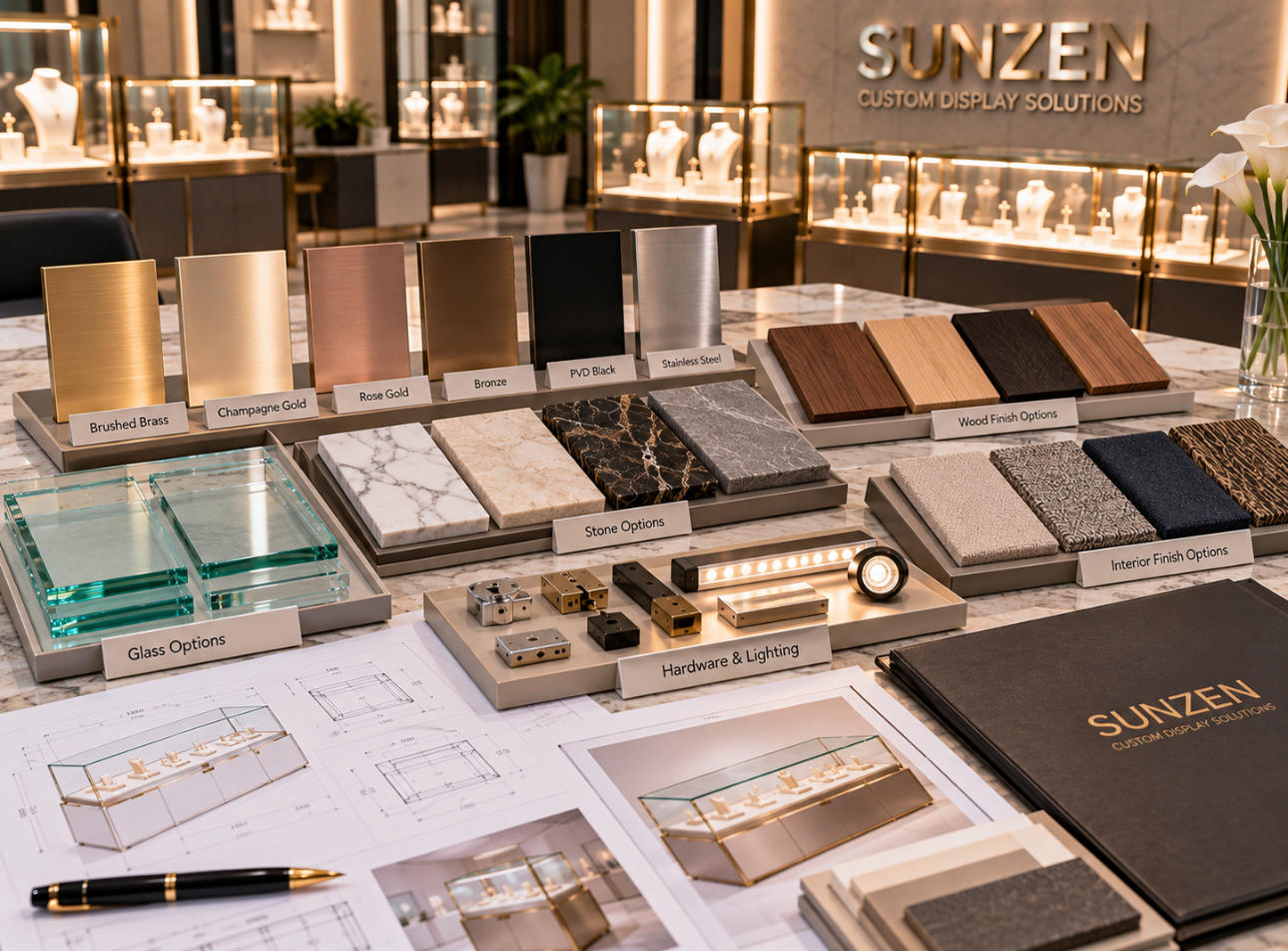
Finish Consistency Is a Manufacturing Capability
The important capability is not simply producing one attractive sample. It is reproducing the approved appearance across all visible components and, where required, across multiple fixtures.
4. Glass Quality Must Support the Merchandise, Not Compete With It
Luxury display cases often depend heavily on transparency. The glass enclosure should allow the merchandise to remain visually dominant while the fixture itself feels precise and controlled.
Glass Selection
The manufacturer should understand when standard glass is adequate and when low-iron, laminated, tempered or other project-specific glass is appropriate.
Glass Execution
Selection alone is not enough. Edge quality, alignment, joint consistency, silicone or bonding details and interaction with the frame affect the final result.
For projects where high transparency is central to the visual concept, low iron glass display cases may be considered as part of the specification rather than treated as an automatic upgrade for every luxury fixture.
5. Lighting Should Be Engineered as Part of the Display Case
Luxury retail lighting is not simply an LED strip added near the end of production. The lighting system affects how jewelry, watches, perfume, cosmetics and other premium merchandise are perceived.
| Lighting Detail | Why It Matters |
|---|---|
| Color Rendering | Influences how accurately merchandise colors and materials appear |
| Color Temperature | Changes the visual character of products and surrounding finishes |
| Beam Position | Determines where light falls and whether key products receive emphasis |
| Diffusion | Helps control visible LED points and uneven illumination |
| Concealment | Keeps wiring, drivers and structural components out of the customer view |
| Maintenance Access | Allows components to be serviced without unnecessarily dismantling the fixture |
6. Luxury Quality Is Often Visible in Millimeters
A display case can meet its overall dimensions and still look poorly executed. Luxury retail projects place greater emphasis on the small relationships customers actually see.
Door Gaps
Adjacent doors and drawers should read as a controlled visual system.
Glass Alignment
Glass panels should relate cleanly to frames, tops and neighboring surfaces.
Reveal Lines
Shadow gaps and reveals need consistent width and continuity.
Flush Surfaces
Transitions between adjoining materials should follow the approved design intent.
Edge Details
Visible edges, miters and corners often reveal the quality of fabrication immediately.
Hardware Operation
Doors and drawers should operate smoothly without undermining alignment when closed.
A capable custom display case manufacturer therefore needs both dimensional control and visual QC for premium projects.
7. When Should a Luxury Brand Request a Prototype or First Article?
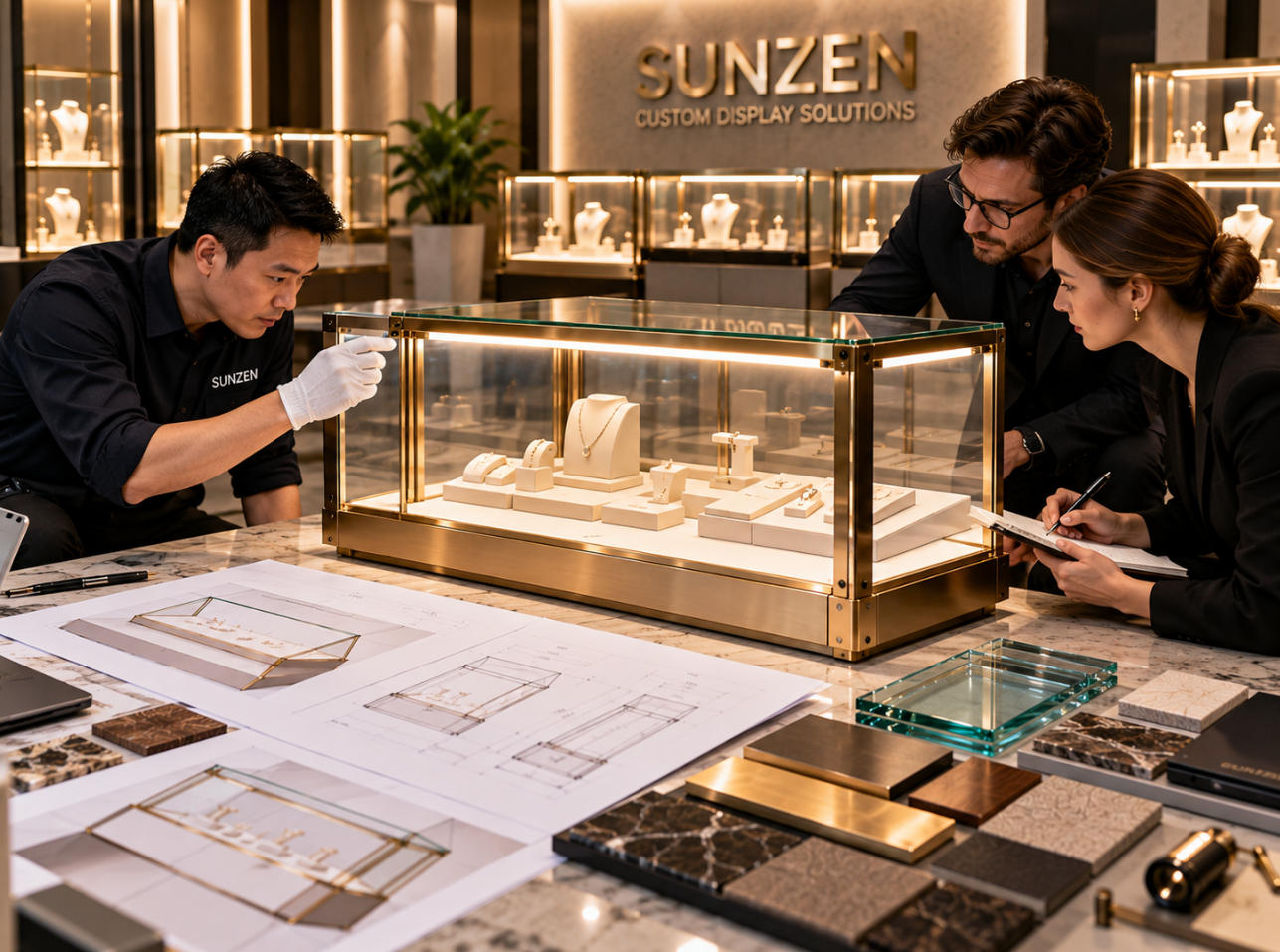
A Prototype Is an Execution Test
For an important new fixture family, a prototype allows the team to evaluate the physical result before repeating the design across multiple production units.
Prototype Review Can Include
- Overall proportions
- Material combinations
- Metal color and sheen
- Glass alignment
- Lighting performance
- Door and drawer operation
- Lock integration
- Interior presentation
- Visible gaps and transitions
- Service and maintenance access
Prototyping is particularly valuable when the fixture will later become a repeatable brand standard or be used across several locations.
8. Can the Manufacturer Maintain Brand Consistency Across Multiple Fixtures?
Luxury execution is not proven by producing one strong display case. A brand environment may contain wall showcases, counters, islands, freestanding vitrines and other fixture types that all need to share the same material and detailing language.
The manufacturer should therefore be able to manage approved finish references, component specifications, drawings and QC standards across the full fixture family.
This is particularly important for luxury brand retail fixtures, where consistency across different fixture formats is part of the brand experience.
9. Luxury Execution Becomes Harder When the Brand Expands to Multiple Stores
A flagship prototype may be carefully supervised, but a rollout requires the same approved quality to be reproduced across batches and locations.
| Rollout Requirement | Capability to Evaluate |
|---|---|
| Finish consistency | Can approved metal, wood, stone and lining references be reproduced? |
| Fixture repeatability | Can dimensions, gaps and construction remain controlled across batches? |
| Component control | Can the same lighting and hardware specifications be maintained? |
| Store adaptation | Can fixtures adapt to different layouts without losing the brand language? |
| Documentation | Can approved drawings and finish standards be retained for future orders? |
For international or repeated programs, the challenge therefore moves from one-off craftsmanship to controlled luxury production.
10. The Manufacturer Must Work Effectively With Designers and Project Teams
Luxury retail fixtures rarely exist as isolated products. They interact with flooring, walls, lighting, electrical systems, signage, architectural finishes and merchandising.
The manufacturer should therefore be able to communicate with brand teams, designers and contractors about dimensions, interfaces, electrical requirements, fixing conditions and installation constraints.
This is one reason a capable retail fixture manufacturer should be evaluated not only by factory output but also by its ability to support technical coordination throughout the project.
11. What Should Quality Control Look Like for Luxury Display Cases?
Luxury QC should combine technical inspection with visual inspection.
Technical QC
- Overall dimensions
- Glass dimensions and alignment
- Door and drawer operation
- Locks and hardware
- Lighting and electrical functions
- Stability and assembly
Visual QC
- Metal finish consistency
- Surface defects
- Visible gaps and reveals
- Joint quality
- Material transitions
- Interior cleanliness and presentation
The manufacturing process should ultimately protect the approved design rather than treating QC as a final dimensional check after all visual decisions have already been made.
Luxury Display Case Manufacturer Capability Scorecard
When shortlisting manufacturers for a premium retail project, use a capability scorecard rather than evaluating price and factory size alone.
| Capability | What to Verify | Priority |
|---|---|---|
| Design Translation | Can concepts and architectural details be converted into controlled manufacturing information? | High |
| Material Knowledge | Can glass, metal, wood, stone and lining materials be integrated correctly? | High |
| Finish Control | Can approved colors, textures and sheen levels be reproduced consistently? | High |
| Glass Execution | Are clarity, edges, alignment and joints controlled? | High |
| Lighting Integration | Is lighting engineered into the fixture rather than added as an afterthought? | High |
| Prototype Capability | Can critical designs be physically validated before repeat production? | Medium–High |
| Visual QC | Are gaps, finishes, transitions and visible details inspected? | High |
| Brand Consistency | Can approved standards be maintained across a complete fixture family? | High |
| Project Coordination | Can the manufacturer work with designers, contractors and brand teams? | High |
| Repeatability | Can the same quality be reproduced across future batches or stores? | Project Dependent |
What Evidence Should a Luxury Brand Request Before Selecting a Manufacturer?
Marketing photographs are useful, but supplier evaluation should go further. Ask for evidence that shows both finished quality and how that quality is achieved.
Before Shortlisting
- Relevant luxury retail project examples
- Factory and production capability
- Examples of complex material combinations
- Engineering or shop drawing capability
- Examples of finish quality
Before Production
- Approved drawings
- Material and finish samples
- Glass specification
- Hardware and lighting specification
- Prototype or first article where appropriate
- Defined QC and approval criteria
Where possible, compare finished project evidence with actual showcase manufacturing capability so the evaluation is based on execution rather than presentation alone.
Planning a Luxury Retail Display Case Project?
SUNZEN works with brands, designers and project teams on custom display cases and retail fixtures requiring coordinated glass, metal, cabinetry, lighting and premium finish execution.
For an initial project review, provide available drawings, renders, material references, fixture quantities, destination information and project schedule. The manufacturing requirements can then be reviewed against the intended design and execution standard.
Review Your Luxury Display Case Requirements
Share your drawings, design references and material requirements with SUNZEN to discuss manufacturing feasibility, finish control and project execution.
Discuss Your Luxury Retail ProjectFrequently Asked Questions
What makes a display case manufacturer suitable for luxury retail projects?
A suitable manufacturer should be able to translate design intent into manufacturable fixtures while controlling premium materials, glass, finishes, lighting, hardware, tolerances and visual consistency. It should also support samples, prototypes, technical coordination and quality control appropriate to the project.
What capabilities should luxury brands look for in a display case manufacturer?
Luxury brands should evaluate design and engineering support, material knowledge, finish control, glass execution, lighting integration, prototype capability, visual quality control, project coordination and the ability to reproduce approved standards consistently.
How important are finishes in luxury display case manufacturing?
Finishes are highly important because customers view retail fixtures at close range. Metal tone and sheen, wood grain, lacquer quality, stone details, interior lining and material transitions can strongly influence the perceived quality of the completed fixture.
Should a luxury brand approve physical finish samples before production?
Physical samples are useful for important visible finishes because written descriptions or digital images may not accurately establish color, texture or sheen. The approved reference should be identified and retained for production comparison.
When should a luxury display case prototype be made?
A prototype or first article is especially useful for new, technically complex or repeatable fixture designs. It allows the team to review proportions, finishes, glass, lighting, hardware, material transitions and operation before wider production begins.
Why are tolerances important for luxury retail display cases?
Luxury fixtures are judged not only by overall dimensions but also by visible relationships such as door gaps, glass alignment, reveals, joints, flush surfaces and edge details. Small inconsistencies can be noticeable under premium retail lighting.
How should luxury display cases be quality controlled?
Quality control should combine technical checks such as dimensions, hardware, locks and lighting with visual checks for finish consistency, gaps, joints, glass alignment, material transitions and surface defects.
Can a manufacturer maintain luxury fixture quality across multiple stores?
It can if approved drawings, finish references, materials, lighting, hardware and QC standards are documented and controlled across production batches. Multi-store projects also require repeatability and the ability to adapt fixtures without losing the brand design language.

