
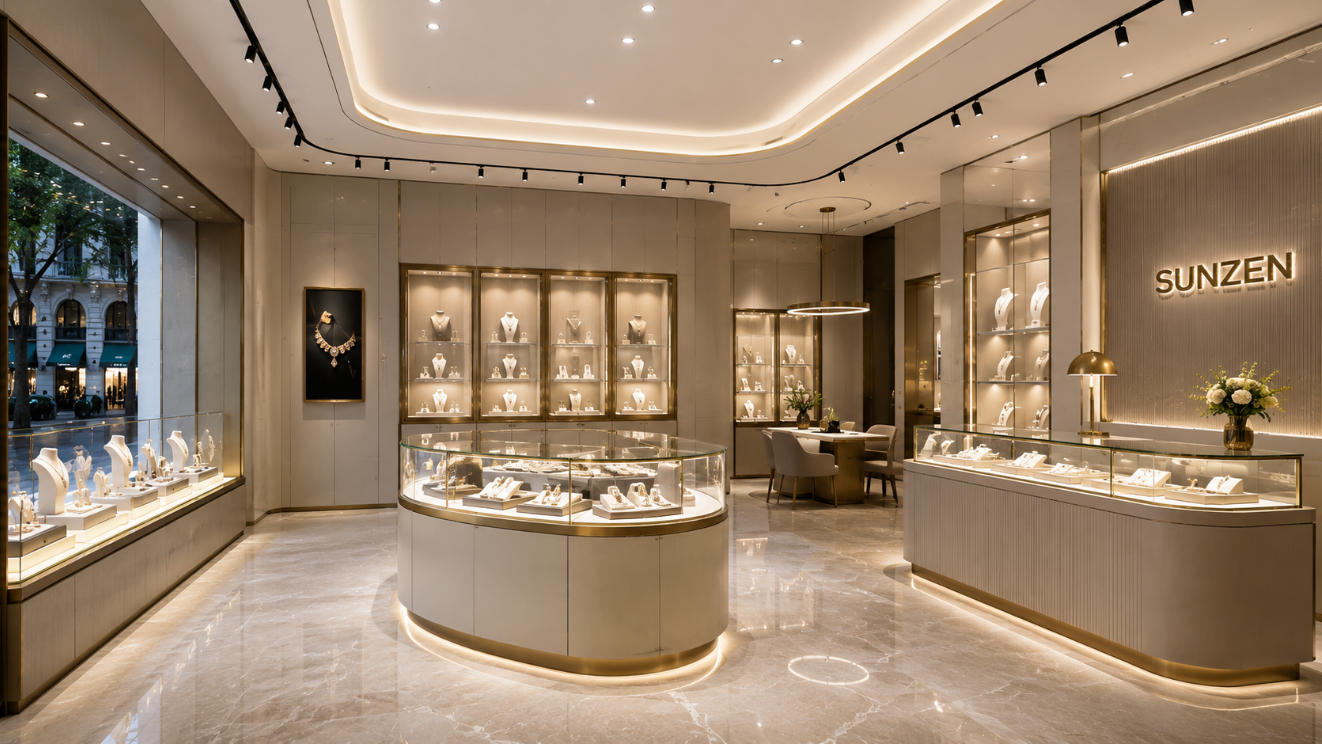
How to Design a Luxury Jewelry Store Showcase?
Professional layout planning, showcase positioning, lighting strategy, material selection and custom fixture coordination for luxury jewelry retail environments.
A successful jewelry store showcase design is not created by selecting attractive display cabinets independently. The showcases, customer circulation, sightlines, merchandise categories, lighting and surrounding interior architecture need to work as one retail system.
For luxury jewelry boutiques, every display position should help customers understand the collection while supporting consultation, security and efficient staff operation.
This guide explains how to develop a high-end jewelry store from the initial floor plan through showcase layout, lighting, materials, 3D visualization and production-ready fixture design.
For broader whole-store planning services, explore our jewelry store design solutions.
Start With the Store Experience — Not the Display Cabinet
The first question should not be “Which showcase looks best?” It should be “How should customers experience the jewelry?”
A store can contain beautiful fixtures and still feel uncomfortable if circulation is narrow, sightlines are blocked or display heights are inconsistent.
Effective luxury jewelry store design starts by understanding the customer journey, merchandise structure and sales process before individual showcases are positioned.
Customer Journey
Define how customers enter, browse, pause, receive consultation and move toward purchase.
Merchandise Hierarchy
Decide which collections deserve hero positions and which require higher-density display.
Staff Workflow
Maintain efficient access to showcases, storage, consultation and checkout areas.
Six Questions to Answer Before Designing the Store
Who Is the Target Customer?
A bridal boutique, diamond salon and high-volume gold retailer may require very different layouts and sales environments.
What Jewelry Will Be Displayed?
Rings, necklaces, gold, diamonds and colored gemstones create different presentation requirements.
What Are the Architectural Conditions?
Floor area, frontage, entrances, columns and ceiling conditions influence which fixture types can be used effectively.
How Does the Sales Process Work?
Determine whether customers mainly browse independently or receive one-to-one assisted consultation.
What Should the Store Communicate?
Proportions, materials and lighting should support the intended market position rather than follow decoration trends alone.
What Happens Behind the Display?
Storage, security, opening systems and replenishment need to be resolved before manufacturing.
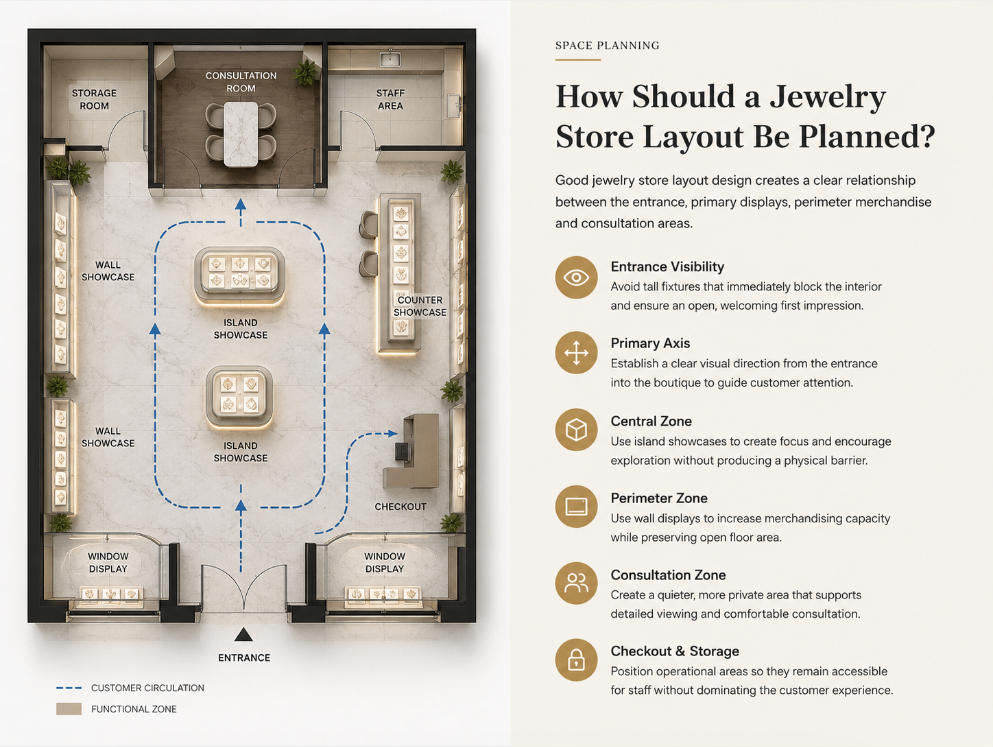
How Should a Jewelry Store Layout Be Planned?
Good jewelry store layout design creates a clear relationship between the entrance, primary displays, perimeter merchandise and consultation areas.
The layout should encourage exploration while keeping important categories easy to understand.
Use Different Showcase Types for Different Retail Functions
A professional jewelry store should not be filled with one repeated cabinet type. Different fixtures should perform different merchandising and spatial roles.
Jewelry Island Showcase
Creates a central merchandising zone and supports viewing from several directions.
Jewelry Wall Showcase
Uses the perimeter efficiently and organizes collections into clear vertical zones.
Jewelry Counter Showcase
Supports close viewing and staff-assisted jewelry presentation.
Jewelry Window Showcase
Creates the first merchandise impression before customers enter the store.
Jewelry Pedestal Showcase
Provides strong emphasis for signature pieces and limited collections.
Jewelry Upright Showcase
Creates vertical presentation without requiring a full architectural wall system.
Browse different jewelry display cases when selecting fixture formats.
Not Every Showcase Should Compete for Attention
Hero Displays
Use selected windows, pedestals or central fixtures for signature pieces and new collections.
Core Collections
Use islands, counters and wall showcases for the main merchandise assortment.
Supporting Displays
Complete the assortment without reducing the visual impact of feature products.
Design Showcase Heights Around Human Viewing
Display height affects both jewelry visibility and the perceived openness of the boutique.
How Should Jewelry Store Lighting Be Designed?
Effective jewelry store lighting design combines ambient lighting, architectural accents and integrated showcase illumination rather than relying on one bright light source.
The goal is to create visual hierarchy and product focus without making the entire boutique equally bright.
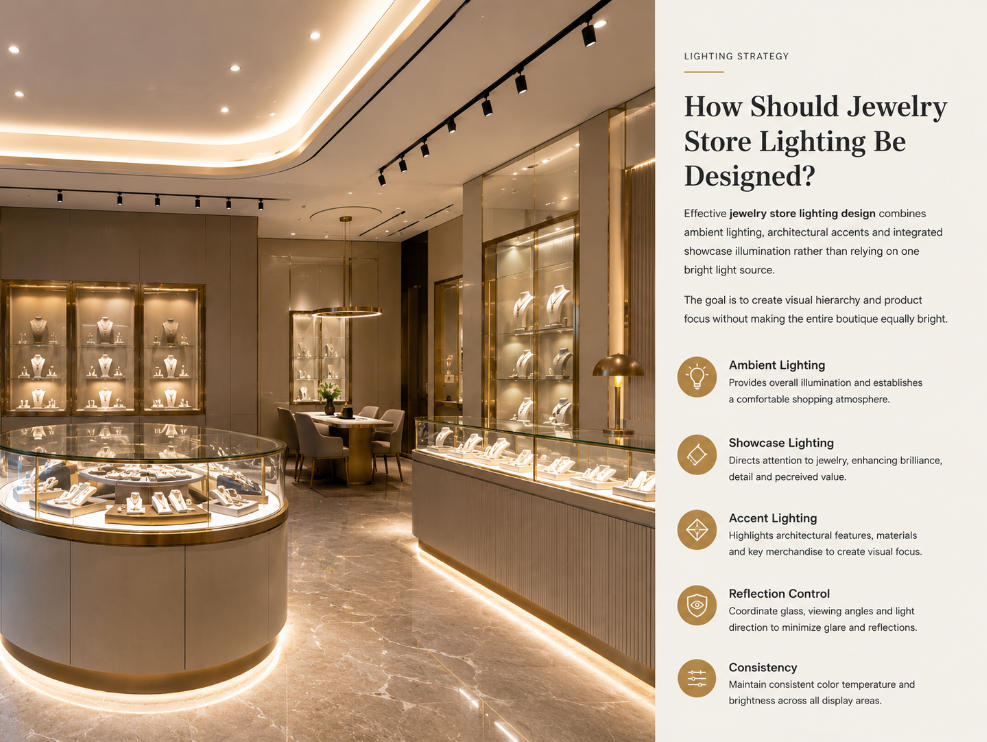
Build the Jewelry Store Lighting in Three Layers
General Store Lighting
Provides overall visibility and establishes the base atmosphere.
Showcase Lighting
Creates jewelry focus inside the case and separates merchandise visually from the surrounding environment.
Architectural Lighting
Highlights selected surfaces, brand features and focal merchandise.
Different Jewelry Categories Need Different Presentation
Diamonds
Use focused lighting and restrained backgrounds so brilliance remains dominant.
Gold Jewelry
Coordinate warm materials carefully without making the entire display excessively yellow.
Colored Gemstones
Prioritize accurate color perception and avoid surrounding materials that compete with the stones.
Necklaces
Provide sufficient vertical presentation space for complete product forms.
Rings
Use controlled spacing so individual pieces remain easy to compare.
High-Value Pieces
Reduce visual clutter and give important jewelry more physical and visual space.
Choose Materials That Support the Jewelry
Luxury does not require the maximum number of decorative materials. A stronger jewelry showcase design usually uses a controlled material palette consistently across the store.
High-Clarity Display Glass
Clear glazing reduces the visual barrier between customers and merchandise.
Refined Metal Details
Metal can define frames and architectural lines without appearing visually heavy.
Wood & Veneer
Wood introduces warmth and helps balance glass, stone and metal.
Stone Surfaces
Selected stone can create visual weight at islands, counters and feature zones.
Interior Materials
Velvet, microfiber and leather-effect surfaces should provide a quiet background for jewelry.
One Material Language
Different fixture types should still read as one coordinated boutique environment.
Create Contrast Between the Store and the Jewelry
Too Little Contrast
When interior lining, metal, floors, walls and merchandise have similar visual intensity, jewelry can disappear into the environment.
Result: the store may look expensive, but products lose priority.
Controlled Contrast
Use tone, lighting, spacing and texture to clearly separate merchandise from the fixture.
Result: customers notice the jewelry first and the store design second.
A Beautiful Jewelry Store Must Still Work Every Day
Staff-Side Access
Opening direction should support efficient merchandise presentation.
Locks & Hardware
Security components should be integrated as discreetly as practical.
Hidden Storage
Frequently used trays and support materials should remain close to relevant sales zones.
Cable Management
Electrical systems should remain concealed while still allowing maintenance access.
Cleaning Access
Glass and interior surfaces need practical daily maintenance access.
Customer Comfort
Operational requirements should not make the retail environment feel defensive or restrictive.
Review the Entire Store Before Manufacturing the Fixtures
Individual showcase drawings cannot always reveal whether the complete boutique feels balanced.
3D visualization allows the design team and client to evaluate showcases, circulation, lighting, walls, ceiling and architectural materials before manufacturing begins.
Turn the Approved Store Concept Into Production-Ready Fixtures
Once the layout and visual direction are approved, individual showcases need to be technically resolved before manufacturing.
For project-specific case engineering, explore our custom jewelry display case manufacturing solutions.
Seven Mistakes That Can Weaken a High-End Jewelry Store
Judge the Design as a Complete Retail Environment
A completed jewelry boutique should not feel like a room filled with separate display cabinets. Fixtures, lighting, architecture and merchandise should work together as one consistent brand environment.
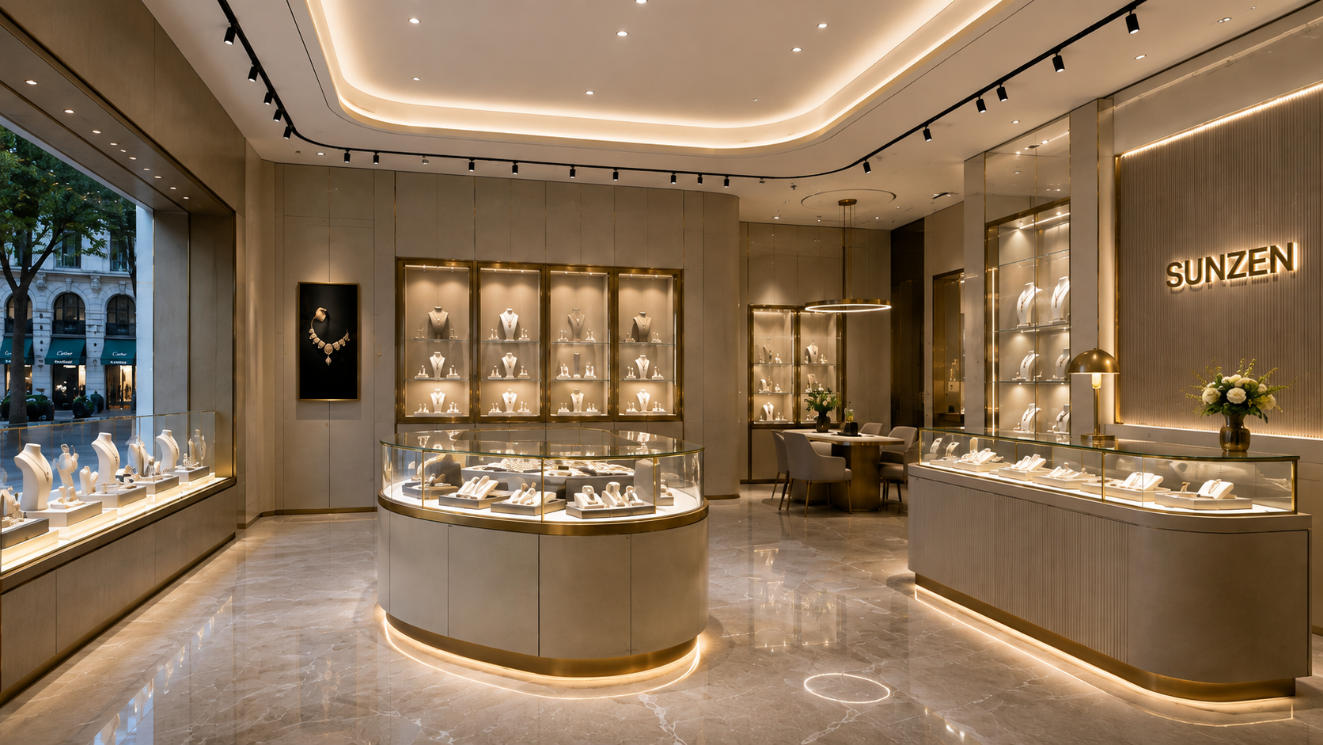
Clear Circulation
Customers can understand and move through the store comfortably.
Strong Product Hierarchy
Important collections naturally receive greater visual emphasis.
Unified Materials
Different fixture types still share one controlled design language.
Balanced Lighting
The jewelry remains the focus without making the boutique uncomfortable.
Design One Showcase or Coordinate the Entire Jewelry Store?
Individual Showcase Project
Suitable when one feature cabinet or replacement fixture needs to integrate into an existing environment.
Priority: match existing dimensions, finishes, lighting and operation.
Complete Jewelry Store Project
Suitable when multiple fixture types, circulation zones and architectural elements need to be developed together.
Priority: maintain one design language throughout the boutique.
For complete fixture production, explore our jewelry store fixture manufacturing solutions.
When Should You Develop the Store as One Complete Design System?
For flagship stores and premium boutiques, layout, lighting, furniture and showcase detailing benefit from being coordinated before manufacturing begins.
This allows the same proportions, materials and visual language to continue from the shop window through central displays, wall showcases and consultation zones.
See our luxury jewelry store design and custom showcase solutions for complete boutique projects.
What Information Helps Design a Jewelry Store?
Explore SUNZEN Solutions by Project Requirement
Jewelry Store Design
Complete planning for circulation, zones, customer experience and store-wide coordination.
Jewelry Display Cases
Browse island, wall, counter, pedestal, upright and other display formats.
Custom Jewelry Display Case Manufacturer
Explore customization of dimensions, glass, materials, lighting and storage.
Jewelry Store Fixture Manufacturer
For complete boutiques requiring coordinated wall, island, counter and service fixtures.
Planning a New Jewelry Store or Boutique?
Send SUNZEN your floor plan, store dimensions, merchandise categories and design references. We can review the project and develop an appropriate showcase layout, visual direction and fixture solution.
Design the Store Around the Customer, the Jewelry and the Brand
The strongest jewelry store showcase design does not begin with decoration. It begins by understanding merchandise, customer movement, sightlines and the sales experience.
From there, showcase types, dimensions, materials and lighting can be developed as one coordinated retail environment. This allows the fixtures to support the jewelry instead of competing with it.
For high-end projects, connecting concept design with technical engineering and manufacturing also helps ensure that the approved store can be translated accurately into finished fixtures.
Jewelry Store Showcase Design FAQs
How should a high-end jewelry store showcase be designed?
A high-end jewelry store showcase should be designed around the merchandise, customer viewing experience, store layout and sales process. Showcase type, dimensions, sightlines, lighting, materials, staff access and storage should be coordinated rather than developed independently.
How should a jewelry store layout be planned?
A jewelry store layout should provide clear entrance visibility, comfortable circulation, logical merchandise zones and natural transitions between browsing, assisted viewing, consultation and checkout. Central fixtures should support movement rather than block sightlines across the store.
Which showcase types are commonly used in jewelry stores?
Common formats include island showcases, wall showcases, counter showcases, window displays, upright showcases, pedestal cases and other project-specific display fixtures. Different formats should be selected according to the merchandise and spatial function.
How should jewelry store lighting be coordinated with display cases?
Jewelry store lighting should combine ambient, showcase and accent lighting. Integrated display lighting should be coordinated with the jewelry category, glass reflections, viewing angles and surrounding store illumination before the fixtures are manufactured.
What materials work well for luxury jewelry store showcases?
Luxury jewelry showcases commonly combine clear display glass, metal, wood or veneer, stone and soft interior lining materials. The most effective material palette is usually controlled and consistent so the fixtures support the jewelry rather than visually compete with it.
Should every jewelry showcase use the same design?
Not necessarily. Different showcase types can perform different functions, but they should share a consistent design language through proportions, materials, finishes, lighting and detailing so the store feels coordinated.
Why is 3D visualization useful before jewelry store fixture manufacturing?
3D visualization helps review circulation, showcase proportions, material relationships, lighting and the overall store atmosphere before manufacturing begins. It allows larger design issues to be identified before individual fixtures are finalized technically.
Can SUNZEN design and manufacture a complete jewelry store fixture package?
Yes. Project scope can include store layout development, showcase planning, 3D visualization, CAD engineering and coordinated manufacturing of wall, island, counter, window and other jewelry store fixtures according to the project requirements.
What information should I provide to start a jewelry store design project?
Useful information includes the floor plan, store dimensions, storefront conditions, jewelry categories, required fixture types, brand guidelines or design references, material preferences, operational requirements, project location and expected schedule.

