
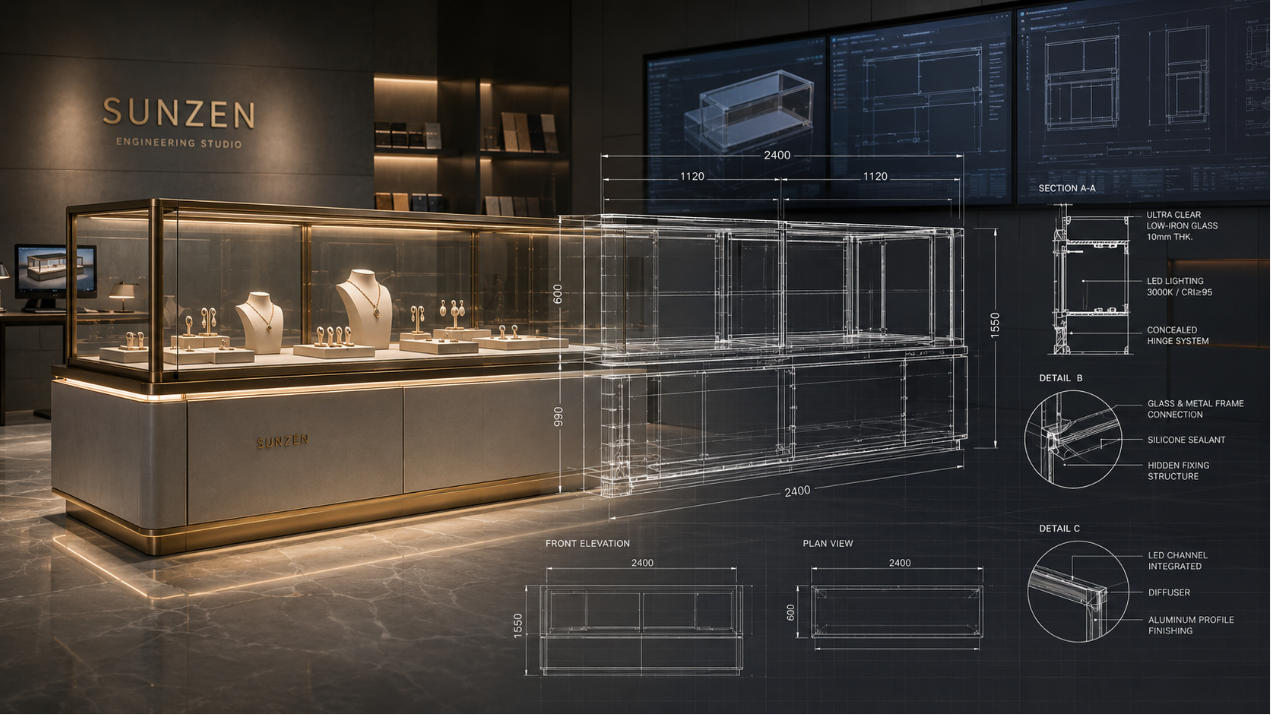
Display Case Engineering for Production-Ready Showcase Solutions
Professional display case engineering transforms an approved display concept into a technically resolved system of structures, glass, hardware, lighting, access and manufacturable components.
A showcase may appear visually simple from the customer side, but its construction requires careful coordination between transparent panels, structural supports, doors, drawers, lighting, electrical components, finishes and assembly relationships. Engineering defines how these elements work together before production begins.
SUNZEN connects technical development with our broader showcase engineering capability. If your project is still at the visual and functional concept stage, begin with display case design.
What Does Display Case Engineering Resolve?
Build a Stable Display System
Frames, bases, internal supports and connection points must safely support glass, doors, shelves, merchandise and integrated components while maintaining the intended visual proportions.
Engineer Transparent Components
Glass dimensions, thickness, edges, joints, support conditions and opening relationships need to coordinate with the surrounding structure and access system.
Make Moving Components Work
Doors, drawers, locks, hinges, slides and access panels require controlled clearances, appropriate hardware and predictable movement during daily operation.
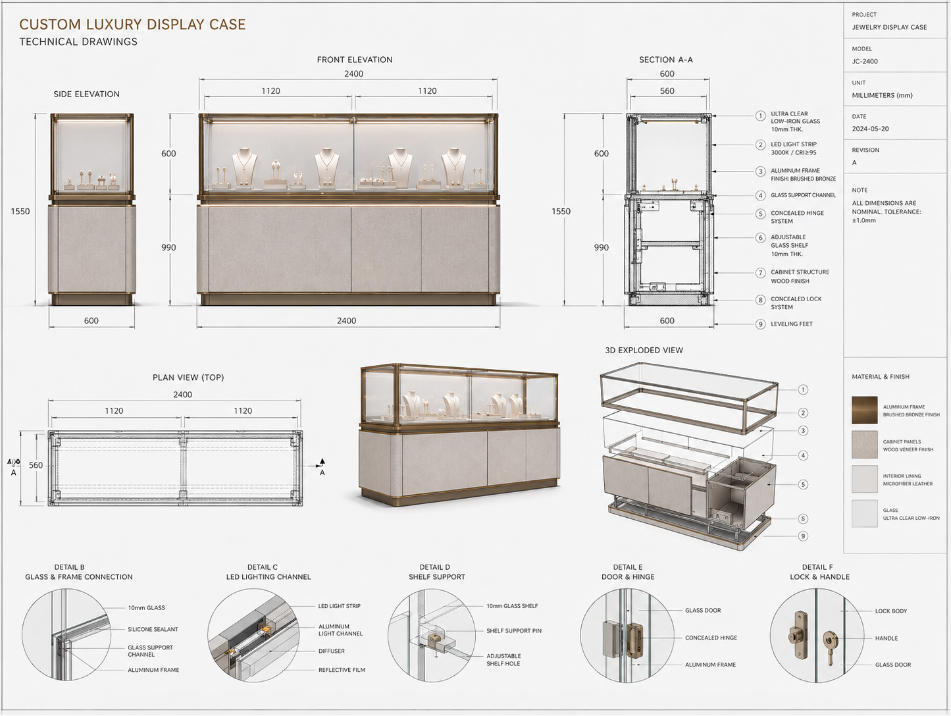
Translate the Approved Design into Production-Ready Drawings
Engineering drawings establish the information required to manufacture, assemble and inspect a display case accurately. The documentation should explain both the overall dimensions and the detailed relationships between components.
Overall Dimensions: Define length, depth, height, reference levels and major construction boundaries.
Elevations & Sections: Explain internal relationships that cannot be understood from a single external view.
Component Dimensions: Define glass, metalwork, cabinetry and other fabricated parts.
Hardware Positions: Locate hinges, slides, locks, brackets and connection points.
Lighting Integration: Coordinate channels, wiring routes, drivers and service access.
Assembly Relationships: Clarify how individual components connect during factory assembly and installation.
Engineer the Structure Behind the Finished Showcase
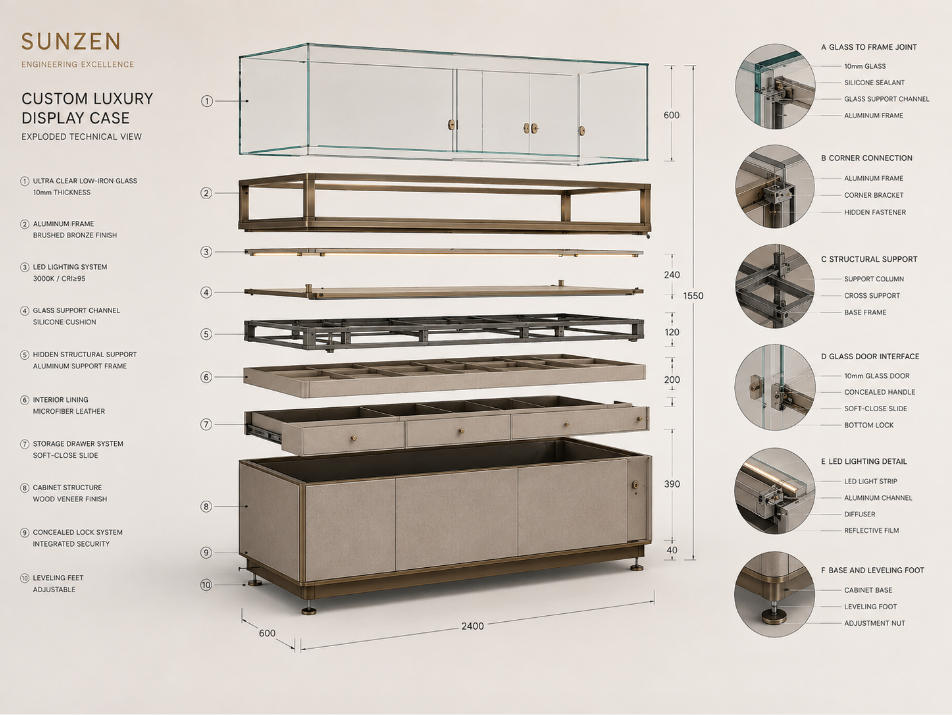
A finished showcase may use slim frames and large areas of glass, but the hidden construction still needs to support glazing, merchandise, moving components and repeated daily operation.
Frame & Base Structure
Determine where internal support is required and how structural loads transfer through the showcase into the base.
Connection Points
Resolve how metal, cabinetry, glass and other components connect without creating unnecessary visible bulk.
Service Life
Engineering should consider repeated opening, closing, cleaning, merchandise loading and normal maintenance over the life of the fixture.
Coordinate Glass, Structure and Visibility as One System
Glass display case engineering requires more than selecting transparent panels. Glass dimensions, support conditions, joints, hardware and installation sequence all influence the final appearance and function.
Large transparent areas can create a visually light showcase, but glazing still needs reliable support and clear relationships with doors, locks, metal frames and the structural base.
Engineering also needs to consider how glass components will be fabricated, transported, installed and replaced if maintenance is required later.
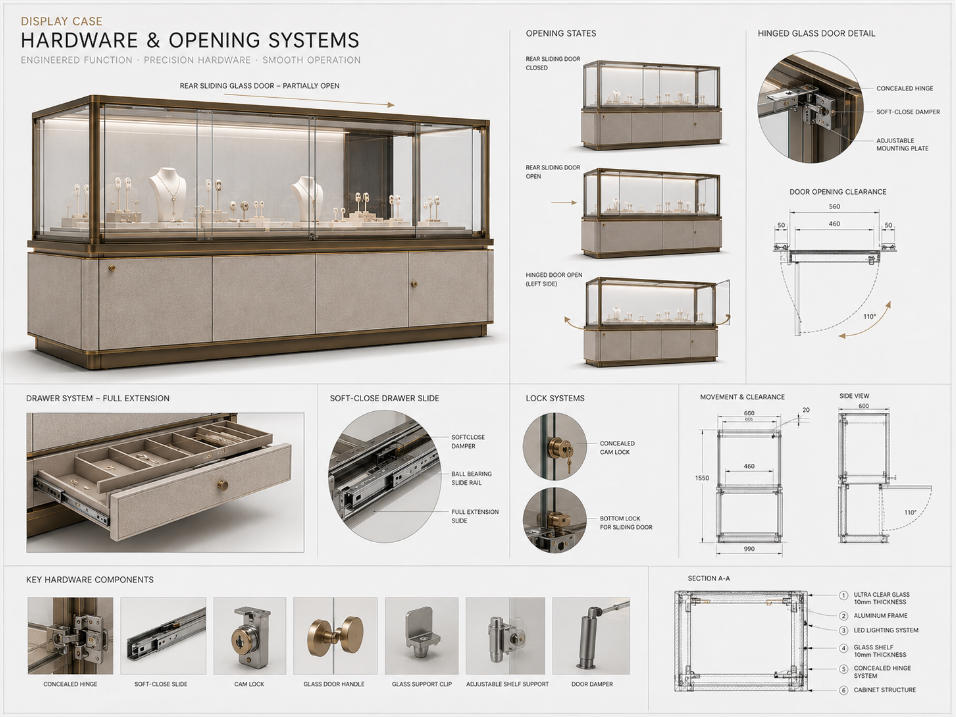
Engineer Doors, Drawers and Opening Systems for Daily Use
A display case may be opened thousands of times during its service life, so hardware should be selected and positioned around the weight, dimensions, frequency of use and movement of each component.
Hinged Doors: Resolve hinge positions, opening angles, weight and surrounding clearance.
Sliding Doors: Coordinate tracks, overlaps, handles, locks and usable opening width.
Drawers: Define slides, internal dimensions, load capacity and concealed clearances.
Locks: Integrate security hardware without unnecessarily interrupting the customer-facing appearance.
Access Panels: Provide maintenance access to electrical or internal technical components where required.
Integrate Lighting Without Compromising the Showcase
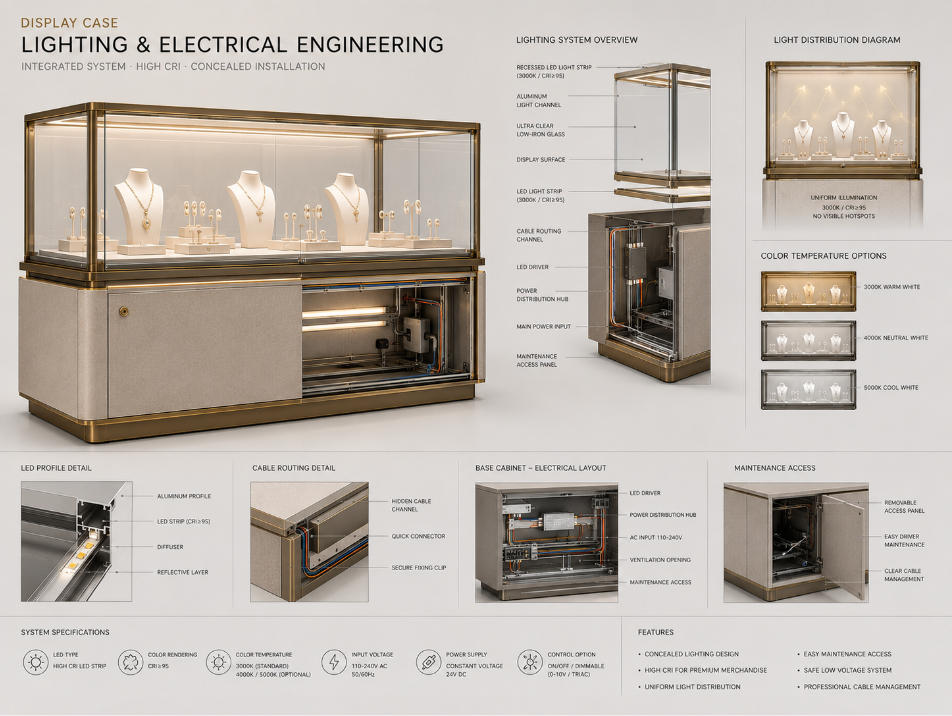
Display lighting should appear simple and refined from the customer side even when the technical system behind it includes LED profiles, wiring, connectors, power supplies and maintenance access.
Engineering coordinates lighting channels with glass, shelves, metalwork and cabinetry so illumination supports the intended presentation without creating visible technical clutter.
Electrical routes, driver locations and service access should be resolved before production rather than improvised after the showcase has already been fabricated.
Resolve How Different Materials Meet
A custom display case may combine glass, aluminum, stainless steel, wood, stone, fabric, acrylic and other materials produced through different manufacturing processes. These materials cannot always be treated as though they behave identically.
Glass-to-Metal
Coordinate support, joint appearance, edge conditions and dimensional allowances between transparent and structural components.
Metal-to-Cabinetry
Resolve visible gaps, overlaps, fixing methods and finish transitions between fabricated metal and wood-based construction.
Stone & Decorative Surfaces
Consider thickness, edge treatment, support, installation sequence and alignment with adjacent materials.
Good technical documentation makes these interfaces intentional rather than leaving them to interpretation during production.
Display Case Design and Engineering Solve Different Problems
Define What the Display Should Be
Display case design establishes proportions, product presentation, visual language, material direction, viewing relationships and functional intent.
Explore our display case design page for the concept and functional design stage.
Define Exactly How It Will Work and Be Built
Engineering converts the approved design into dimensions, structures, glass specifications, hardware relationships, electrical integration and production-ready documentation.
How Display Case Engineering Moves Toward Manufacturing
Design Review
Review the approved 3D design, dimensions, materials, product presentation and operating requirements.
Structural Development
Define frames, supports, base construction and major structural relationships.
Glass & Hardware Coordination
Resolve glazing, doors, hinges, slides, locks and opening relationships.
Lighting Integration
Coordinate LED profiles, wiring routes, drivers, connectors and maintenance access.
CAD Documentation
Prepare elevations, sections, detail drawings and component information for production.
Production Handoff
Release approved technical information to manufacturing and clarify critical construction requirements.
Engineering Should Reflect How the Display Case Will Actually Be Made
Technical detail is valuable only when it can be translated efficiently into fabrication, finishing, assembly, packing and installation.
Fabrication Logic
Component shapes, connections and tolerances should reflect realistic metalwork, cabinetry, glass and finishing processes.
Assembly Sequence
Engineering should consider how components will be assembled in the factory and how large or delicate parts will be handled.
Installation Readiness
Large showcases, wall-mounted units and integrated systems may require additional coordination for transport, access and final site assembly.
Continue to showcase manufacturing to see how production-ready engineering moves into fabrication and assembly.
Different Display Cases Create Different Engineering Challenges
Jewelry Display Case Engineering
Frequent staff access, security hardware, drawers, close-view lighting and refined glass relationships require careful technical coordination.
Explore our jewelry display cases.
Watch Display Case Engineering
Premium detailing, product supports, integrated lighting and precise presentation require controlled component alignment and finishing.
Explore our watch display cases.
Museum Display Case Engineering
Large glazing areas, access systems, enclosure requirements and exhibition-specific functions create a different technical development process.
Explore our museum display cases.
Connect Technical Documentation Directly with Manufacturing
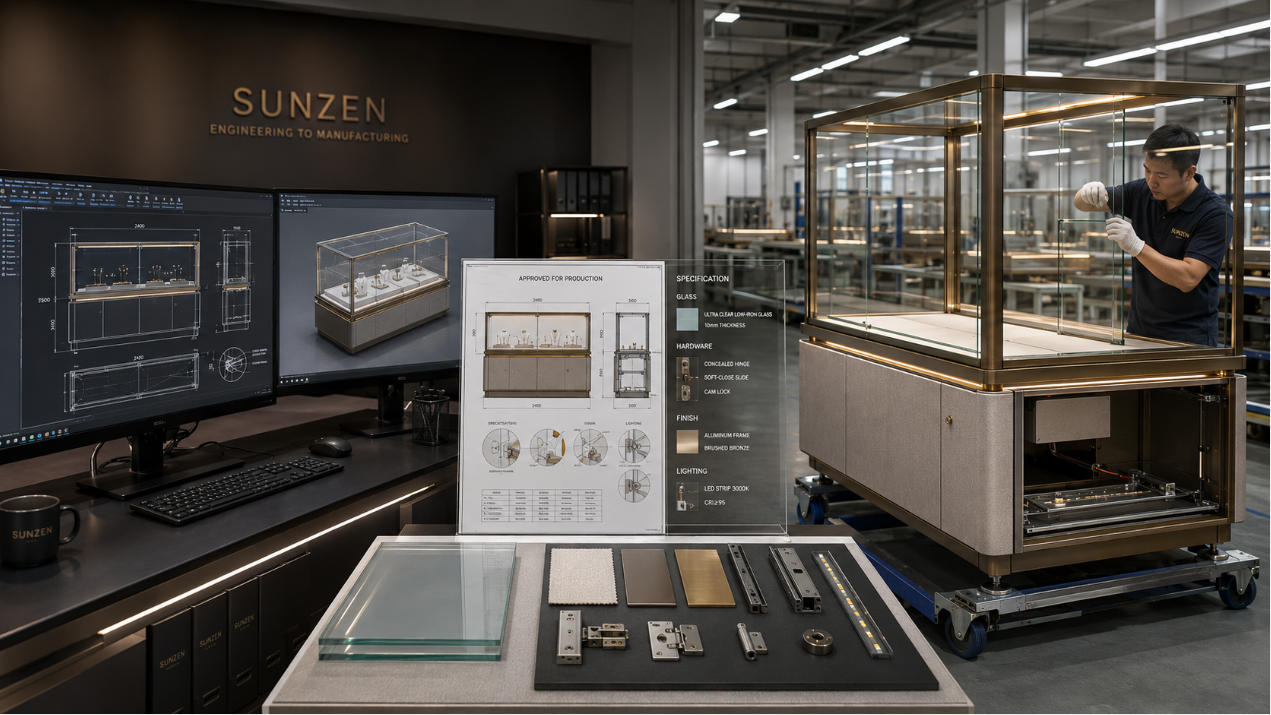
The objective of display case engineering is not only to create accurate drawings, but to ensure that the approved design can be manufactured, assembled and delivered with the intended appearance and function preserved.
SUNZEN connects showcase engineering directly with showcase manufacturing, allowing technical details to be developed with actual fabrication and assembly requirements in mind.
Once production and quality inspection are complete, our project delivery capability supports packing, transport and installation-stage coordination.
From Display Case Engineering to Finished Showcase
Resolve the Construction
Define dimensions, structural systems, glass, access, hardware, lighting and material interfaces.
Communicate the Technical Solution
Create accurate elevations, sections, details and component information for manufacturing and assembly.
Build Against Approved Information
Fabricate, finish and assemble components according to the approved technical documentation and design intent.
For the broader engineering capability, visit showcase engineering. For factory production, continue to showcase manufacturing.
Display Case Engineering FAQs
What is display case engineering?
Display case engineering is the technical development of an approved display design into production-ready structures, dimensions, glass relationships, hardware, lighting, electrical integration and construction documentation.
What is included in display case engineering drawings?
Engineering drawings can include overall dimensions, elevations, sections, component details, glass sizes, structural supports, hardware positions, opening systems, lighting channels, wiring routes and assembly relationships.
What is the difference between display case design and engineering?
Display case design defines the visual concept, proportions, product presentation, material direction and functional intent. Display case engineering converts the approved design into technical information that explains how the showcase will be manufactured and assembled.
How is glass engineered for a display case?
Glass engineering coordinates panel dimensions, thickness, edge conditions, joints, support points, door relationships, hardware and installation sequence with the overall structural system of the display case.
How are doors and drawers engineered in display cases?
Doors and drawers are developed around component weight, hardware, opening direction, travel distance, surrounding clearance, locks, staff access and repeated daily operation.
How is lighting integrated into display case engineering?
Lighting engineering coordinates LED profiles, channels, wiring routes, connectors, drivers, power access and maintenance requirements with glass, shelves, metalwork and cabinetry.
Why are tolerances important in showcase engineering?
Display cases combine materials produced through different manufacturing processes. Appropriate tolerances help control gaps, alignment, movement and assembly while preserving the intended finished appearance.
Can SUNZEN engineer and manufacture the same display case?
Yes. SUNZEN connects display case engineering with custom showcase manufacturing, quality control and project delivery so approved technical documentation can move directly into physical production.
Need Engineering Support for a Custom Display Case?
Share your approved concept, 3D design, dimensions, materials and functional requirements with SUNZEN. We can develop the showcase into detailed CAD documentation, structural solutions, glass, hardware and lighting systems ready for manufacturing.

