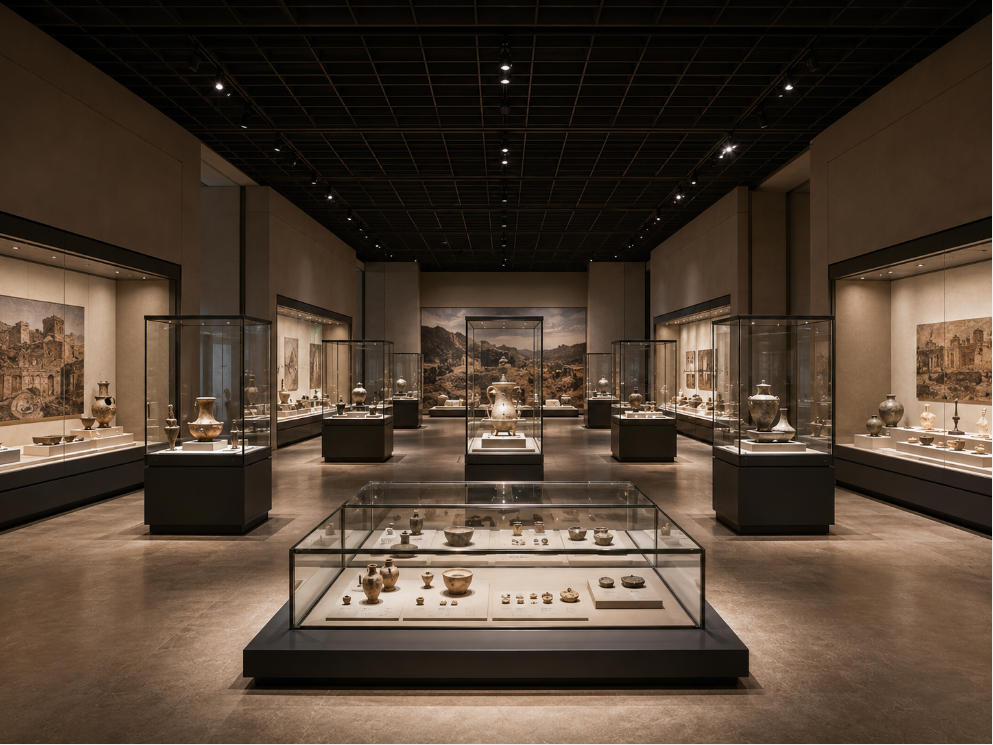
Museum Showcase Manufacturer for Professional Cultural Exhibition Projects
As a professional museum showcase manufacturer, SUNZEN develops custom display cases for museums, art galleries, heritage institutions, cultural exhibitions and private collections. Each showcase is engineered around the displayed object, exhibition environment and technical requirements rather than adapted from a standard commercial cabinet.
Our capabilities connect showcase design, CAD engineering, material specification, manufacturing and quality control. Explore our complete range of kes pameran muzium for different artifact and exhibition requirements.
A museum showcase manufacturer does more than build a glass cabinet. The manufacturer translates exhibition and collection requirements into a physical protective display system.
Museum showcases often require closer coordination between artifact protection, visibility, lighting, access, security, structural stability and environmental performance than ordinary commercial display fixtures.
For custom museum projects, manufacturing development can begin from architectural drawings, exhibition layouts, artifact information and technical specifications. These inputs are progressively translated into showcase dimensions, structures, glass specifications and production-ready details.
What Should a Professional Museum Showcase Manufacturer Provide?
Exhibition Design Coordination
Showcase proportions, viewing height and visual language are coordinated with exhibition architecture and collection presentation.
CAD Engineering
Detailed technical drawings define dimensions, structures, glass, opening systems, lighting and functional components before production.
Material Specification
Glass, metals, interior finishes, seals and other components are selected according to project and exhibition requirements.
Custom Manufacturing
Structural components, glass, lighting, hardware and internal systems are assembled according to approved production drawings.
Quality Control
Dimensions, glass, lighting, access systems, locks, finishes and assembly are inspected before project delivery.
Project Delivery Support
Completed showcases can be prepared with protective packaging, identification and installation documentation according to project scope.
Why Museum Showcases Require a Different Manufacturing Approach
Commercial Display Cabinet
Commercial fixtures are generally developed around product presentation, branding, storage and everyday retail operation.
Main priorities: merchandising, customer interaction, visual presentation and commercial durability.
Pameran Muzium
Museum vitrines may need to combine object visibility with controlled access, security, sealing, specialized lighting and environmental-management options.
Main priorities: artifact presentation, protection, technical performance and long-term exhibition requirements.
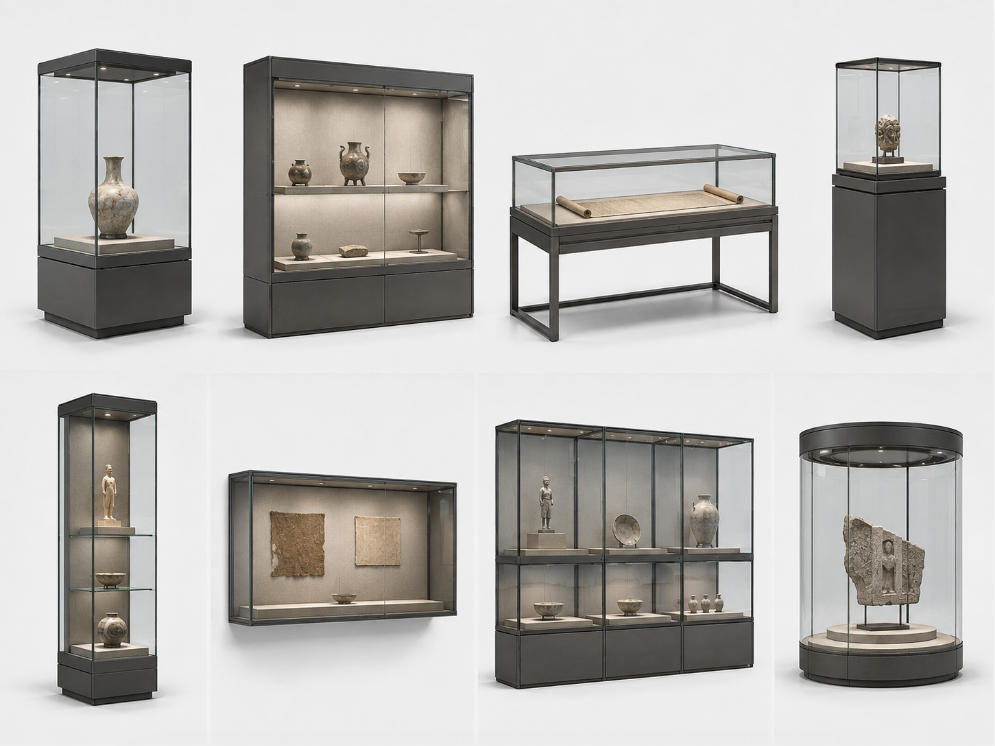
Different Collections Require Different Museum Showcase Structures
Museum display cases can be developed in different structural formats according to artifact dimensions, viewing requirements, exhibition layout and access conditions.
The objective is not to select a showcase style first and force the collection into it. The showcase structure should instead respond to what is being displayed and how visitors are expected to view it.
Choose the Showcase Configuration Around the Artifact and Exhibition Space
Freestanding Museum Showcases
Independent vitrines for central gallery areas where artifacts may need to be viewed from several directions.
Wall Museum Showcases
Wall-integrated or wall-positioned cases suitable for documents, textiles, collections and thematic displays.
Table Museum Display Cases
Low-profile vitrines for manuscripts, coins, books, maps, jewelry and smaller cultural objects.
Pedestal Museum Showcases
Compact vitrines that isolate individual objects and create stronger visual focus around important artifacts.
Tall Museum Display Cases
Vertical enclosures for sculptures, costumes, vessels and collections requiring additional internal height.
Wall-Mounted Display Cases
Compact wall-mounted configurations for selected documents, artifacts and smaller collections.
Modular Museum Showcases
Adaptable display systems for temporary exhibitions, rotating collections and changing gallery requirements.
Project-Specific Custom Showcases
Special structures developed around unusual artifact dimensions, architectural conditions or exhibition concepts. Learn more about the development process in our custom museum showcase guide.
Coordinated Showcase Systems
Multiple showcase formats can share consistent materials, colors, structural details and lighting language across one exhibition.
Translate the Exhibition Concept Into Production-Ready Showcase Engineering
Museum showcase production begins before materials enter the workshop. The exhibition concept must first be translated into accurate dimensions, structures and technical specifications that can be manufactured consistently.
This development process creates the connection between the exhibition designer’s visual intent, the collection’s technical requirements and the physical showcase that will eventually be manufactured.
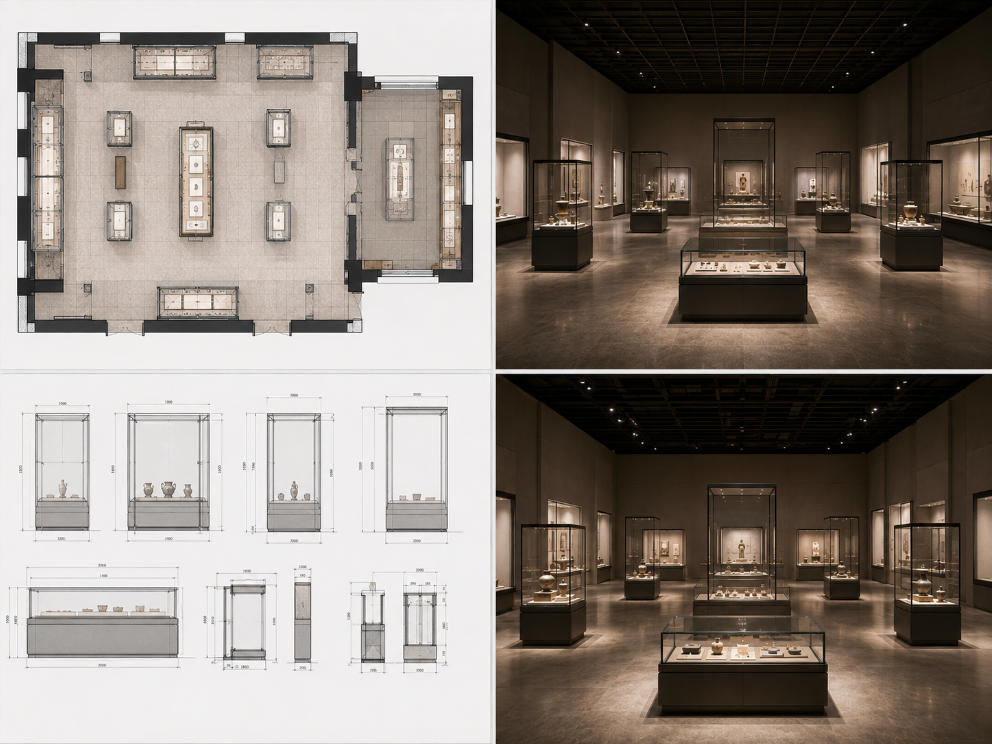
Start With the Collection, Exhibition Layout and Technical Requirements
Artifact Information
Object dimensions, weight, material sensitivity and presentation requirements influence the showcase structure and interior configuration.
Exhibition Environment
Gallery dimensions, visitor circulation, surrounding lighting and architectural conditions influence showcase placement and proportions.
Technical Requirements
Access, glass, lighting, security, sealing and environmental-management requirements should be defined according to the project specification.
Visualize the relationship between the showcase, the artifact and the gallery before production.
Three-dimensional development helps evaluate showcase proportions, display heights, visitor sightlines and relationships between different display cases within the exhibition space.
For coordinated museum projects, this stage is also useful for establishing a consistent visual language across freestanding, wall, table, pedestal and other showcase configurations.
Define Every Functional System Before Museum Showcase Production
Production drawings transform the approved visual concept into manufacturable information. Dimensions, tolerances and functional systems should be resolved before components enter production.
Glass Enclosure
Define glass dimensions, specifications, joints and relationships with the supporting structure.
Structural Frame
Engineer the internal or visible frame according to showcase dimensions, glass loads and design requirements.
Opening System
Coordinate hinged, sliding, lift-up or project-specific access according to artifact installation and staff requirements.
Lighting System
Integrate lighting positions, cable routing, drivers and maintenance access within the showcase architecture.
Security & Sealing
Integrate locks, controlled access and sealing components according to the required showcase performance.
Display Interior
Define display decks, lining, artifact supports and visible interior surfaces according to exhibition requirements.
Select Museum Showcase Materials Around Exhibition and Collection Requirements
Museum showcase materials should be evaluated not only for appearance but also for structural performance, durability, maintenance and their relationship with the displayed collection. Glass, metal, seals, interior panels and surface finishes must work together as one engineered enclosure.
Material specifications can vary according to the artifact, exhibition duration, showcase size and conservation requirements. For this reason, materials should be confirmed at project level rather than selected as decorative finishes alone.
Glass
High-clarity glazing selected according to visibility, safety and project performance requirements.
Metal
Engineered structural components and finished metal elements for strength, precision and visual consistency.
Seals
Gaskets and sealing components coordinated with doors, glass joints and enclosure construction.
Interior Panels
Display decks, backing panels and internal surfaces developed around artifact presentation requirements.
Hardware
Locks, hinges, slides and opening mechanisms selected according to access, load and security requirements.
Material Decisions Should Support Both Presentation and Preservation
Materials inside or close to the display enclosure may need additional evaluation when sensitive collections are involved. Project specifications can therefore define requirements for interior boards, fabrics, coatings, adhesives and other materials used within the showcase.
Where conservation requirements are specified by the museum, curator or conservation consultant, the showcase manufacturer should coordinate the construction and material selection with those requirements rather than assume that one standard specification is suitable for every collection.
Coordinate the Technical Systems as Part of the Showcase Architecture
Professional museum vitrines can contain several functional systems within a visually minimal structure. Glass, doors, seals, locks, lighting and environmental components should therefore be considered together during engineering.
Optical Performance
Glass dimensions, joints and structural elements should be designed to minimize unnecessary visual interference around the artifact.
Opening Systems
Access should allow safe installation, removal and maintenance of artifacts while remaining discreet when the showcase is closed.
Locking Systems
Locks and access hardware can be integrated into the showcase structure to reduce their visual impact.
Sealing
Glass joints, doors, gaskets and structural interfaces can be coordinated according to the enclosure requirements of the project.
Integrated Lighting
Lighting can be incorporated into the showcase while keeping visible hardware, wiring and maintenance components controlled.
Environmental Options
Where required, the enclosure can be engineered to accommodate passive or project-specific environmental-management systems.
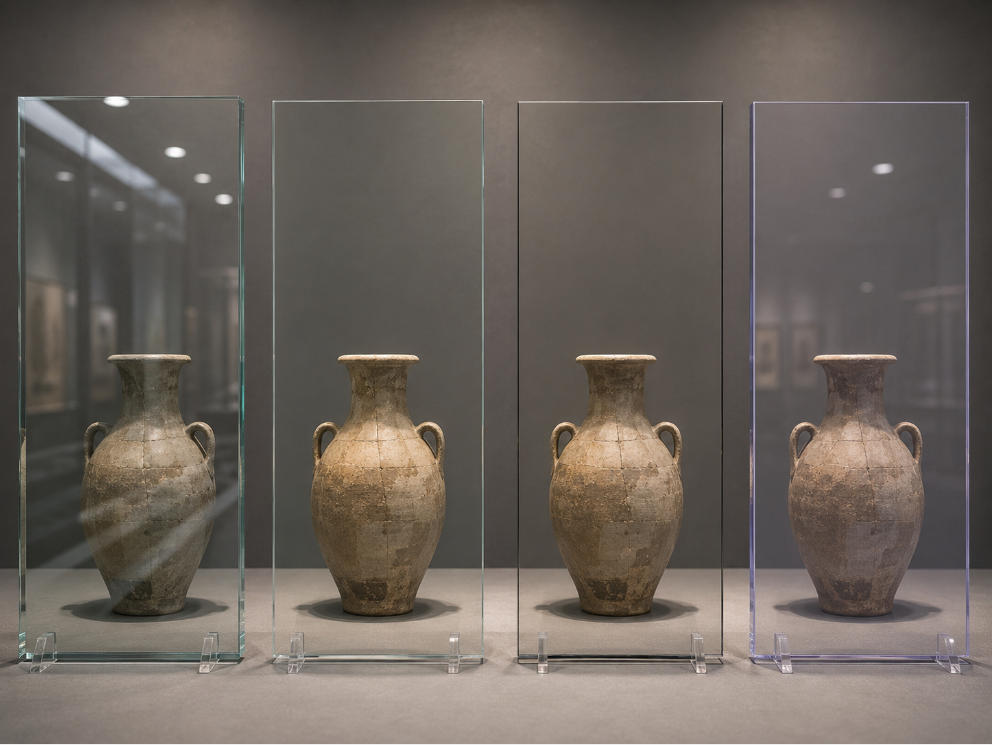
Make the Protective Enclosure Visually Disappear Around the Artifact
Glass is one of the most important components of a museum showcase because visitors view the collection through it. The objective is to provide the required physical enclosure while minimizing unnecessary visual interference.
Specify Glass According to the Showcase, Not by One Standard Formula
| Glass Consideration | Design Objective | Project Consideration |
|---|---|---|
| Optical Clarity | Reduce visual interference between the visitor and artifact | Gallery lighting, viewing distance and collection type |
| Reflection | Improve viewing under challenging exhibition lighting | Light position, surrounding architecture and viewing angle |
| Safety | Create an appropriate protective enclosure | Glass dimensions, structure and applicable project specification |
| UV Performance | Support conservation requirements where specified | Artifact sensitivity and project conservation criteria |
| Glass Joints | Maintain clean visual lines | Manufacturing tolerances, sealing and enclosure design |
Illuminate the Collection Without Allowing the Lighting System to Dominate
Integrated museum showcase lighting should support interpretation of the artifact while remaining visually discreet. Light positions, beam direction, brightness and access for maintenance should be considered together with the showcase structure.
Lighting requirements vary according to the displayed material. The final specification should therefore follow the exhibition lighting plan and any conservation limits established for the collection.
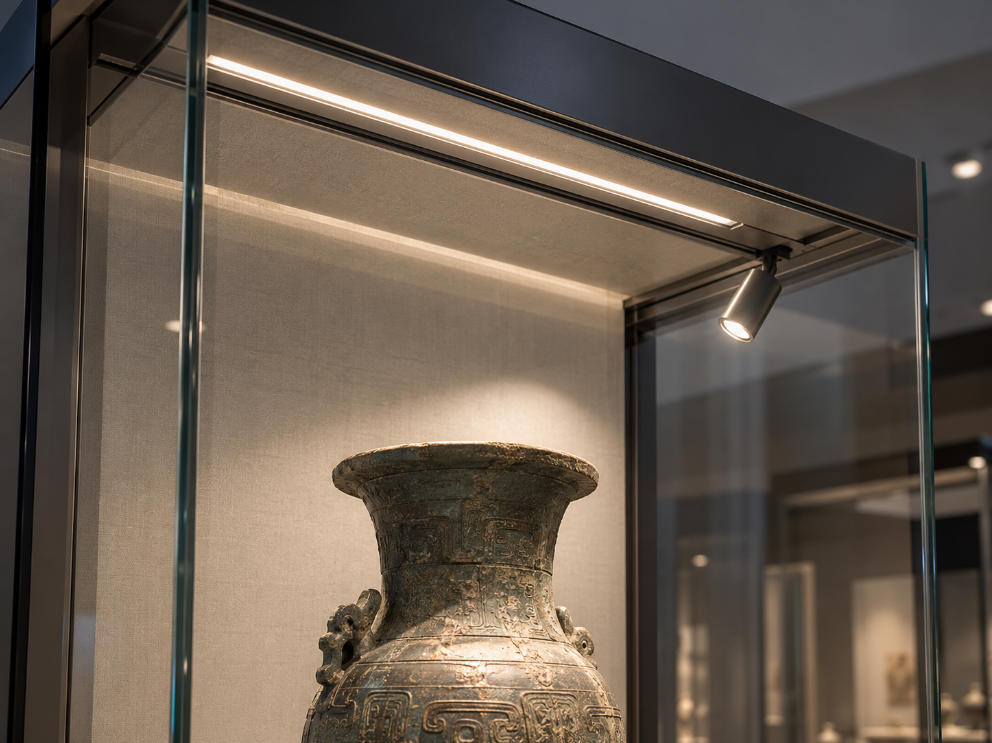
Coordinate Artifact Light, Showcase Light and Gallery Light
A showcase does not exist independently from the gallery around it. Reflections and perceived contrast are influenced by both internal illumination and the surrounding exhibition environment.
Artifact Illumination
Provide sufficient visual definition for the collection while respecting project-specific lighting criteria.
Glass Reflection
Evaluate light direction and viewing angles to reduce distracting reflections across important sightlines.
Gallery Relationship
Coordinate internal showcase lighting with the surrounding ambient and architectural illumination.
Integrate Security Into the Showcase Without Distracting From the Exhibition
Security requirements depend on the value, vulnerability and access requirements of the displayed collection. The showcase structure can therefore be developed around project-specific glass, locks, access systems and other security provisions.
Integrated Locks
Locking hardware can be concealed or visually minimized while remaining practical for authorized staff.
Controlled Opening
Doors and opening mechanisms should provide predictable staff access without compromising the closed showcase appearance.
Protective Construction
Glass, framing, hardware and structural connections should be coordinated according to the required security level.
Design Access Around Artifact Installation and Museum Operation
The ideal opening system depends on showcase dimensions, artifact size, staff access, available clearance and exhibition maintenance procedures. Access should be large enough for safe object handling while remaining visually controlled when closed.
| Opening Type | Typical Application | Engineering Consideration |
|---|---|---|
| Hinged Door | Wall, upright and freestanding showcases | Door clearance, glass weight, hinges and locking |
| Sliding Access | Cases where outward opening clearance is limited | Tracks, sealing, overlap and maintenance |
| Lift-Up Access | Table and horizontal display cases | Lid weight, support mechanism and safe staff operation |
| Large Access Panel | Large artifacts and special installations | Object installation route, structural support and closure |
| Project-Specific System | Unusual artifacts or architectural conditions | Custom engineering based on the exhibition requirement |
Control the Interfaces Between Glass, Doors and Structure
Where a project requires a more controlled enclosure, sealing performance depends on the complete showcase construction rather than one component alone. Glass joints, doors, gaskets, service penetrations and structural interfaces must be considered as one system.
The required enclosure performance should be defined during the technical specification stage so the appropriate sealing strategy can be incorporated before manufacturing begins.
Provide Environmental-Control Options When the Collection Requires Them
Some collections require closer management of the microenvironment inside the display enclosure. In these projects, the showcase can be engineered to accommodate passive conditioning materials or other project-specified environmental systems.
The appropriate solution depends on the artifact, exhibition duration, gallery environment and conservation specification. Environmental performance should therefore be developed together with the museum or conservation team rather than treated as a generic feature.
Passive Conditioning
Dedicated compartments can be incorporated for project-specified conditioning materials without placing them directly in the visible display area.
Monitoring Provision
Where specified, the enclosure can provide suitable locations or access for environmental monitoring equipment.
Project-Specific Control
More specialized environmental requirements can be evaluated during engineering according to the museum’s technical specification.
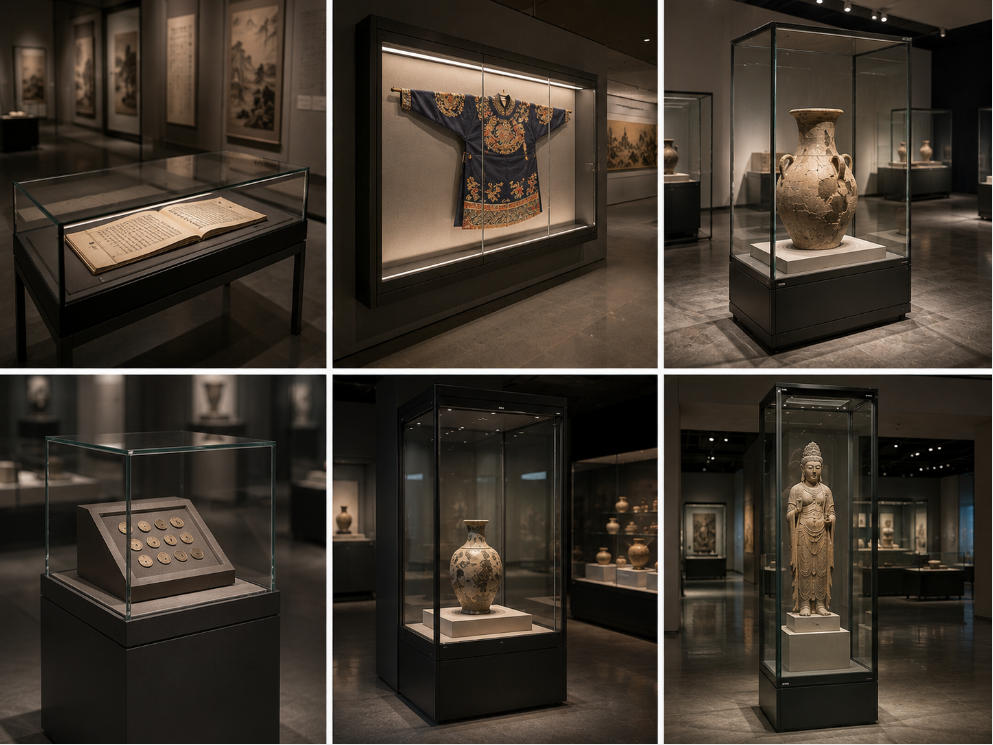
Design the Interior Around the Artifact, Not Around the Cabinet
The visible interior of a museum showcase provides the immediate visual background for the collection. Its proportions, color, surface texture and object-support strategy should reinforce the exhibition concept without competing with the artifact.
Define Performance Requirements Before Final Production Approval
| System | Items to Define | Why It Matters |
|---|---|---|
| Glass | Type, dimensions, optical and project-specific performance | Visibility, safety and enclosure design |
| Structure | Frame, base, load and dimensional tolerances | Stability and manufacturing accuracy |
| Access | Opening type, clearance, hardware and staff operation | Artifact installation and maintenance |
| Security | Locks and project-specific protective requirements | Controlled access to the collection |
| Sealing | Doors, joints, gaskets and service penetrations | Required enclosure performance |
| Lighting | Light source, position, control and maintenance access | Artifact presentation and visual comfort |
| Interior | Decks, lining, supports and visible finishes | Artifact presentation and material compatibility |
| Environment | Passive or project-specific management provisions | Collection-specific conservation requirements |
Translate Approved Engineering Into Controlled Museum Showcase Production
Museum showcase manufacturing requires close coordination between metalwork, cabinetry, glass, lighting, hardware, seals and interior finishing. Each production stage should follow approved technical drawings and material specifications rather than rely on workshop interpretation alone.
The manufacturing objective is consistency: dimensions, glass alignment, finishes, opening systems and functional components should remain coordinated across individual showcases and complete exhibition packages.
Frame & Cabinet Production
Structural components, bases and internal support systems are fabricated according to approved dimensions and load requirements.
Glass Preparation & Fitting
Glass dimensions, edges, joints and alignment are coordinated with the showcase structure, doors and sealing interfaces.
Lighting, Hardware & Access
Locks, hinges, slides, lighting channels, wiring and service components are integrated before final assembly.
Display Interior Finishing
Visible interior surfaces, decks, lining and artifact-support provisions are completed according to exhibition specifications.
Final Showcase Assembly
Glass, structure, doors, seals and technical systems are assembled and adjusted as one complete display enclosure.
Pre-Delivery Review
Completed showcases are checked against approved drawings, material references and project requirements before packing.
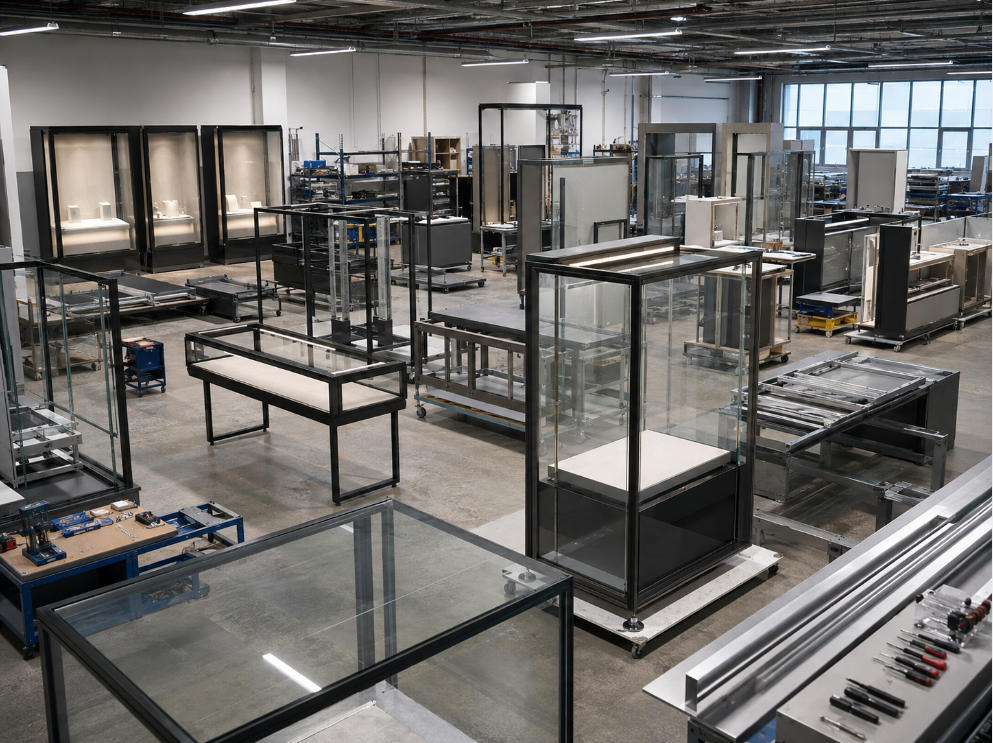
Why Factory Engineering Matters for Custom Museum Showcase Projects
A museum showcase factory must do more than reproduce the appearance of a rendering. Production needs to preserve dimensional accuracy, structural logic, glass relationships, access systems, lighting details and finish consistency across the completed project.
For a closer look at how technical drawings, materials and workshop processes move through production, see our museum showcase factory guide.
Inspect the Complete Showcase, Not Only Individual Components
Quality control should evaluate how the showcase performs as an assembled system. A component may meet its individual specification while still requiring adjustment when combined with glass, doors, seals, lighting and surrounding structures.
Dimensions & Alignment
Check overall dimensions, glass alignment, door clearances and relationships between adjoining components.
Opening & Hardware
Test hinges, sliding systems, lift mechanisms, drawers, locks and authorized staff access.
Lighting & Electrical
Verify illumination, switching, cable management and maintenance access according to the approved specification.
Finish Quality
Inspect visible metal, paint, wood, interior panels and junctions for consistency across the showcase package.
Glass & Sealing Interfaces
Review glass fit, joints, gaskets, door interfaces and other enclosure details according to project requirements.
Complete Assembly
Evaluate the finished vitrine as one coordinated display system before protective packing and delivery.
Verify Critical Details Before Full Project Production
For large exhibitions, flagship museum projects or technically demanding vitrines, a prototype or representative mock-up can help confirm important details before batch production.
Review may focus on glass joints, frame details, opening mechanisms, lighting, finishes, seals, interior materials and the overall relationship between the showcase and the artifact presentation.
What Can Be Evaluated Before Batch Manufacturing?
Proportion & Appearance
Review showcase scale, glass visibility, frame proportions and relationships with the intended exhibition environment.
Access & Operation
Test opening clearance, lock operation, staff access, lighting maintenance and internal service requirements.
Finish & Interior Samples
Confirm metal finishes, coatings, display surfaces, lining and other visible materials before complete production.
Coordinate Multiple Showcase Types as One Museum Display System
A complete museum exhibition may require freestanding vitrines, wall cases, table showcases, pedestal cases, tall display cases and special project-specific enclosures within the same gallery.
The manufacturing challenge is not simply to produce each case individually. The complete showcase family should share a coherent relationship in materials, proportions, glass details, lighting language and visible finishes.
Consistent Design Language
Coordinate visual details across different showcase formats without forcing every case into the same structure.
Shared Material Standards
Use approved glass, metal, coatings and interior finishes consistently throughout the exhibition package.
Coordinated Engineering
Develop each showcase according to its artifact and function while preserving project-wide dimensional and technical standards.
Adapt Showcase Engineering to Different Museum Collections
Fine Art & Decorative Objects
Display solutions can prioritize unobstructed viewing, controlled lighting and refined visual integration with gallery architecture.
Archaeology & Historical Artifacts
Showcases can be developed around object weight, dimensions, supports, secure access and long-term exhibition requirements.
Textiles & Costumes
Taller or wider vitrines may be required to accommodate garments, mounts and controlled viewing distances.
Documents & Manuscripts
Horizontal display cases support close viewing of books, maps, archival material and other flat or low-profile objects.
Natural History Collections
Showcase dimensions and interiors can be adapted around specimens, mounts, educational interpretation and collection scale.
Temporary Exhibitions
Modular or adaptable showcase systems can support changing collections and recurring exhibition programs.
Single Custom Vitrines and Complete Museum Projects Require Different Coordination
Individual Custom Showcase
A single case can be engineered closely around one artifact, collection or architectural condition.
Priority: project-specific dimensions, presentation, access and technical requirements.
Complete Exhibition Package
A larger project requires multiple showcase types to remain consistent across materials, engineering standards, finishes and project documentation.
Priority: coordination, repeatability, quality control and project-wide consistency.
From Exhibition Brief to Completed Museum Showcase Production
What Information Helps a Manufacturer Develop the Right Museum Showcase?
A museum project can begin from different levels of design information. Some clients provide complete exhibition drawings and technical specifications, while others begin with artifact data, gallery dimensions and general display requirements.
Connect Exhibition Intent With Production Engineering
The role of a museum showcase manufacturer is to maintain continuity between exhibition design, technical requirements and the finished physical enclosure. This requires coordination before production rather than attempting to solve technical details after fabrication has begun.
Project-Specific Development
Showcase structures can be adapted to different artifacts, gallery conditions and exhibition requirements.
Technical Drawing Development
CAD details connect approved exhibition concepts with practical manufacturing information.
Coordinated Material Systems
Glass, metal, hardware, interior surfaces and technical components can be reviewed as one complete specification.
Factory Production
Different showcase families can be produced within one coordinated manufacturing process.
Project-Level Quality Control
Completed vitrines can be inspected against approved drawings and project requirements before delivery.
International Project Support
Showcases can be prepared for protected transport and project delivery according to the agreed scope.
See How Museum Showcase Solutions Are Applied in Real Exhibition Projects
Completed projects provide useful context for understanding how showcase size, configuration, artifact type and exhibition architecture influence the final display solution.
Explore our museum showcase projects to view different vitrine types and exhibition applications across cultural environments.
Explore the Museum Showcase Topic From Product, Customization, Factory and Project Perspectives
Kes Paparan Muzium
Browse our kes pameran muzium for different showcase formats and exhibition applications.
Custom Museum Showcases
Learn how custom museum showcases can be developed around artifacts, technical requirements and project-specific exhibition conditions.
Museum Showcase Factory
Explore our museum showcase factory guide covering engineering, materials, manufacturing and quality control.
Projek Pameran Muzium
View our museum showcase projects and examples of display systems applied to cultural exhibition environments.
Develop the Showcase Around the Collection From the Beginning
A successful museum vitrine is the result of coordinated decisions about artifact presentation, glass, structure, access, security, lighting, sealing, materials and manufacturing. These decisions work best when they are resolved together during the design and engineering process.
By connecting exhibition requirements with production development, the showcase can remain visually discreet around the collection while still performing the practical functions required by the project.
Museum Showcase Manufacturer FAQs
Q1 What does a museum showcase manufacturer do?
A museum showcase manufacturer converts exhibition and technical requirements into engineered display cases, coordinating dimensions, glass, structure, lighting, access, security, materials and manufacturing.
Q2 Can museum showcases be completely customized?
Yes. Dimensions, structure, glass, opening systems, lighting, interior finishes, security and environmental-control options can be customized according to project requirements.
Q3 What glass is commonly used for museum display cases?
Depending on the project, options can include low-iron glass, laminated safety glass, anti-reflective glass and UV-filtering configurations.
Q4 Can SUNZEN manufacture from architectural or exhibition drawings?
Yes. Floor plans, elevations, CAD drawings, 3D models and exhibition design documents can be used as the basis for further engineering development.
Q5 Can you provide CAD drawings before production?
Yes. Custom projects can include engineering drawings for dimensional, structural, material and functional confirmation before manufacturing begins.
Q6 Can humidity-control systems be integrated into museum showcases?
Passive buffering or active microclimate options can be considered where required, depending on the artifact and project specification.
Q7 What types of museum showcases can SUNZEN manufacture?
SUNZEN can develop freestanding, wall, table, pedestal, tall, modular and project-specific museum display cases.
Q8 How is museum showcase lighting integrated?
LED lighting can be incorporated into the structural design using concealed linear systems, spotlights or other project-specific arrangements.
Q9 How are museum showcases quality checked?
Inspection can cover dimensions, glass, structure, access systems, locks, lighting, sealing components, surface finishes and final assembly according to approved specifications.
Q10 Can SUNZEN manufacture complete museum exhibition showcase sets?
Yes. Different showcase types can be coordinated for complete exhibition spaces using consistent design language, finishes and technical requirements.
Q11 Can museum showcases be shipped internationally?
Yes. Finished showcases can be prepared with protective export packaging, component identification and project documentation according to product structure and destination.
Q12 How long does a custom museum showcase project take?
Lead time depends on quantity, dimensions, glass specifications, engineering complexity, environmental systems and project requirements. A project-specific schedule should be confirmed after technical specifications are finalized.