
How Can I Verify Whether a Display Case Manufacturer Is a Real Factory?
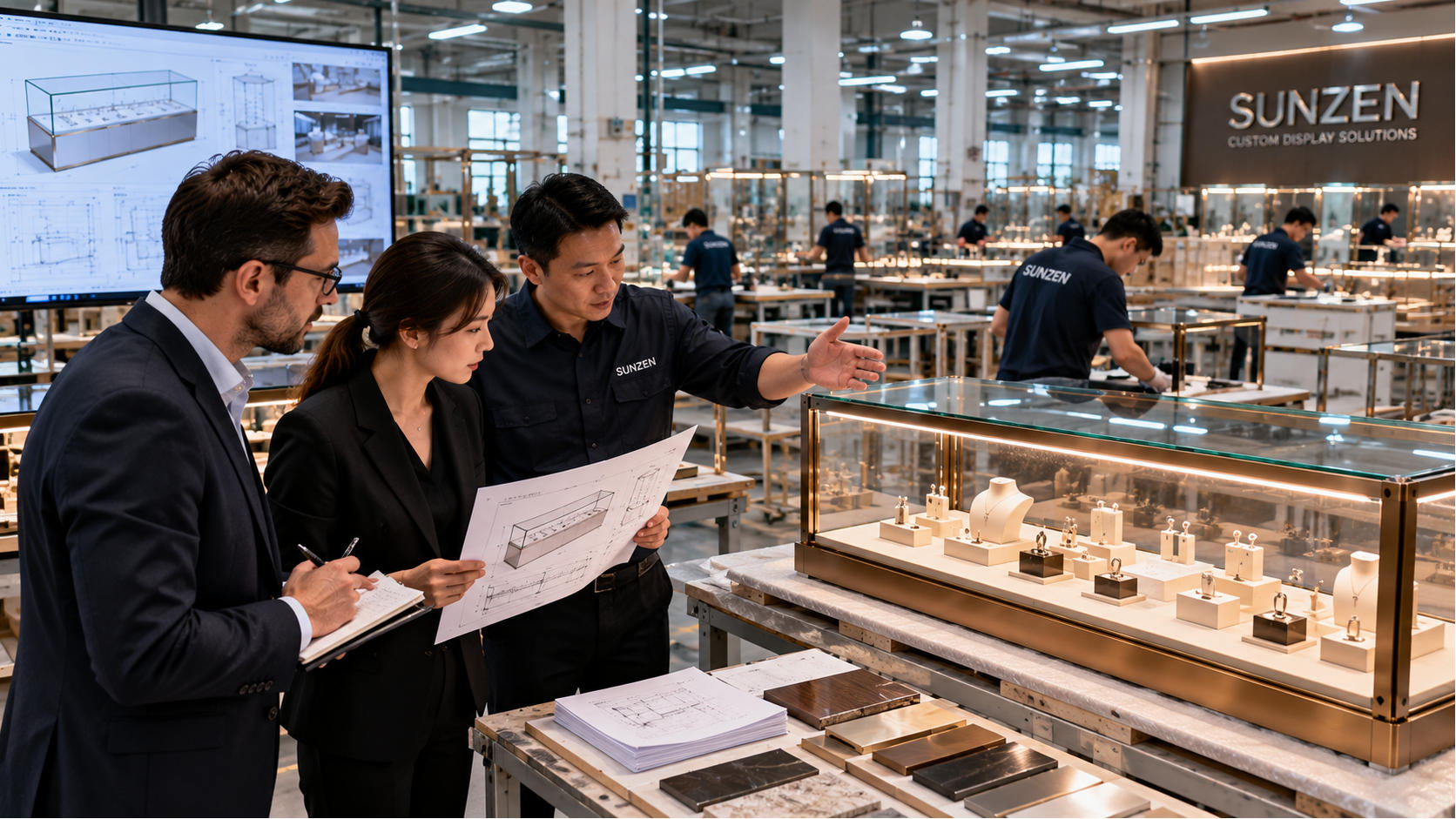
To verify whether a display case manufacturer is a real factory, do not rely only on a company profile, showroom photographs or finished project images.
Ask for evidence that connects the company to an actual production operation: workshop areas, machinery, production workers, work-in-progress fixtures, material processing, assembly, quality control, packing and completed projects.
The strongest verification does not come from one photograph or certificate. It comes from multiple pieces of evidence that are consistent with each other and with the type, quantity and complexity of display cases you plan to order.
What Evidence Shows That a Display Case Manufacturer Is a Real Factory?
For overseas procurement, factory verification should answer two different questions:
Is There a Real Production Operation?
Verify whether the supplier can show active workshop areas, equipment, workers, materials, unfinished fixtures, assembly stations, QC activity and packing operations.
Can That Factory Actually Produce Your Project?
A real factory is not automatically the right factory. Its processes, engineering capability, quality system and capacity must also match your display case requirements.
This distinction is important. Factory verification is not simply about proving that a building exists; it is about establishing whether the production resources you are shown are relevant to the fixtures you intend to purchase.
7 Types of Evidence to Check When Verifying a Display Case Factory
01. Workshop Evidence
Look for active production areas rather than only offices, meeting rooms or a finished showroom. Different stages of work should be visible where relevant to the factory’s stated capabilities.
02. Equipment
Ask which machines and production equipment are used for the processes the company claims to perform and how those processes relate to your fixtures.
03. Production Workers
Workers performing fabrication, assembly, finishing, electrical integration or inspection provide stronger evidence than an empty workshop photographed from one angle.
04. Work in Progress
Partially manufactured fixtures can reveal more than finished photographs because they expose construction methods, materials and assembly details.
05. Production Process
The supplier should be able to explain how approved drawings move through material preparation, fabrication, finishing, assembly, testing and packing.
06. Quality Control
Look for actual inspection activity, measuring tools, functional testing and project-specific QC records rather than relying only on a statement that quality is checked.
07. Project Traceability
Ask the supplier to connect finished project evidence with drawings, production photographs or other records showing how a real fixture moved through manufacturing.
1. Verify the Workshop, Not Just the Showroom
A polished showroom can demonstrate product presentation, but it does not by itself prove manufacturing capability. When verifying a display case factory, ask to see the areas where fixtures are actually processed, assembled, inspected and prepared for shipment.
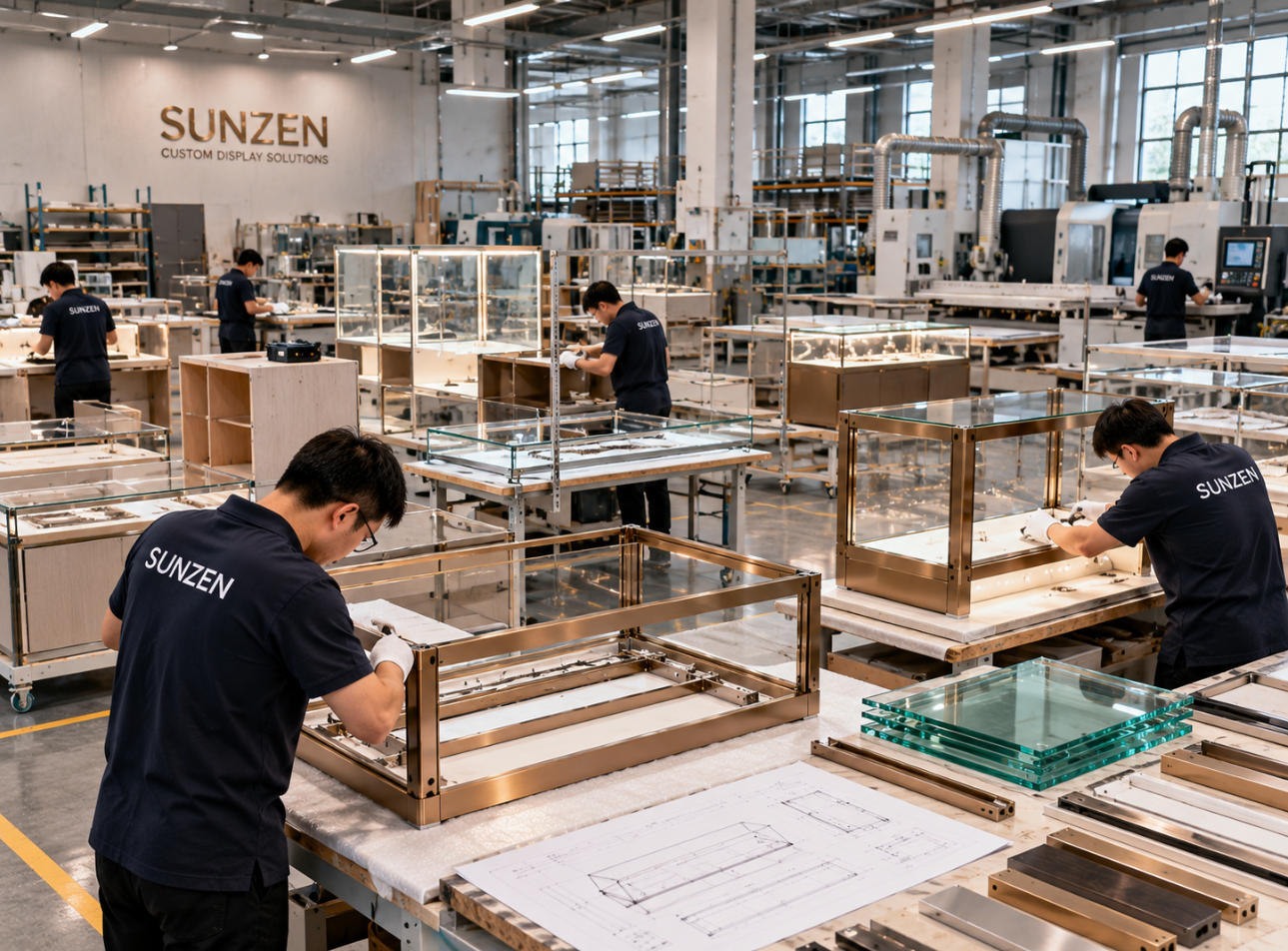
Look for Active Production
A useful factory view should show production activity in context: workers, machinery, materials and fixtures at different manufacturing stages rather than isolated close-up photographs.
What Should You Ask to See?
- Material preparation and storage areas
- Metal or structural fabrication where applicable
- Cabinetry production or preparation
- Glass coordination and fitting
- Surface finishing processes
- Lighting and electrical integration
- Final assembly
- Quality inspection
- Packing and shipment preparation
The exact processes vary by factory and project. The important question is whether the supplier can show how its stated showcase manufacturing capability connects to the actual production of commercial display fixtures.
2. Check Whether the Equipment Matches the Claimed Capability
Equipment is useful verification evidence, but a long machinery list should not automatically be treated as proof of capability.
Instead, ask what each major production process is used for, which processes are completed internally, which are subcontracted, and how external processes are controlled.
| Area to Verify | What to Look For | What It Can Help Confirm |
|---|---|---|
| Metalwork | Fabrication equipment, profiles, frames and work-in-progress components | Whether structural and decorative metal components are being produced or coordinated |
| Cabinetry | Panel processing, cabinet components and unfinished bases | How solid fixture bodies and storage elements are produced |
| Assembly | Partially assembled display cases and dedicated assembly areas | Whether multiple components are integrated into finished fixtures |
| Lighting | LED components, wiring, drivers and functional testing | Whether illuminated fixtures are assembled and checked systematically |
| QC | Measuring tools, inspection stations and records | Whether finished products are checked against project requirements |
| Packing | Protective materials, crates, labels and packed fixtures | Whether the factory prepares products for project delivery |
For custom projects, production equipment also needs to work together with technical development. A factory that receives project-specific fixtures should be able to connect approved display case engineering information with the manufacturing process.
3. Look for People and Work-in-Progress Fixtures
One of the most useful ways to evaluate a factory is to look at what is being produced now—not only what the company says it produced in the past.
Why Work in Progress Matters
Finished display cases hide much of their construction. An unfinished fixture can expose the frame, cabinet structure, wiring routes, hardware preparation, glass interfaces and assembly sequence.
Ask to see several production stages if possible. This helps determine whether the factory understands the complete fixture rather than only one isolated process.
Ask Workers About the Process
During an on-site audit, short technical questions can also be useful. Production staff should generally be able to explain what stage the fixture is at, what drawing or reference is being followed and what happens next.
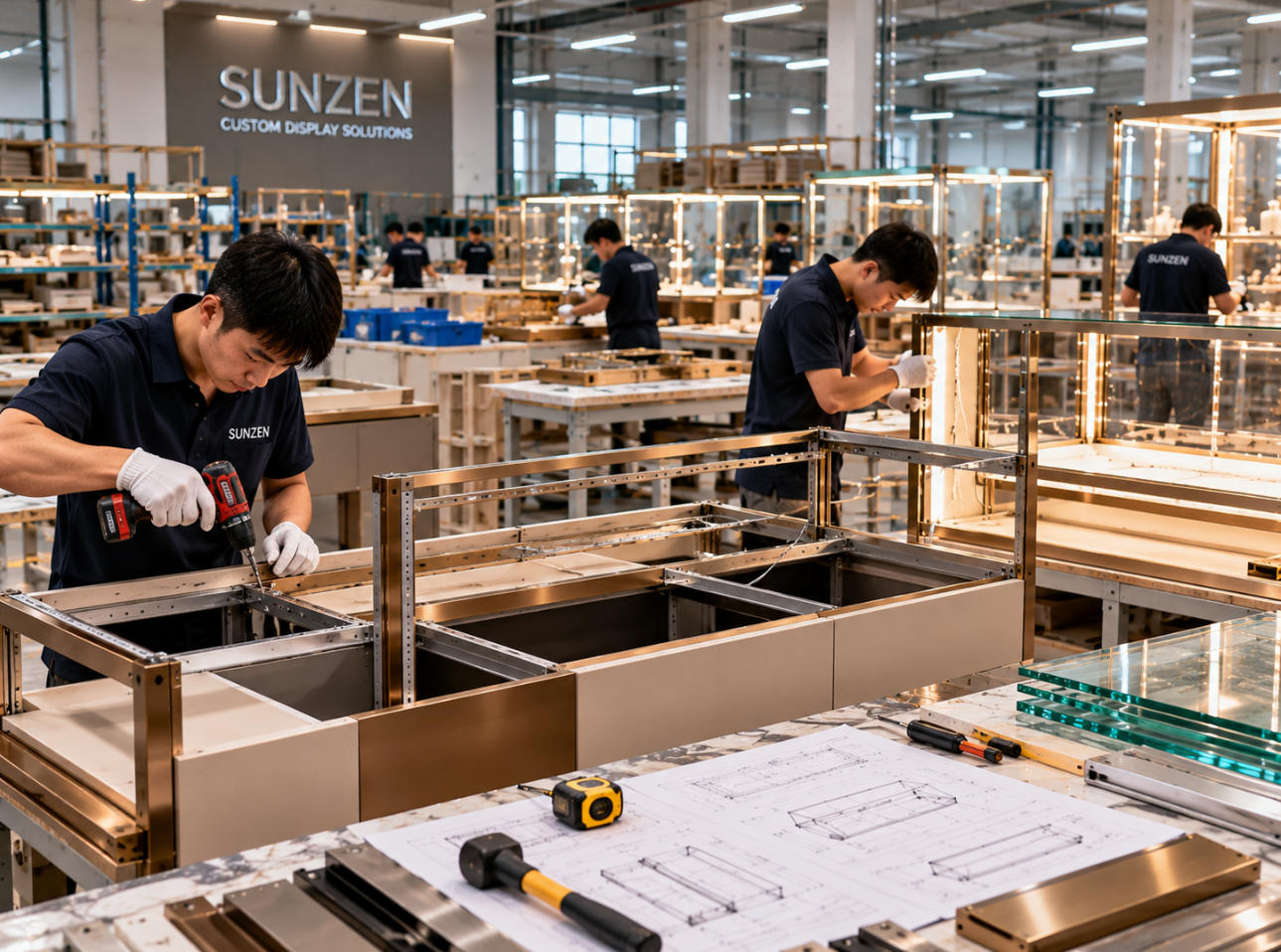
Evidence Is Stronger When It Connects
A worker, an unfinished fixture, an approved drawing and the corresponding production stage together provide more useful evidence than unrelated factory photographs.
4. Ask the Factory to Walk You Through One Real Project
A useful verification technique is to choose one real display case project and ask the manufacturer to explain how it moved from technical information to finished shipment.
Drawing
What approved drawing or specification controlled production?
Materials
Which glass, metal, cabinetry, finishes, hardware and lighting components were used?
Fabrication
Which manufacturing stages were completed and in what sequence?
Assembly
How were glass, cabinetry, metalwork, lighting and hardware brought together?
Inspection
What was checked before the fixture was approved for packing?
Packing
How was the completed fixture protected, identified and prepared for delivery?
This type of traceability makes it harder to rely on unrelated photographs because the manufacturer needs to explain a coherent production sequence rather than present isolated evidence.
5. How Can You Tell Whether You Are Dealing With a Factory or an Intermediary?
The objective is not to assume that every intermediary is unsuitable. The important issue is transparency: you should know who is engineering the fixtures, who is producing them, where production takes place and who is responsible for quality problems.
| Verification Question | What a Buyer Should Clarify |
|---|---|
| Where will my fixtures be produced? | Ask for the actual production location rather than only the sales office address. |
| Which processes are completed there? | Determine which operations are in-house and which are outsourced. |
| Who develops production drawings? | Identify the technical team responsible for translating approved designs into manufacturing information. |
| Who controls subcontracted processes? | Outsourcing is not automatically a problem, but responsibility for specifications and QC should be clear. |
| Who performs final assembly and QC? | Confirm where the complete fixture is assembled and who approves it before shipment. |
| Who handles corrective action? | Know who is accountable if the finished fixture does not match the approved requirement. |
SUNZEN’s broader custom display case manufacturer capability can be evaluated separately from factory verification. Manufacturer selection asks whether a company is suitable for your project; factory verification asks whether its claimed production resources and processes can be substantiated.
6. Can You Verify a Display Case Factory by Video?
A live video factory audit can be useful when an overseas buyer cannot visit in person, particularly during the initial supplier verification stage. However, a live walkthrough is more useful than a collection of edited promotional videos.
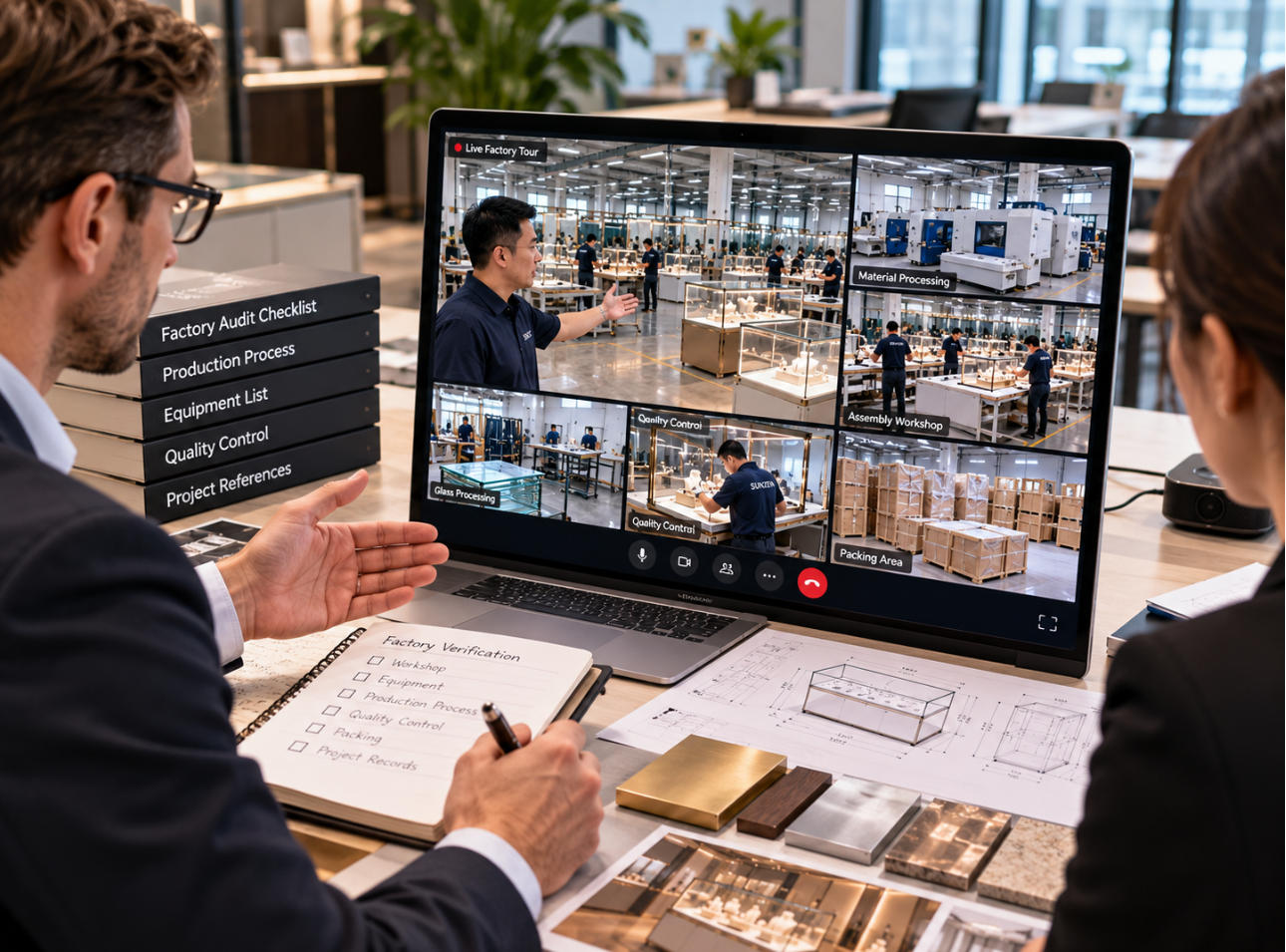
Use a Continuous Walkthrough
Ask the supplier to move through relevant workshop areas in a logical sequence and show current production rather than only predetermined camera angles.
What Should You Ask to See During a Video Audit?
- Factory entrance and general workshop layout
- Active production areas
- Major equipment relevant to your project
- Workers performing real production tasks
- Raw materials and components
- Work-in-progress display cases
- Assembly areas
- QC and testing activity
- Finished fixtures awaiting shipment
- Packing and storage areas
You can also ask the presenter to show a specific machine, fixture or production detail during the call. This makes the audit more interactive and provides stronger verification than a pre-recorded factory introduction.
7. Is an On-Site Factory Audit Always Necessary?
Not every order requires the same level of supplier verification. The appropriate level should reflect the value, complexity, repeatability and risk of the project.
Remote Verification May Be Enough
For an early-stage supplier review, factory documents, live video, current production evidence, samples and project records may provide enough information to decide whether further evaluation is worthwhile.
Audit Higher-Risk Projects More Closely
Larger orders, technically complex fixtures, strict brand standards or long-term rollout programs may justify a more detailed factory audit before substantial production commitments are made.
Verification Can Be Layered
Buyers can move from document review to live video, samples, factory audit, prototype approval and pre-shipment inspection as project risk increases.
A Real Factory Still Needs to Prove It Can Handle Your Project
Confirming that a factory exists is only the first stage. The next question is whether that factory has the engineering, production control and project experience required for your specific display cases.
For example, a factory producing simple standard cabinets may be genuine but may not be suitable for custom luxury fixtures involving complex glass, precision metal finishes, concealed lighting, security hardware and multiple coordinated materials.
Buyers sourcing broader custom display cases should therefore verify both physical production capability and the ability to execute the required fixture specification.
Factory Verification Red Flags to Investigate Further
A single warning sign does not automatically prove that a supplier is unreliable. However, several inconsistencies together should trigger further verification.
Evidence Red Flags
- Only finished product photographs are available
- Factory photographs do not show active production
- The supplier avoids a live workshop walkthrough
- Equipment shown has no clear connection to the claimed processes
- Current work-in-progress cannot be shown
Process Red Flags
- Production stages cannot be explained clearly
- Responsibility for drawings or engineering is unclear
- In-house and outsourced processes cannot be distinguished
- QC procedures are described only in general terms
- Project evidence cannot be connected to production records
Display Case Factory Verification Checklist
Use this checklist when conducting a remote review or on-site factory audit.
| Check | Evidence to Request | Verified? |
|---|---|---|
| Factory location | Actual production address and workshop walkthrough | □ |
| Workshop | Active production areas relevant to display cases | □ |
| Equipment | Machinery connected to claimed manufacturing processes | □ |
| Workers | Production staff performing current work | □ |
| Work in progress | Unfinished fixtures at different manufacturing stages | □ |
| Engineering | Shop drawings or production information connected to a real fixture | □ |
| Assembly | Complete fixture assembly and component integration | □ |
| Quality control | Inspection process, tools and project-specific records | □ |
| Project proof | Project evidence that can be traced through production | □ |
| Packing | Finished fixture protection, labeling and shipment preparation | □ |
What Factory Evidence Can SUNZEN Provide for a Project Review?
For overseas buyers evaluating SUNZEN for a custom display project, the verification process can focus on the production stages and evidence relevant to the proposed fixtures rather than relying only on general company introductions.
Depending on the project and production stage, this can include manufacturing-process information, workshop views, work-in-progress fixtures, assembly, quality inspection and shipment preparation.
Buyers can also review relevant custom showcase projects alongside manufacturing evidence to understand how production capability connects with completed commercial work.
Need to Verify Factory Capability Before Sourcing?
Share your drawings, fixture quantities and project requirements with SUNZEN so the relevant manufacturing requirements can be reviewed before you proceed with sourcing.
Discuss Your ProjectFrequently Asked Questions
How can I verify whether a display case manufacturer is a real factory?
Verify the actual production location and ask for evidence of active workshop areas, equipment, production workers, work-in-progress fixtures, assembly, quality control and packing. A live video walkthrough or on-site audit can provide stronger evidence than finished product photographs alone.
What evidence proves display case factory capability?
Useful evidence includes active production areas, relevant equipment, workers performing manufacturing tasks, unfinished fixtures, production drawings, assembly activity, inspection records, completed project traceability and packing operations. The evidence should relate to the type of display cases you intend to order.
Can I verify a display case factory remotely?
Yes. Remote verification can include document review, current production photographs, project records and a live video walkthrough of the factory. During the live audit, ask to see specific equipment, work-in-progress fixtures, workers, assembly, QC and packing rather than relying only on a pre-recorded factory video.
Is an on-site factory audit necessary before ordering display cases?
Not for every order. The appropriate level of verification depends on project value, technical complexity, quantity, repeatability and sourcing risk. Larger or more complex projects may justify an on-site or third-party factory audit in addition to remote verification.
What should I check during a display case factory audit?
Check the production location, workshop layout, relevant equipment, workers, materials, work-in-progress fixtures, engineering information, assembly process, quality control, finished products and packing areas. Also clarify which processes are completed in-house and which are outsourced.
How can I tell whether a display case supplier is a factory or an intermediary?
Ask where the fixtures will actually be produced, which processes are performed there, who develops production drawings, who controls outsourced processes, where final assembly and inspection take place, and who is responsible for corrective action if a problem occurs.
Does having a factory mean a manufacturer is qualified for my project?
No. A genuine factory still needs to demonstrate that its engineering, production processes, quality control, capacity and project experience match the technical and commercial requirements of your display case project.
What are warning signs when verifying a display case factory?
Warning signs worth investigating include an inability to show active production, reluctance to provide a live workshop walkthrough, unclear responsibility for engineering or production, factory evidence that does not match claimed capabilities, and an inability to explain quality control or connect project photographs with manufacturing records.

